


TL;DR
On Thursday, May 21, a post went viral on LinkedIn showing an email from the Marketing Engineer at Profound — the unicorn answer engine optimization (AEO) platform — offering a user a $250 Amazon gift card in exchange for a G2 review. The post immediately sparked a debate about whether this counts as a bought review, with people questioning the entire practice of review sites.
This guide makes sense of what's acceptable to the industry, what's a gray area, and when the Federal Trade Commission (FTC) gets involved — specifically for B2B SaaS reviews. We focus on five key platforms: G2, Capterra, Gartner Peer Insights (GPI), TrustRadius, and PeerSpot.
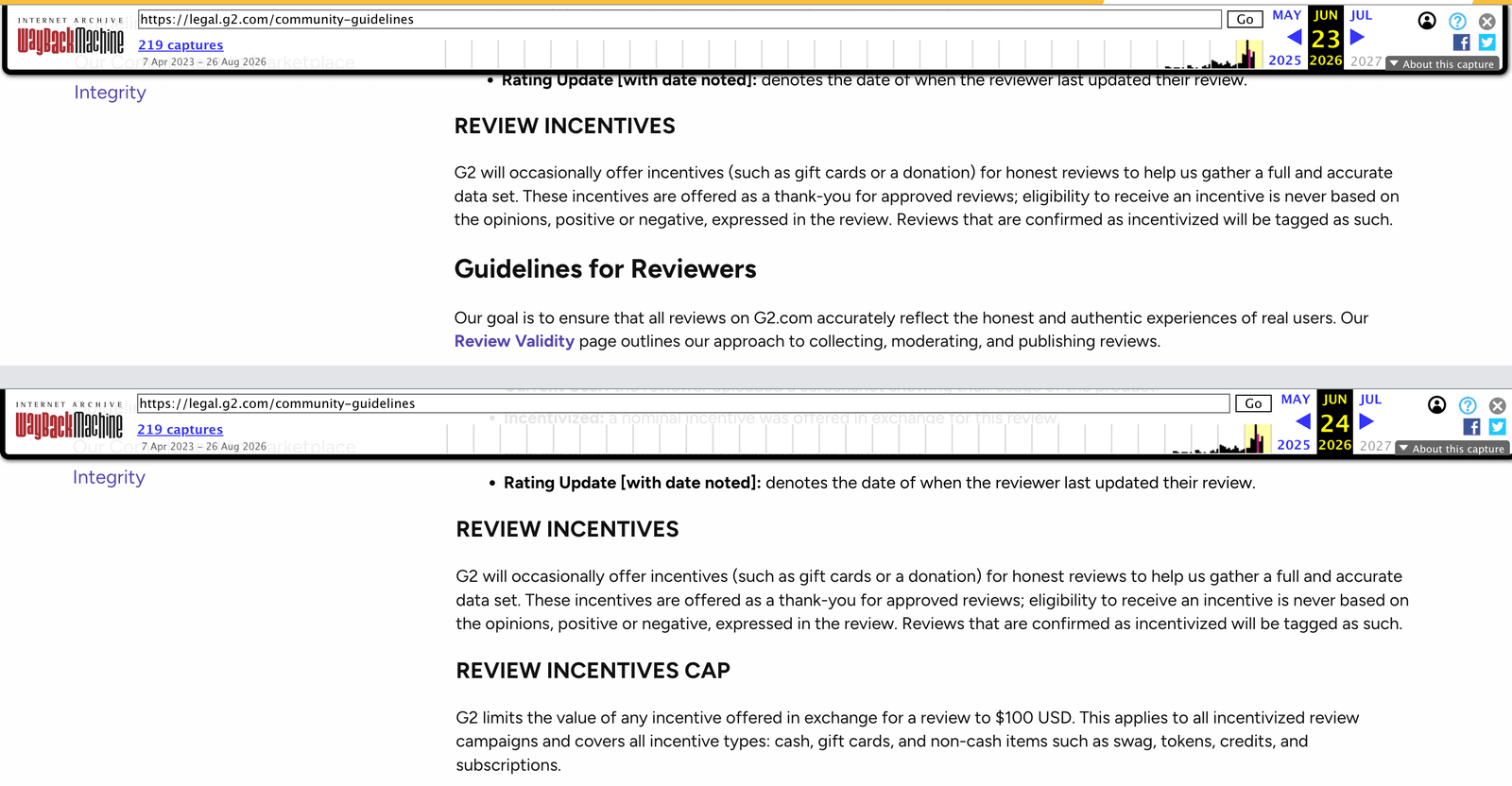
Updated August 30, 2026. G2 has since published a $100 USD cap on any review incentive, in a section its Community Guidelines page did not carry until five weeks after the screenshot circulated. We lay out those dates below, along with what else was on the calendar around that campaign.
What's happening
The post in question came from Waikay CEO Dixon Jones, who attributed the email to Nick Lafferty, Founding Marketing Engineer at Profound. Jones contrasted the offer with Waikay's own approach (asking for honest reviews, no incentive), and the comparison framed the public reaction.
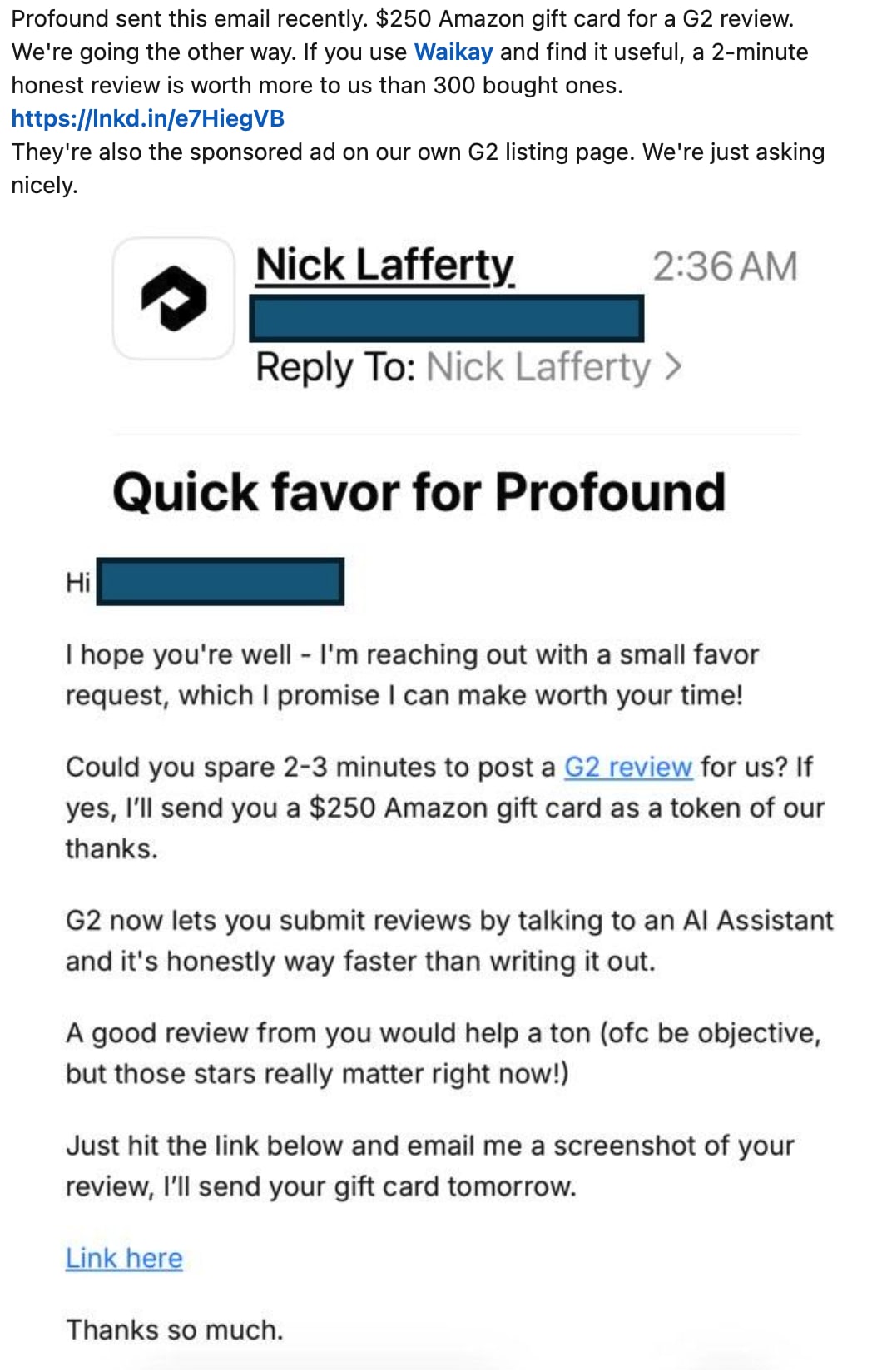
We have not independently verified the screenshot, and we are not here to litigate any one vendor's conduct. What we can do is lay out the actual rules, platform by platform, plus the FTC, so any vendor watching this thread can check their own program against them. For context on Profound's broader G2 strategy, see our category leadership playbook.
A note on scope. This guide is reference material, not legal advice. It summarizes public regulations and platform community guidelines as we read them on the publication date. The consequence ladder below is a way to think about exposure, not a determination of liability in any specific situation. Your in-house counsel writes your final rules.
What this guide does not cover:
- Verification mechanics, character minimums, approval timelines. Those live in our G2 and Capterra review mechanics guide.
- Responding to reviews already published. Our review-handling guide covers that.
- General GPI program mechanics. See how Gartner Peer Insights actually works.
Update: G2's Trust & Safety Index (June 1, 2026)
Within two weeks of the screenshot going viral, G2 published its Trust & Safety Index, a report on how it moderates reviews, landing while the review-incentive debate this guide opens with was still fresh. The Summer 2026 edition covers February 1 to April 30, 2026, and it puts hard numbers behind the enforcement mechanisms described below. Of 244,078 reviews submitted in that window, G2 published 154,625 (63.3%) and removed 89,453 (36.7%). The flags overlap, since one review can trip more than one, but measured against all submissions, 12.7% were caught as fake (31,014), 7.7% for identity issues (18,735), and 5.0% (12,279) for incentive abuse.
The sentence that matters most for review campaigns is G2's own: "Organic and incentivized reviews are both permitted under strict validation rules to reflect the broadest possible voice of the market." Incentives themselves are allowed. What G2 removes is incentive abuse — the same line this guide draws below, where you can reward someone for leaving a review but cannot condition the reward on a favorable one.
Profound, the vendor named in the gift-card email above, is a useful public data point for where that line falls, with an important caveat. We can't say whether any of Profound's reviews carried the $250 the screenshot showed, or whether that email is genuine — it's a single, unverified screenshot.
What the public record does show is scale and sourcing. Profound's G2 reviews surged with the controversy: our May 18 scan counted just over 300; the profile then added more than 500 in a two-day span as the screenshot spread, and by June 1 it was past 950. G2 labels each review by how it was collected, and the new ones carry a mix of tags — some seller-invite (the vendor invited the customer), some Incentivized, some both. The Incentivized tags mean G2 was told about those incentives and the disclosure travels with each review; what the tags don't show is the dollar amount. Semrush, with a far larger G2 review base, added just three reviews tagged as incentivized over the same two days of May. The reviews are all still standing, given that G2 moderates on an ongoing basis, including post-publication audits, a count that holds weeks later has effectively cleared that screen. None of that reveals what any reviewer was offered; it shows how the reviews were sourced, that the incentives in the mix were disclosed, and that the reviews met G2's validation rules. Clearing a platform's rules is a separate test from the FTC's, which the rest of this guide covers.
What the push was aimed at
The question that hung over the campaign at the time was why late May. What follows is Blastra's reading of a public record anyone can check. We have found no public statement from Profound about its reasons, and we did not ask.
Profound was the only Leader on G2's first AEO Grid, published in the Winter 2026 reports with nine products on it. The category then ran away: nearly 600 listings as of August 30, 2026, with Semrush ranked above Profound by G2 Score. Standing alone in a category is one exercise; holding a position in a crowded one is another.
On June 11, Profound hosted Zero Click New York for a reported 1,000-plus marketing leaders. Co-founder and CEO James Cadwallader opened with a keynote called "The Agent Revolution," and the Summer 2026 AEO Grid was on the screen behind him, with Profound flagged at the Highest Satisfaction edge.

The review push sits in between. Our May 18 scan counted just over 300 reviews on the profile; by June 1 it was past 950, and on August 30 it stood above 1,100.
Our reading, offered as speculation. A review push of that size lifts two things a visitor sees immediately: the Live grid on G2's category page, which recomputes as reviews land, and the review count on the profile. Both are one click from a category page, and both are what a room of 1,000 marketing leaders opens after a keynote about a company's category position.
The useful part for anyone else planning a campaign is knowing which of the two grids a push actually reaches. The one that goes in a deck and the one a buyer lands on do not update on the same clock.
The consequence ladder
Think of the consequences as a ladder: cheap, private outcomes at the bottom; expensive, public ones at the top. Vendors often worry only about the bottom rung, where a moderator rejects the review. The full ladder runs to FTC civil penalty, with reputational damage as a parallel risk that has no ceiling.
Rung 1. Failed moderation. The platform rejects the review. The vendor may never hear about it. No public mark on the profile.
Rung 2. Platform suspension or Buyer Alert. We've never heard loud stories or seen profile banners triggered on B2B review sites, but we know from the policies that the mechanisms exist. Here they are.
G2 displays a warning banner: "G2 has removed fraudulent reviews." G2 can also suspend vendor dashboard access, prevent new reviews on the profile, and prohibit adding product listings. Capterra has a Buyer Alert that surfaces on the product profile. G2 acquired Capterra in February 2026, but the two platforms still operate independently, and there is no published policy on whether a vendor penalized on one will be penalized on the other. Gartner Peer Insights uses the most open-ended language: "a comment on vendor's profile, suspension of services, or other to be determined at our discretion." TrustRadius doesn't publish a public banner equivalent. Its enforcement is operational: aggressive moderation (rejecting roughly 47% of incoming reviews) and suspension from TrustRadius's vendor program — the managed review-campaign access, not removal of the public profile itself.
Rung 3. FTC warning letter. The FTC is the U.S. agency that polices deceptive advertising. Reviews and testimonials fall under that umbrella because they shape buyer decisions. Until October 2024, the FTC could go after companies for fake or undisclosed reviews but couldn't actually fine them; it could only force them to stop. Then the agency's new Fake Reviews Rule took effect, and the FTC got the power to seek civil penalties for the first time. The Rule applies to all businesses, B2B included.
A warning letter is the FTC's opening move under the standard sequence (letter → investigation → consent decree → civil penalty). It tells a company "we think you're violating the Rule; here's your chance to fix it before we escalate." The first batch went out December 22, 2025 — covered in Named Cases below, along with the specific conduct the FTC flagged.
Rung 4. FTC consent decree and civil penalty. This is where the dollar number sits. The maximum civil penalty under the Rule is $53,088 per violation, where "violation" means per infraction, not per company-total. Every non-compliant review can count as a separate violation, and every day an ongoing violation continues counts as another. The exposure stacks quickly. Liability extends beyond the company itself: knowing-violator executives and managers can be named individually, and third-party agencies, reputation-management firms, and hired influencers are within scope. None of this is B2B-exempt. The Rule applies the same way it does to consumer brands.
Rung 5. Reputational damage. A screenshot of your outreach on LinkedIn. A competitor's CEO comparing your tactics to theirs. A buyer reading the LinkedIn comments before they read your G2 reviews. None of this requires the FTC to do anything. None has a dollar figure. It is the most expensive consequence because no consent decree can close it.
Named cases: who's been caught
All publicly named FTC review enforcement to date has been consumer-side. No B2B SaaS vendor sits in the record yet. The headline cases:
- Cure Encapsulations (2019). Garcinia cambogia seller bought fake Amazon reviews. $12.8M judgment, $50K paid.
- Sunday Riley (2019–2020). Prestige skincare brand. CEO directed employees to write fake Sephora reviews. Consent order, no fine — and the toothlessness of that outcome is part of what motivated the 2024 Rule.
- Fashion Nova (2022). Fast-fashion retailer suppressed reviews under four stars. $4.2M settlement.
- Rytr (December 2024, set aside December 22, 2025). AI review-generation tool. The FTC originally banned Rytr from selling the service; in December 2025 the agency set the order aside, citing the AI Action Plan. The reversal is narrow: it applies to AI tool providers, not to vendors who buy, condition, or disseminate fake reviews.
Sitejabber (January 2025) — the closest case to B2B SaaS so far. Sitejabber is an AI-enabled consumer review platform. The FTC alleged Sitejabber inflated ratings by collecting pre-fulfillment "instant feedback" pop-ups, asking customers to "rate your overall shopping experience so far" before they received the product, then publishing those ratings as merchant and product reviews. In some cases, "fewer than 1% of the reviews were from verified purchasers, and without the Instant Feedback Survey reviews, the rating would be more than 2 stars lower." Final consent order approved 5–0. Why this one is the closest analog: Sitejabber is, in practice, a review platform collecting on behalf of vendors. Structurally, that's exactly what G2, Capterra, and TrustRadius do.
December 22, 2025: ten warning letters. The FTC sent letters to ten companies under the new Rule. Recipients weren't named (standard FTC practice at this stage). Per law-firm summaries (Greenberg Traurig, Venable, Arnold & Porter, Kelley Drye), the FTC flagged three patterns: reviews from people who hadn't used the product; compensation contingent on positive sentiment; and reviews by officers, managers, or employees without disclosure of the material connection (any relationship a reasonable buyer wouldn't expect, like employment or payment; defined in The FTC rules in detail below). The letters said civil penalties were the next step if the conduct continued. We are probably looking at the beginning of a long curve: at $53,088 per violation per day across an industry that has been incentivizing reviews for years, there is a lot of money the FTC stands to recover. The first publicly named B2B SaaS vendor case is almost certainly a question of when.
The FTC rules in detail
The FTC works through two related documents. Together they define what's prohibited and what counts as proper disclosure. (Quick note on citation format: "16 CFR Part X" refers to the U.S. Code of Federal Regulations, Title 16, which is the chapter that houses FTC rules.)
The Endorsement Guides (16 CFR Part 255)
These have been on the books for decades, most recently revised July 26, 2023. They are interpretive: they define what counts as an endorsement, what a "material connection" is, and what "clear and conspicuous" disclosure looks like.
A material connection is any connection a reasonable consumer would not expect: employment, family, payment, free product, gift cards, sweepstakes entries, charity donations, or swag of meaningful value. For B2B SaaS, that covers paying employees to write user reviews, asking the family of employees to review, sending product credit in exchange for a review, sending swag in exchange for a review, or mailing a gift card directly to a customer in exchange for a review.
Clear and conspicuous means the consumer can see the disclosure without taking any action. For B2B SaaS outreach, the two failure modes that come up most often are: a disclosure hidden behind a click or hover, and a disclosure placed where the reader will miss it (small text at the bottom of an email signature, for instance). The disclosure has to live in the same medium as the endorsement, in plain view.
The Fake Reviews Rule (16 CFR Part 465)
This is the newer document, and the one with civil-penalty teeth (covered in the consequence ladder above). The FTC adopted it 5–0 on August 14, 2024, and it took effect October 21, 2024.
The Rule prohibits seven categories of conduct:
| § | What it prohibits |
|---|---|
| 465.2 | Creating, selling, buying, or disseminating fake reviews by reviewers who don't exist, didn't use the product, or misrepresent their experience |
| 465.4 | Providing compensation or any incentive conditioned on the writing of a review expressing a particular sentiment. Neutral incentives are permitted if disclosed |
| 465.5 | Reviews by company officers, managers, employees, agents, or their immediate family without clear and conspicuous disclosure of the material relationship |
| 465.6 | Misrepresenting a company-controlled review website as independent |
| 465.7 | Suppressing negative reviews through groundless legal threats, physical threats, intimidation, or false public accusations |
| 465.8 | Selling or distributing fake social media followers, likes, views, etc. |
Section 465.4 permits neutral, disclosed incentives. It prohibits any incentive conditioned on a particular sentiment. Language matters here. "We'd love your honest review and will send a $25 gift card" reads differently from "tell us how much you loved your visit and get a $5 coupon." The first promises a payment for a review of any sentiment. The second implies the review must be positive.
Section 465.5 covers insider reviews and insider solicitations. An executive cannot solicit a review from their own employee without disclosure, even if the employee is a real user of the product. Family members of employees fall under the same rule.
The Rule's scope is "businesses" generally. The Endorsement Guides reference "products, services, or business" without distinguishing consumer and business contexts. There is no B2B carve-out.
Applied to the scenario in the screenshot: an offer of $250 in exchange for a G2 review is providing compensation. Whether that compensation is conditioned on sentiment depends on the wording. The Endorsement Guides require disclosure of the material connection in the published review — and the platform-rule analysis (covered below) turns on a separate question: whether G2 was told. The published reviews themselves carry the answer.
The five platforms, side by side
Each platform has its own incentive program. Each program has different caps, different administrators, and different disclosure mechanics. If you are still choosing which review sites to collect on besides G2, the G2 alternatives list compares them by traffic and badge program.
| Platform | Per-review cap | Who administers the incentive | Disclosure on the published review | Penalty mechanism |
|---|---|---|---|---|
| G2 | $100 USD hard cap (published June 24, 2026); $5–$50 reported range inside G2's own program | G2 (vendor pays G2 monthly invoice) | Permanent "Incentivized" tag | Buyer Alert banner on profile; account suspension; revoked dashboard access |
| Capterra | $25 USD nominal value, hard cap | Capterra (vendor sources via Vendor Portal) | "Reviewer Source" icon | Buyer Alert on profile; suspension of services |
| Gartner Peer Insights | $25 USD, hard cap (tied explicitly to FTC) | Gartner (Reward Link sent to reviewer) | Standard review attribution; Gartner-managed | "Comment on vendor's profile, suspension of services, or other to be determined at our discretion" |
| TrustRadius | $25 first two emails, $50 third (per operational reports) | TrustRadius (managed program) | "Incentivized" badge that persists across API, widget, and Chrome extension syndication | Rejection at moderation; program suspension |
| PeerSpot | Gift card per published review/interview (amount not publicly disclosed; per-program limits apply) | PeerSpot (Interviews Subscription: PeerSpot's team schedules, interviews, transcribes, edits, and issues the gift card via third-party Merchants) | Verified-interview attribution on every review; LinkedIn + direct-contact verification | Red warning badge on the vendor's profile if planted reviews are suspected; review removal |
G2
G2's review incentive policy is permissive inside its official program and restrictive outside it. G2 permits incentivized reviews through its official Review Campaigns program. G2 administers the gift cards; the vendor never mails one directly. Reviewers see the disclosure during the flow. The published review carries a permanent "Incentivized" tag.
Outside that program, G2's Community Guidelines prohibit:
"Independently incentivizing reviewers without disclosing those incentives to G2"
In our reading, that is the load-bearing rule. A vendor who emails a customer a $250 Amazon gift card in exchange for a G2 review is incentivizing independently — and the policy turns on whether G2 was told. G2 has publicly described a notification path: vendors who run their own incentive programs can notify G2, and G2 will tag the resulting reviews so the disclosure travels with them. Reported outside programs, in G2's stated framing, sit inside the policy and get tagged. Unreported ones do not. The screenshot of an offer email alone doesn't tell an outside observer which side of that line the vendor is on; the vendor knows.
A $100 cap now sits on the page, and it was not there in May. G2's Community Guidelines carry a section headed REVIEW INCENTIVES CAP:
"G2 limits the value of any incentive offered in exchange for a review to $100 USD. This applies to all incentivized review campaigns and covers all incentive types: cash, gift cards, and non-cash items such as swag, tokens, credits, and subscriptions."
Read the scope carefully before assuming it applies only to G2's own campaigns. The section sits directly beneath REVIEW INCENTIVES, which describes the gift cards G2 itself hands out, so the placement invites that reading. The sentence says all incentivized review campaigns, and the types it enumerates include swag, credits and subscriptions, which are vendor-side incentives that G2 does not administer. Elsewhere in the same document G2 already contemplates vendor-run programs, listing "independently incentivizing reviewers without disclosing those incentives to G2" as prohibited conduct. Our reading is that the cap binds vendor programs as well as G2's. What G2 has not published is how it enforces the cap against a program it was never told about.
The dates are worth laying out, because the section is new. Internet Archive captures of the same URL show REVIEW INCENTIVES running straight into "Guidelines for Reviewers" on May 23 and again on June 23. The cap appears in the June 24 capture.
| Date | What happened |
|---|---|
| May 21, 2026 | The $250 gift-card email circulates on LinkedIn |
| May 23, 2026 | G2's Community Guidelines carry no incentive cap |
| June 1, 2026 | G2 publishes its Trust & Safety Index |
| June 23, 2026 | Still no cap |
| June 24, 2026 | The $100 cap appears |
We are showing a sequence rather than a cause. G2 has published no explanation for the change, the offer in the screenshot predates the cap by five weeks, and nothing published before June 24 committed G2 to a number. What the sequence does settle is that $250 sits at two and a half times the ceiling G2 chose to publish a month later, and that anyone running a comparable campaign today is over it.
What the public signal does tell you. The "Incentivized" tag on a vendor's reviews is observable on G2. A profile that ticks from 300 to 800 reviews in two days, with the new reviews carrying a mix of seller-invite and Incentivized tags (some both), is a profile where the incentivized reviews were disclosed to G2, by definition of how the Incentivized tag is applied. That moves the platform-policy question off the table and shifts the audit-worthy questions to: what amount was offered and over what cadence. Review velocity matters because G2's manual moderation has a typical 3-business-day window; surges that clear the queue faster than that are unusual on their own. Neither amount nor velocity is itself a rule violation. Both are signals that buyers, competitors, and platforms read closely.
A campaign moves one G2 grid and cannot touch the other. This is the distinction that decides whether a campaign pays off this quarter or next. G2 publishes a quarterly Grid Report, whose data is fixed some weeks before the report ships, and a Live grid on the category page that recomputes as reviews land. Reviews collected after a report's data is fixed cannot move a position on it, while they show up on the Live grid immediately. Since the Live grid is what a buyer lands on from a category page and the report is what ends up in a deck, a campaign aimed at the wrong one is a quarter early or a quarter late. Our G2 badges guide carries the current deadline calendar.

G2 also prohibits segmenting outreach to potentially positive reviewers, conditioning incentives on positive sentiment, discouraging negative reviews, and contacting reviewers to influence or change a published review.
Platform-supported pattern: Configure a Review Campaign in your G2 vendor dashboard. Choose the incentive (gift card or charity donation, bring-your-own-nonprofit). G2 generates the landing page and email sequence. The reviewer sees the disclosure; G2 moderates; G2 sends the card. If you must run an outside program, notify G2 first.
Capterra
Capterra publishes the most prescriptive disclosure list of any platform. The nominal value of an incentive cannot exceed $25 USD. Non-monetary incentives (swag, T-shirts, branded gear) are capped at the same $25. Vendors cannot stack incentives on top of Capterra's own. Vendors cannot run a raffle for prizes worth more than $25.
Capterra publishes an explicit exclusion list: vendor employees, officers, directors, agents, family members; direct competitors; government and public-sector employees; individuals on OFAC (the U.S. Treasury's Office of Foreign Assets Control) sanctions lists; anyone whose company prohibits accepting business gifts. The last category catches more enterprise SaaS buyers than expected. See G2's acquisition of Capterra for cross-platform implications.
Platform-supported pattern: Source reviews through the Vendor Portal's official link. $25 cap on every incentive (gift card or non-monetary). Disclose the number of recipients, currency amount, timing, expiration, and independence from the platform. The Reviewer Source icon appears on the published review.
Gartner Peer Insights
GPI ties its incentive cap explicitly to the FTC. From GPI's documentation: "Per the FTC Guidelines on Endorsements, incentives must be of nominal value, defined as less than $25." Every gift card is $25 USD. There is no path to a higher per-reviewer incentive on GPI.
Gartner administers every card. The vendor never mails directly. The reviewer's identity stays anonymous to the vendor.
GPI's penalty language is the most discretionary of the five platforms: "penalties may include a comment on vendor's profile, suspension of services, or other to be determined at our discretion." That open-ended "or other" is the difference in shape. Combined with the fact that GPI sits under Gartner, where Magic Quadrant analysts may notice, in our reading this is the highest-stakes platform for incentive violations, even though it does not publish enforcement actions.
Platform-supported pattern: Start with the Gartner-funded starter promotion (50 cards × $25 = $1,250 USD) when it is available in your market. Extend with vendor-funded sourcing links, capped at $10,000 USD per market per year (400 reviews × $25). Time-limited promotions vary; check current windows with Gartner.
TrustRadius
TrustRadius has the most articulated position on why incentives exist: their argument is that incentives reduce participation bias and increase representativeness, so vendor campaigns are welcome as long as the disclosure is "prominent and unambiguous."
The recommended disclosure language, verbatim from their vendor docs:
"In exchange for your honest review, you will receive a $25 Amazon gift card."
Two design choices to notice. The incentive applies to the act of reviewing; the published review can be positive, neutral, or critical and still earn the card. The word "honest" disclaims sentiment conditioning, which is what § 465.4 of the FTC Rule prohibits.
The incentivized badge persists across API, widget, and Chrome extension syndication. That permanence is the audit-relevant fact: the disclosure follows the review when the review travels, alongside the standard review-verification signals on the published listing.
Platform-supported pattern: Hand TrustRadius a CSV of contacts plus context on how you sourced them. TrustRadius reviews the list for representativeness. Standard sequence is three emails over roughly two weeks (Tuesday, Friday, the following Friday). Gift card amounts are reported at $25 for the first two emails and $50 for the third.
PeerSpot
PeerSpot's flagship offering is the Interviews Subscription. The vendor pays PeerSpot a subscription. PeerSpot's team then schedules phone calls with the vendor's customers, conducts the interview directly, transcribes and edits the result, and publishes the review on PeerSpot's platform. PeerSpot describes it as "reviews on steroids" and a "white-glove service."
That's the actual structural difference from G2/Capterra/GPI/TrustRadius: the reviewer never writes their own review. PeerSpot's staff produces the review text from a phone interview. On the other four platforms, the reviewer writes (or speaks into G2's AI assistant) and the platform moderates what came out. On PeerSpot, the platform produces the prose.
The gift-card mechanics are similar to the other four — the vendor sets the budget, the platform administers the incentive. Per Section 6 of PeerSpot's Terms of Service: "a Reviewer who provides a verified review or interview that is published may be eligible for a gift card reward," with cards administered through third-party Merchants and per-program limits applied. PeerSpot doesn't publish a per-reviewer dollar amount in the ToS. Geographic restrictions apply; digital cards must be claimed within 30 days. From an FTC perspective, this puts PeerSpot in the same posture as the other four official programs — the platform owns the compensation flow, not the vendor.
PeerSpot has staked out a public position on FTC compliance. In a September 2024 piece, they frame phone-verified interviews as the FTC-compliant alternative to platforms gamed by AI-generated submissions and freelance-marketplace solicitation. They state they "guarantee zero fake reviews" and "ensure zero AI-generated content." In an April 2026 follow-up, the framing sharpens: "The key question is no longer how much review content exists. It is whether that content can be trusted."
Two things worth noting if you're auditing how PeerSpot fits next to the other four:
- The per-reviewer amount isn't public. PeerSpot's ToS doesn't disclose the dollar value of the gift card. The FTC's nominal-value benchmark (under $25, the same number Capterra and GPI use explicitly) is the safe default to assume.
- The disclosure mechanic differs from "Incentivized" tags. G2/Capterra/TrustRadius stamp the incentive on the review face. PeerSpot relies on the verified-interview process itself as the third-party-verification disclosure, and PeerSpot's methodology also requires the reviewer to self-disclose any financial incentive received.
Enforcement mechanism: red warning badge on the vendor's profile if planted reviews are suspected, per PeerSpot's published methodology: "Vendors suspected of planting fake reviews get a red warning badge."
Platform-supported pattern: Subscribe to the Interviews Subscription. Hand PeerSpot your customer list. PeerSpot handles outreach, the interview, transcription, editing, publication, and the gift card. Same shape as the other four official programs — you fund it, the platform runs it. The differentiator is the interview-and-write-up format, not the compensation structure.
The grey zones
Sweepstakes
The FTC permits sweepstakes-style incentives ("review for a chance to win") when the incentive is not conditioned on positive sentiment and the material connection is disclosed in each entry. The platform rules tighten that further. Capterra bans raffles for prizes over $25. GPI does not permit raffles in lieu of the per-reviewer cap. G2's official program does not run sweepstakes. A "review and win a MacBook" promotion may be FTC-compliant in principle, but it breaks Capterra's and GPI's explicit caps. Off-platform sweepstakes are still vendor-side endorsements that need disclosure.
Swag and "thank you for being a customer" gifts
A genuine customer-relationship gift, sent in a flow that does not ask for a review, is not a material connection. A thank-you T-shirt accompanied by "and by the way, would you review us?" is. The decoupling test is whether the gift and the review request are part of the same exchange (same email, same conversation, same campaign). If they are, disclose. If the gift is worth more than $25, you are past Capterra's and GPI's caps even with disclosure.
Charity donations in the reviewer's name
The FTC's position is that a charity donation is an incentive, and if the reader would evaluate the review differently knowing it was motivated by the donation, the donation should be disclosed. G2 explicitly supports charity donations as a Review Campaign option (bring-your-own-nonprofit). GPI offers 30+ U.S.-based charities at $25 per approved review. Capterra's $25 nominal-value cap applies. TrustRadius does not surface charity options as prominently, though Trusted Seller transparency requirements would extend to them.
Your safe review-collection playbook
For the founder or marketing lead designing this campaign, or auditing one already in motion:
- Do not buy reviews. Direct payment to a reviewer, outside any platform's official incentive program, is the conduct the FTC and the platforms are both organized against. Everything below is the playbook for how to incentivize reviews without crossing that line.
- Use the platform's official program. Don't decouple the gift card from the platform's flow. Each platform has a sanctioned program (described in the platforms section above). Use what the platform provides.
- If you must run something outside the program, notify the platform first. G2 has documented this safe-harbor path explicitly. The other platforms are less explicit; reach out to your vendor-portal contact or the support address listed in their documentation before you run anything outside the sanctioned flow.
- Disclose every material connection in vendor-side outreach. Even when the platform handles the disclosure on the published review, your outreach email should still disclose the incentive and the conditions. "In exchange for your honest review, you will receive a $X gift card" is the canonical pattern.
- Never condition on sentiment. "Honest" is the safe word in outreach. "Loved," "favorite," and "best experience" all trip § 465.4 of the Fake Reviews Rule (covered in The FTC rules in detail above).
- Don't solicit from the excluded categories. Vendor employees, immediate family of employees, direct competitors, government and public-sector employees, OFAC-sanctioned individuals, anyone whose employer prohibits accepting business gifts. Exclusions vary slightly by platform; the spirit is the same.
- Document everything. Outreach email copy, contact list, source of each contact, disclosure language, who got which incentive and when. If a platform or auditor asks how your program ran, you should be able to reconstruct it.
- Recalibrate quarterly. Platform community guidelines update. Calendar a quarterly re-read of each platform's community guidelines and the current FTC penalty number.
What we don't know
- Whether any B2B SaaS vendor sat in the December 2025 FTC warning-letter batch. Recipients are not publicly disclosed.
- Whether G2 has ever applied a Buyer Alert specifically for incentive violations, as opposed to fake-review violations. G2 documents the mechanism but no public named example surfaced.
- Whether TrustRadius's stated FTC compliance posture has been independently audited.
- Whether the LinkedIn screenshot that prompted this guide is genuine. We assembled the rules because vendors are searching for them, without taking a position on any specific incident.
- What prompted G2 to publish the $100 incentive cap on June 24, 2026. We found no published explanation, and the dates on their own cannot establish one.
- How G2 enforces the cap against a vendor-run program it was never notified about. The published text binds all incentivized review campaigns; the enforcement path for undisclosed ones is not documented.
Sources
Primary FTC documents:
- 16 CFR Part 465: Fake Reviews Rule (Federal Register publication, Aug 22, 2024)
- 16 CFR Part 255: Endorsement Guides (eCFR)
- FTC Press Release: Final Rule Banning Fake Reviews (Aug 2024)
- FTC Press Release: 10 Warning Letters (Dec 22, 2025)
- FTC Final Order Against Sitejabber (Jan 2025)
- FTC Reopens and Sets Aside Rytr Final Order (Dec 22, 2025)
- FTC Final Consent Agreement with Sunday Riley (Nov 2020)
- FTC: Fashion Nova Settlement (Jan 2022)
Primary platform documents:
- G2 Community Guidelines (the REVIEW INCENTIVES CAP section; Internet Archive capture history)
- G2 Review Campaigns: gift card options
- G2 Research Agenda (quarterly review deadlines and release dates)
- Profound: Zero Click New York on-demand sessions
- Capterra Community Guidelines
- Gartner Peer Insights: Incentives FAQ
- Gartner Peer Insights: Gartner-Funded Gift Card Promotion FAQ
- TrustRadius: FTC Incentivized Review Guidelines
- PeerSpot Methodology
- PeerSpot Terms of Service (Section 6: Gift Cards)
- PeerSpot Interviews Subscription
- PeerSpot: FTC Cracks Down on Fake Reviews — PeerSpot's Approach (Sep 2024)
- PeerSpot: FTC Guidance on Reviews & B2B Marketing (Apr 2026)
Related Blastra coverage:
- How to navigate G2 and Capterra after the acquisition
- How to earn PeerSpot badges
- Who owns your software reviews
Key takeaways
- Plan for the public outcomes. Buyer Alerts, FTC warning letters, civil penalties, and screenshots on LinkedIn are visible to your customers and competitors. Moderation rejection happens privately.
- Use the platform's official program. Every one of the five major B2B SaaS review platforms has one. The rules outside the program are universally stricter than the rules inside.
- G2 now caps any review incentive at $100 USD. Published June 24, 2026, covering cash, gift cards, swag, tokens, credits and subscriptions, and written to reach all incentivized review campaigns rather than only G2's own.
- The FTC's Fake Reviews Rule applies to B2B. There is no carve-out for business software. Up to $53,088 per violation per day.
- Disclosure is the load-bearing word. Disclose the material connection in the same medium as the endorsement. The "honest" rule from § 465.4 of the Fake Reviews Rule keeps outreach copy clear of sentiment conditioning.
- December 2025 was the enforcement signal. Ten companies got warning letters under the Rule. Recipients weren't disclosed, and the FTC's standard sequence is letter, investigation, consent decree, penalty.
Read this as reference. Your in-house counsel writes your final rules.
Blastra is not affiliated with, endorsed by, or sponsored by G2, Gartner, Capterra, TrustRadius, PeerSpot, Profound, or any other company named in this guide. Trademarks, logos and brand elements belong to their respective owners. Screenshots of third-party pages are reproduced for reporting and commentary, and the review counts, ratings and category figures cited are point-in-time observations of publicly visible data on the dates stated.