


TL;DR
Trustpilot has no formal badge or award program like G2, Capterra, or SourceForge. There are no quarterly reports, no annual lists, no "Top Rated" badges to earn through a competitive process. The recognition system is the TrustScore itself — a 1–5 rating based on all your reviews — plus the green star visuals you can display through TrustBox widgets on your site. For B2B SaaS, Trustpilot is fundamentally different from every other platform we've covered, and that difference matters for deciding where to spend your time.
Should You Prioritize Trustpilot?
Before you read the rest of this guide, our assessment.
Trustpilot makes sense if:
Your customers behave like consumers when they buy your product. Self-serve signups, credit card purchases, individual decision-makers rather than buying committees. Think website builders, CRM tools with free tiers, design platforms, e-commerce tools. If your users are the kind of people who'd leave a Trustpilot review after a bad car rental or a flight cancellation — and leaving one takes about 30 seconds, no account verification, no structured form — they might leave one for your software too.
You want consumer-facing brand trust signals. Trustpilot's green stars are recognized by everyday internet users in a way that G2 badges simply aren't. If your marketing reaches people outside the B2B software bubble — paid ads, landing pages aimed at small business owners, comparison shopping — the Trustpilot star rating carries immediate visual trust.
You already have a Trustpilot profile accumulating reviews. Many B2B SaaS companies discover they already have an unclaimed profile with organic reviews. If that's you, the question shifts from "should I be on Trustpilot?" to "should I manage what's already there?"
Trustpilot is probably not your priority if:
You sell to enterprise buyers through a sales team, procurement process, and multi-month evaluation cycle. Those buyers look at G2, Gartner Peer Insights, and TrustRadius — platforms designed for exactly that buying motion.
You have a small customer base (under 50 accounts). Trustpilot is an open platform — anyone can post a review, including people who aren't your customers. With a small customer base, the ratio of legitimate reviews to noise can work against you. The platforms with verified reviewer requirements (PeerSpot, Gartner Peer Insights) offer more protection here.
You need competitive category rankings. Trustpilot doesn't rank you against competitors in your software category. There's no Grid, no Shortlist, no quadrant. If category positioning is what you're after, that's a different set of platforms entirely.
The comparison:
| Factor | Trustpilot | G2 | Capterra |
|---|---|---|---|
| Buyer type | Individual, consumer-like | B2B software buyer | B2B software buyer |
| Awards/badges | None (TrustScore is the signal) | Quarterly Grid reports, 10+ badge types | Shortlist, badges (quarterly) |
| Review verification | Open — anyone can post | Verified professional profiles | Verified, moderated |
| Free plan | TrustScore + basic widget + 50 invitations/month + review replies | Profile only (replies require paid plan) | Profile only |
| Recognition display cost | Free (basic) to paid (custom widgets) | $2,999+/year for badge display | Included with reviews |
| Time to earn recognition | Immediate (TrustScore updates in real-time) | Quarterly cycle | Quarterly cycle |
| AI search relevance | Brand-level trust signal | Software-specific category signal | Software-specific category signal |
One thing stands out in this comparison: Trustpilot's free plan is genuinely usable. You get a TrustScore, a basic widget to display it, 50 review invitations per month, and — critically — the ability to respond to every review your customers leave. For a B2B SaaS company with a few hundred customers, that might be everything you need. Compare that to G2, where even replying to reviews that your customers took the time to write requires a paid plan. On G2, the reviews are about your product, written by your users, and you need to pay to participate in the conversation. On Trustpilot, the entire review management loop — collect, respond, display — works at the free tier.
With G2 now owning Capterra, GetApp, and Software Advice, a free independent alternative starts looking more interesting — challenges and all. And Trustpilot's own numbers are striking: AI search click-throughs to Trustpilot grew roughly fifteen-fold in 2025, making it the fifth most-cited domain on ChatGPT globally.
How Trustpilot Recognition Works
Since there's no formal badge program, "recognition" on Trustpilot comes from three things working together.
The TrustScore
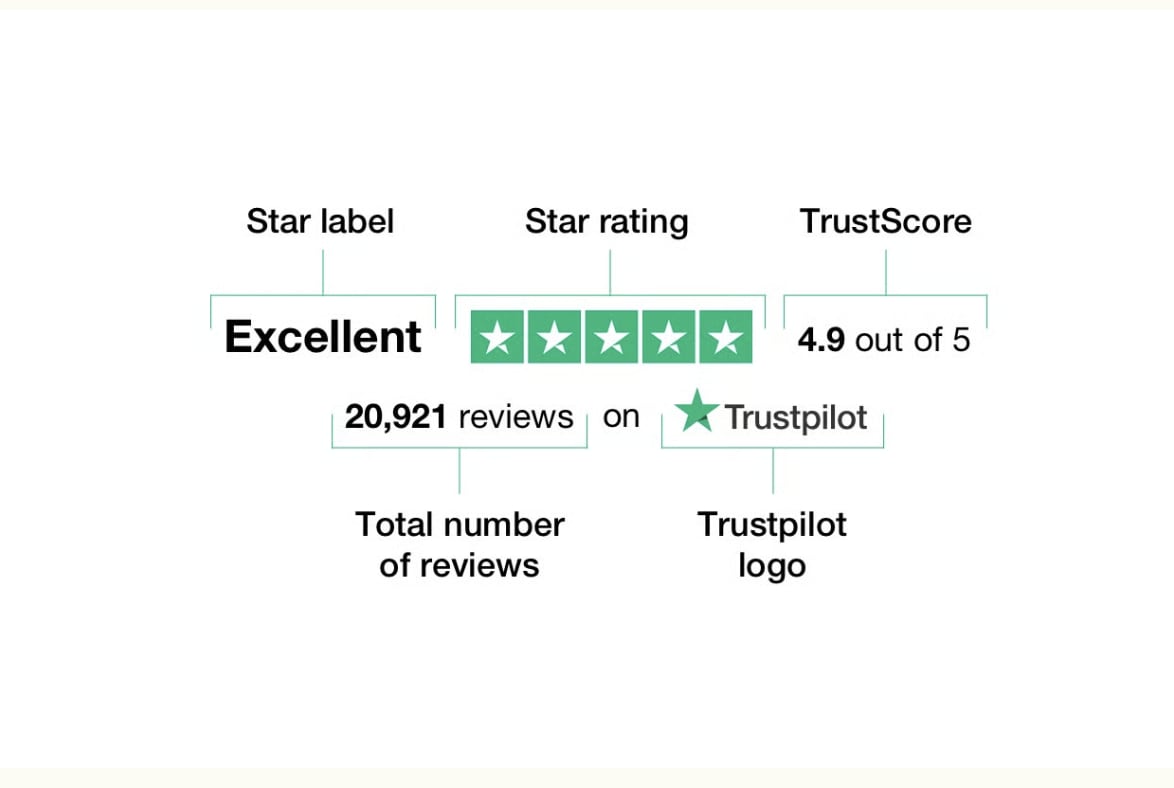
Your TrustScore is a number between 1.0 and 5.0, calculated from all your reviews. It's not a simple average. Three factors go into it.
Recency weighting gives more influence to recent reviews than old ones, using exponential decay. A five-star review from last week counts more than a five-star review from two years ago. This means your TrustScore reflects your current performance, and it means a string of bad reviews can move the score quickly.
Review frequency rewards businesses that collect reviews consistently. Sporadic bursts of reviews carry less weight than a steady stream. This is worth knowing if you're planning a one-time review campaign versus building an ongoing collection process.
Bayesian averaging is the most interesting part, and the one most businesses don't know about. The name sounds technical, but the concept is simple: instead of calculating your score purely from real reviews, the platform adds a set of imaginary "baseline" reviews to every new profile. Trustpilot starts yours with seven phantom reviews at 3.5 stars. These aren't real reviews — they're a statistical safety net that prevents a single genuine review from creating a misleading score. Without them, a brand-new profile with one five-star review would show a perfect 5.0, which wouldn't be meaningful. With the phantom baseline, that same profile shows something closer to 3.7. You need roughly 10–15 reviews above 4.5 stars to push your TrustScore above 4.0. This is the "dig out" period every new profile goes through, and it's why starting early matters — the phantom reviews dilute less as your real review count grows.
The TrustScore updates in real-time for businesses with fewer than 10,000 reviews (daily for those above). There are no quarterly cycles to wait for, no publication dates to plan around. This is a significant difference from G2's quarterly Grid reports or Capterra's periodic badge recalculations.
The Green Stars
The star rating displayed alongside your TrustScore is the visual recognition that most people associate with Trustpilot. Five green stars next to a 4.3 rating is recognizable even to people who've never heard of G2 or Capterra.
This is Trustpilot's equivalent of a badge — and in some contexts, it's more powerful than a formal award. A consumer seeing "4.5 ★★★★★ on Trustpilot" in a Google ad understands it immediately. The same consumer seeing "G2 High Performer Fall 2025" has to decode what that means. (We wrote about this badge legibility problem — it affects humans and AI systems alike.)
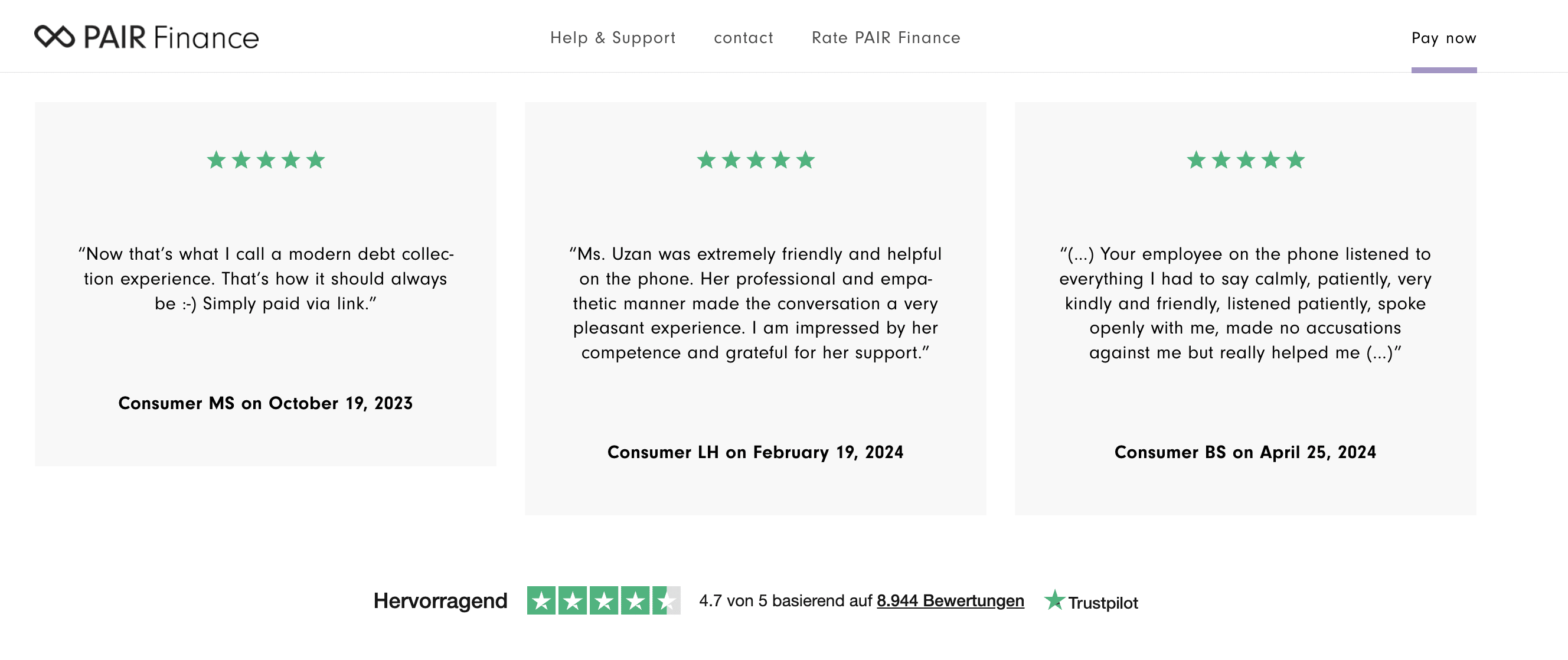
Trustpilot's own research (a 2025 study by London Research, commissioned by Trustpilot — note the funding) found that their star ratings in Google Shopping ads produced a 57% higher click-through rate compared to Google's native seller ratings. That's a vendor-funded statistic for a consumer market (Google Shopping ads, not software purchases), so apply appropriate skepticism — but it's the best available data on the effectiveness of Trustpilot recognition in advertising.
TrustBox Widgets
TrustBox is what Trustpilot calls the embeddable widgets that display your TrustScore and reviews on your website. The free plan includes a basic widget. Paid plans unlock customizable designs, review carousels, and integration options.
We're covering TrustBox at a high level here because the strategic question — whether to be on Trustpilot at all — matters more for most B2B SaaS companies than the details of widget customization. If you decide Trustpilot is right for you, their TrustBox documentation covers the implementation specifics.
What Trustpilot Actually Looks Like for B2B SaaS
Trustpilot's roots are in consumer reviews — restaurants, travel companies, e-commerce. Its taxonomy reflects this. There isn't a clean "B2B SaaS" category. Pipedrive, for example, sits under "CRM Providers" which belongs to "Business Services > Sales and Marketing." The platform is organized around companies and brands, not software categories.
So what does it actually look like when B2B SaaS companies end up on Trustpilot? We looked at three real profiles.
Wix — What Active Review Solicitation Can Do
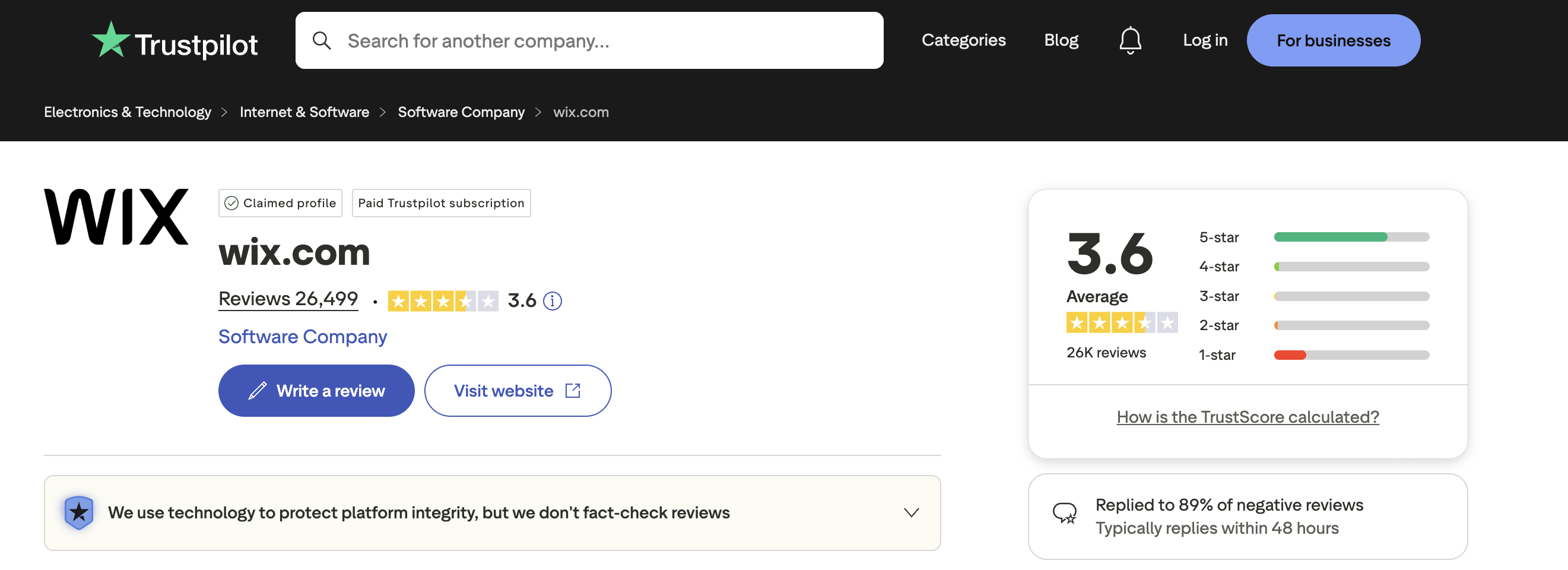
Wix has over 26,000 reviews on Trustpilot and a TrustScore of 3.8 stars. The profile is claimed and actively managed — the company responds to negative reviews consistently, often within a day. But look at the review distribution: 74% five-star, 20% one-star, and almost nothing in between. The five-star reviews are overwhelmingly from invited users praising ease of use, while the one-star reviews are almost entirely about billing, cancellation difficulty, and unexpected renewals.
This is what a well-managed Trustpilot profile looks like at scale: consistent review solicitation drives the overall score up, active response management signals engagement, but the underlying complaint patterns remain visible to anyone who reads beyond the star rating. The bimodal distribution — mostly fives, a chunk of ones — is itself a signal that review invitations are working but customer service pain points persist.
Webflow — The Duplicate Profile Problem
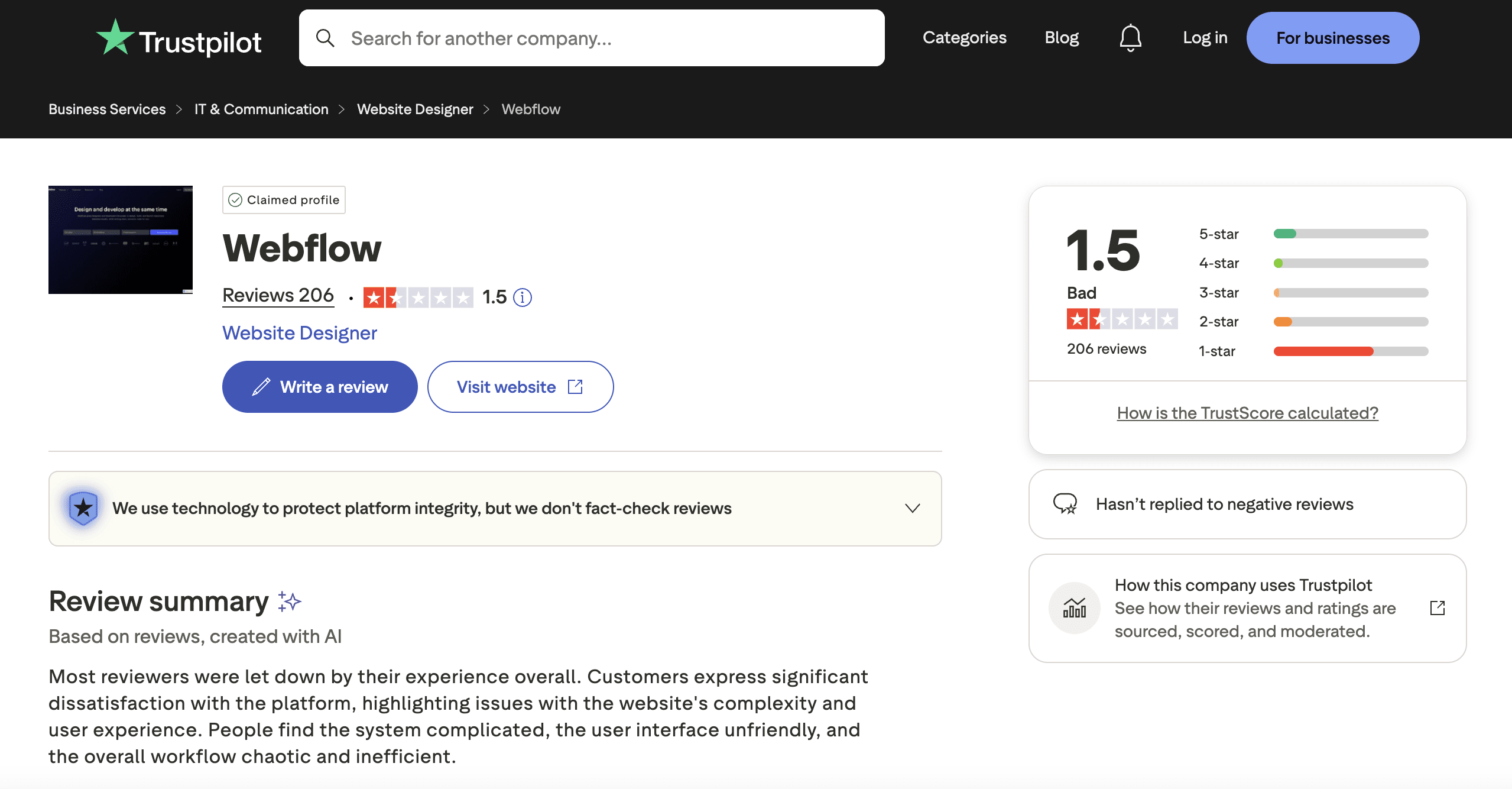
Webflow has two profiles — one at webflow.com (206 reviews, 1.5 stars) and one at webflow.io (11 reviews, 2.2 stars). Neither appears actively managed. The complaint patterns mirror what you see with Wix: pricing frustration, cancellation difficulty, and customer support issues. The low review volume combined with predominantly negative sentiment makes both profiles cautionary reading. This matters given how much Webflow invests in its broader discoverability strategy — the company is frequently cited as a case study for AI answer engine optimization (AEO), maintains active Reddit presence, and runs sophisticated SEO. All of that work to show up well in AI recommendations, while a 1.5-star Trustpilot profile sits unattended. It's a reminder that visibility posture has gaps you don't notice until someone points them out.
The duplicate profile situation is a Trustpilot-specific quirk worth knowing about. Because profiles are tied to domain names rather than company identity, a business can end up fragmented across multiple URLs without realizing it. Webflow has two. If that's your situation, our guide to claiming and merging Trustpilot profiles covers how to find all of them and consolidate them into one.
Pipedrive — What Active Management Looks Like
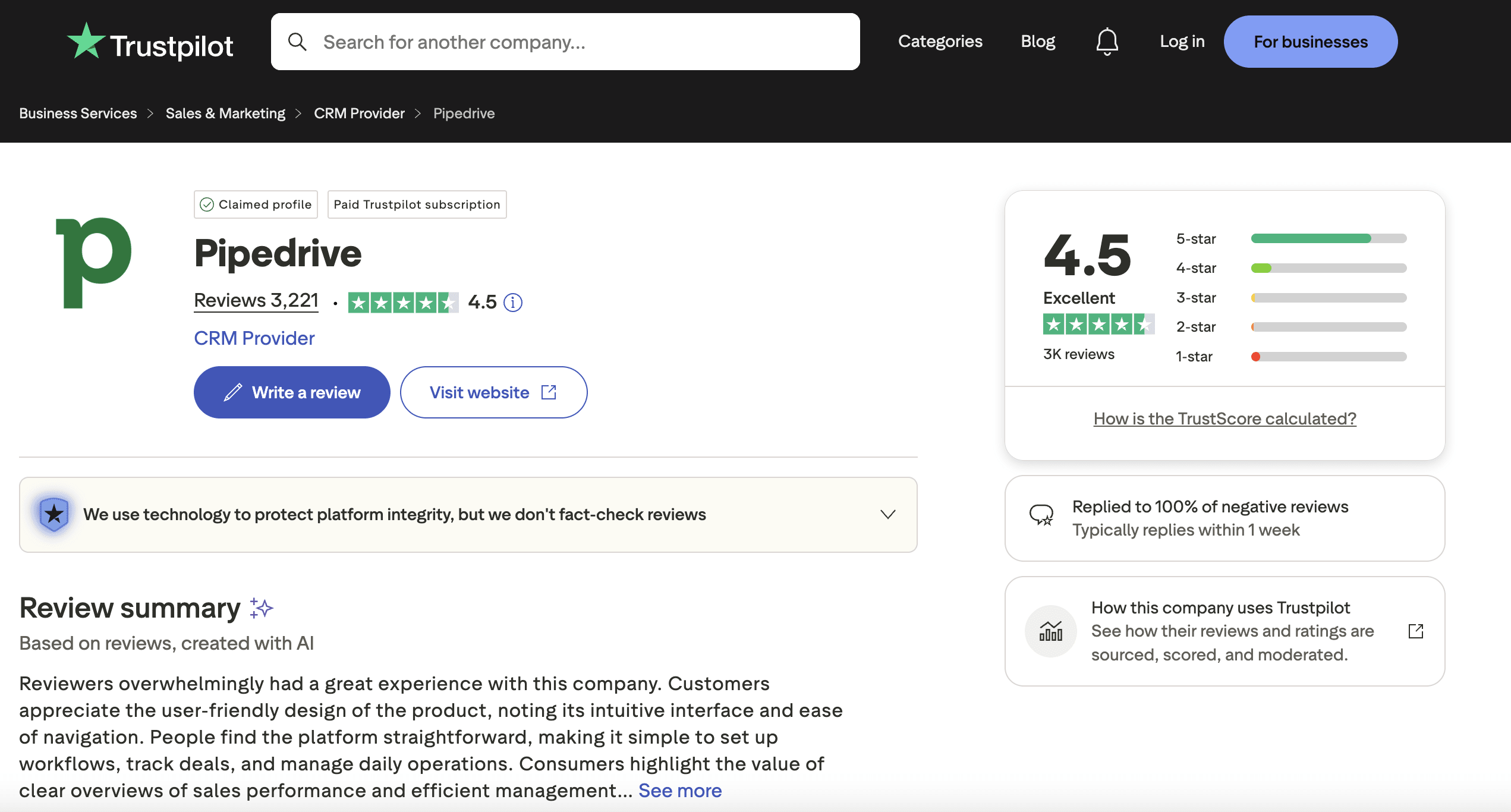
Pipedrive tells a different story: 3,200 reviews, a 4.3 TrustScore, and an actively managed profile with the company replying to both positive and negative reviews. This is the kind of profile that turns Trustpilot into a genuine trust signal.
A few things are interesting about Pipedrive's profile. First, despite having a strong 4.3 rating, Pipedrive doesn't prominently display a Trustpilot badge on their own website. This might suggest that even companies succeeding on Trustpilot don't consider it their primary recognition platform for B2B credibility.
Second, Pipedrive's profile carries a notice from Trustpilot about review solicitation practices. This is part of Trustpilot's transparency system — when a business actively invites reviews (which Trustpilot allows within their guidelines), the platform flags it so visitors can weigh that context.
Third, the volume itself is notable. With 3,200 reviews, Pipedrive has significantly more Trustpilot reviews than most B2B SaaS tools accumulate on G2 or Capterra. Whether that's because of consumer-like buying patterns in some customer segments, active review solicitation, a large user base generating organic feedback, or some combination of all three — we can't say with certainty. But the review volume is there.
What the Profiles Tell Us
The contrast between these three companies is instructive. Wix (3.8 stars, 26K reviews) and Pipedrive (4.3 stars, 3,200 reviews) both actively manage their profiles, but with very different outcomes. Wix's bimodal review distribution — overwhelmingly five-star from invited reviews, heavily one-star from organic complaints — suggests review solicitation is doing the heavy lifting. Pipedrive's more consistent rating distribution suggests either different solicitation practices, a different customer satisfaction reality, or both.
Webflow, with unmanaged profiles and sub-2.0 ratings, shows what happens when you leave Trustpilot to its own devices. Leaving a Trustpilot review is about as easy as rating a bad Uber ride — a star rating, a few sentences, done in under a minute. That low friction means organic reviews skew toward emotional reactions to negative experiences. Without active solicitation to balance that signal, the profile tells a one-sided story.
The pattern across these companies suggests something about which B2B SaaS products end up with meaningful Trustpilot presence: it correlates with how consumer-like the user experience feels. Wix and Webflow users interact with those products the way they'd interact with any consumer app. When frustrated about billing or cancellation, they go where consumers go — Trustpilot. The review behavior follows consumer instincts, regardless of whether the product is technically B2B.
Compare this to the review experience on G2 or Capterra, where leaving a review involves filling out a structured form with feature ratings, use cases, and professional context. The friction of that process filters for intentional, considered reviews. Trustpilot's open model means you get volume, but you need active management to ensure that volume tells a representative story.
The Pricing Question
Trustpilot offers three tiers: Free, Plus, and Advanced (possibly more — the naming and structure shift periodically). Actual prices aren't published. Third-party sources report starting prices around $299/month for paid plans, with annual contracts that auto-renew.
What the free plan includes is worth spelling out because it's surprisingly complete for B2B SaaS:
The free tier gives you your TrustScore (calculated and displayed automatically), a basic TrustBox widget for your website, up to 50 review invitations per month, and the ability to reply to reviews. For a B2B SaaS company with a few hundred customers, that might be everything you need. Fifty invitations a month translates to 600 per year — enough to reach most of your customer base.
Paid plans add customizable widgets, enhanced analytics, competitive intelligence, API access, and Google Seller Ratings integration (which places your star rating directly in Google Shopping ads). The Google Seller Ratings feature is the main reason a B2B SaaS company might consider paying — if you run Google Ads targeting bottom-of-funnel buyers, having star ratings in your ad creative can meaningfully affect click-through rates.
What we don't know about pricing: exact tier costs, what triggers contract conversations, whether enterprise-level pricing follows a different structure, and how negotiable the terms are. Complaints from users on third-party forums mention unexpected auto-renewals and features locked behind more expensive tiers than expected. We're flagging this because it appeared in multiple sources, but we haven't verified it firsthand.
Step-by-Step: Making Trustpilot Work for B2B SaaS
If you've read this far and decided Trustpilot is relevant for your company, here's the path through.
Step 1: Check Whether You Already Have a Profile
Search for your domain on Trustpilot — not your company name, your domain (e.g., trustpilot.com/review/yourcompany.com). You might already have reviews accumulating on an unclaimed profile. Webflow's unmanaged 1.5-star profile is a cautionary example of what happens when reviews accumulate without anyone watching. If you find an existing profile — or more than one — claiming and consolidating them is the first priority.
Step 2: Claim and Complete Your Profile
Claiming is free and gives you access to the business dashboard, where you fill out your company information, add your logo, and write a description. Trustpilot's business onboarding is less complex than G2 or Capterra because there's no category taxonomy to navigate (remember, the platform is organized around companies, not software categories). The mechanics, including what to do when the self-serve flow won't verify you, are in our claim-and-merge guide.
Step 3: Respond to Existing Reviews
If you inherited reviews from an unclaimed profile, start responding. Especially to negative ones. Pipedrive's profile demonstrates what active review management looks like — thoughtful responses to both positive and negative reviews signal that you're paying attention. This matters both for human visitors reading the reviews and for AI systems that may evaluate review response patterns as a signal of business credibility.
Step 4: Build a Review Collection Process
The free plan gives you 50 invitations per month. Use them. Trustpilot has guidelines about how you can invite reviews — you can ask customers directly, but you can't incentivize or cherry-pick who you ask (asking only happy customers violates their terms). The platform wants you to invite all customers and let the TrustScore reflect genuine experience.
For B2B SaaS, the most natural touchpoints for review invitations are: after onboarding completion, after a successful support interaction, at contract renewal, or after a positive milestone (feature launch they requested, quota achievement with your tool). These are the same review collection principles that apply across platforms — if you've already built a review process for G2 or Capterra, the mechanics transfer.
Step 5: Decide on Widget Placement
The basic free widget displays your TrustScore and star rating. Place it where trust matters — pricing pages, signup flows, landing pages for paid campaigns. For B2B SaaS, the highest-value placement is typically on pages where a prospect is deciding whether to commit: trial signup, demo request, or pricing comparison.
Step 6: Monitor and Maintain
Unlike platforms with quarterly cycles, Trustpilot's TrustScore moves in real-time. A bad week of reviews shows up immediately. This means your Trustpilot profile needs ongoing attention rather than quarterly sprints. The good news is that for most B2B SaaS companies, the review volume is low enough that monitoring takes minutes per week, not hours.
What We Don't Know
Trustpilot's documentation and our research leave some questions unanswered for B2B SaaS specifically:
Whether Trustpilot reviews influence AI search recommendations for B2B software. Trustpilot's marketing materials reference AI visibility, but the evidence they cite comes from consumer contexts. We know AI systems evaluate consensus across multiple source types, and Trustpilot is a prominent platform that AI crawlers access. But we don't have specific evidence that a Trustpilot profile meaningfully influences how AI models recommend enterprise or B2B software. For consumer-adjacent B2B tools, the influence is more plausible.
Exact pricing for paid plans. We've reported the ~$299/month figure from third-party sources, but Trustpilot doesn't publish its pricing. Your actual cost may differ based on business size, negotiation, and which features you need.
B2B SaaS-specific case studies. Trustpilot's published success stories are overwhelmingly consumer-facing: ThriftBooks, TurboDebt, Personnel Checks, TaxSlayer Pro, LendingTree. We couldn't find a B2B SaaS case study where Trustpilot was positioned as the primary review platform. This gap doesn't mean it can't work for B2B SaaS — Pipedrive's profile suggests it can — but it does mean you're working without a published playbook.
How the Bayesian averaging formula affects category-specific scoring. We know about the seven phantom reviews at 3.5 stars. We don't know whether this baseline varies by category, business size, or region.
How Trustpilot Fits in Your Directory Strategy
Trustpilot's role in a visibility posture is different from G2 or Capterra. It's not a software-specific platform — it's a brand trust platform that software companies happen to appear on.
This means it adds a different type of signal to your overall presence. While G2 and Capterra provide category-specific credibility ("this is a top-rated CRM"), Trustpilot provides brand-level trust ("this is a well-regarded company"). Both matter, and they matter to different audiences.
For SaaS listings management, the practical implication is: Trustpilot belongs in the mix if your customers naturally encounter it, but it shouldn't replace dedicated software review platforms. It supplements them.
The diversification argument is stronger than ever. With G2's acquisition of Gartner Digital Markets — which includes Capterra, GetApp, and Software Advice — now finalized, concentrating all your review presence in platforms owned by a single company carries real risk. Trustpilot, as an independent platform with massive consumer reach, provides a genuinely distinct signal source — and one that AI systems evaluate independently from the G2/Capterra/GetApp ecosystem. Building a directory strategy as a competitive moat means having presence where your competitors don't. TeamViewer demonstrates this at scale — managing awards across 8+ platforms including over 120,000 Trustpilot reviews.
Source Documentation
Primary Sources (Dated, Reliable)
| Source | Date | Notes |
|---|---|---|
| Trustpilot Support — TrustScore Calculation | Accessed Feb 2026 | Official methodology documentation |
| Trustpilot Business — Plans and Pricing | Accessed Feb 2026 | Official (though actual prices require sales contact) |
| Trustpilot Business — TrustBox | Accessed Feb 2026 | Official widget documentation |
| Trustpilot for Business Blog — Badge Effectiveness | July 2025 | London Research study, commissioned by Trustpilot (57% CTR claim) |
| Coalition for Trusted Reviews | Accessed Feb 2026 | Founding members include Trustpilot, Amazon, Booking.com |
Company Profiles Analyzed
| Company | URL | Reviews | TrustScore | Status |
|---|---|---|---|---|
| Wix | trustpilot.com/review/www.wix.com | ~26,000 | 3.8 | Claimed, actively managed |
| Webflow | trustpilot.com/review/webflow.com | 206 (primary) | 1.5 | Unclaimed |
| Pipedrive | trustpilot.com/review/pipedrive.com | ~3,200 | 4.3 | Claimed, actively managed |
Secondary Sources
| Source | Notes |
|---|---|
| DesignRush — Trustpilot Review | ~$299/month starting price reported |
| Reddit r/Entrepreneur | User discussions on pricing and auto-renewal complaints |
Key Takeaways
- No badge program exists. Trustpilot has no formal badge or award program. The TrustScore and green star rating are the recognition system, and they work differently from everything else in the software review landscape.
- The free plan works. Genuinely usable for most B2B SaaS companies — TrustScore, basic widget, 50 review invitations per month, and review response capability at no cost. Compare this to G2's $2,999+ annual fee for badge display rights.
- Best for consumer-like buying patterns. Self-serve signups, individual decision-makers, products that feel like consumer apps. Enterprise software sold through procurement processes is a poor fit.
- Check for unclaimed profiles. Trustpilot is an open platform. Your customers (or unhappy former trial users) may already be writing about you there.
- New profiles start at 3.5 effective baseline. The Bayesian averaging system means you'll need roughly 10–15 positive reviews to push above 4.0. Plan your initial review collection accordingly.
- Different signal type. Trustpilot provides brand-level trust rather than category-specific software credibility. Both matter — and as the software review landscape consolidates, having an independent trust signal outside the G2/Capterra ecosystem becomes increasingly valuable.
- Active management matters. Wix's 3.8-star profile with 26,000 reviews and Pipedrive's 4.3-star profile both demonstrate what consistent management looks like — compare that to Webflow's unmanaged 1.5-star profile. The platform rewards attention.
FAQ
Is Trustpilot free for businesses?
Yes. The free plan includes your TrustScore, a basic TrustBox widget, 50 review invitations per month, and the ability to reply to all reviews. Paid plans start around $299/month and add customizable widgets, analytics, and Google Seller Ratings integration.
How is the TrustScore calculated?
The TrustScore uses recency weighting, review frequency, and Bayesian averaging — including seven baseline 3.5-star phantom reviews for new profiles. New profiles typically need 10–15 positive reviews above 4.5 stars to reach a 4.0 TrustScore.
Does Trustpilot have badges like G2 or Capterra?
No. Trustpilot has no badge or award program. The TrustScore and green star rating are the recognition system. The five green stars are instantly recognizable to consumers — more so than B2B-specific badges.
Should B2B SaaS companies be on Trustpilot?
Trustpilot works best for SaaS with consumer-like buying patterns: self-serve signups, credit card purchases, individual decision-makers. Enterprise software sold through procurement processes fits better on G2, Gartner Peer Insights, or TrustRadius. Check if you already have an unclaimed profile accumulating reviews.
How do I claim my Trustpilot business profile?
Search trustpilot.com/review/yourcompany.com (use your domain, not company name). Claim it free through Trustpilot's business portal to access the dashboard, respond to reviews, send invitations, and add widgets. If the domain email check fails, or the profile is already claimed by someone who has left, see claiming and merging Trustpilot profiles.
Can anyone leave a Trustpilot review?
Yes. Unlike G2 or Capterra which verify reviewers, Trustpilot is open — anyone can post a review in 30 seconds. This low friction means organic reviews often skew negative, making active review solicitation essential.
Do AI search engines use Trustpilot reviews?
AI systems evaluate consensus across multiple source types when recommending software. Trustpilot provides brand-level trust signals that complement category-specific signals from platforms like G2. For consumer-adjacent B2B tools, Trustpilot reviews likely influence AI recommendations — though B2B-specific evidence is limited.
Is Trustpilot worth it for SaaS companies?
For SaaS with self-serve, consumer-like buying — yes, especially since the free plan is genuinely usable. For enterprise SaaS sold through sales teams and procurement, G2 and Gartner Peer Insights deliver more relevant buyer signals. Consider Trustpilot as a complement to, not replacement for, B2B-specific platforms.
Recommended Reading
Platform Guides
- How to Earn G2 Badges — G2's badge system requires paid plans ($2,999+/year) to display. Understand what you're getting into before investing.
- How to Earn Capterra Badges — Capterra badges are free to display (for now). With G2's acquisition of Gartner Digital Markets, this may change.
- How Gartner Peer Insights Actually Works — For enterprise buyers, Gartner's platform carries more weight than consumer review sites.
- How to Earn TrustRadius Badges — TrustRadius offers an independent alternative with strong B2B focus.
- How to Get G2 and Capterra Reviews — The review collection principles transfer across platforms, including Trustpilot.
- How to Claim and Merge Trustpilot Business Profiles — If you found more than one profile on domains you own, this is the operational path to a single managed one.
Strategy & Context
- What Are Software Directories? — Understanding the landscape of B2B software discovery platforms.
- Directory Strategy as Competitive Moat — Why presence across multiple platforms matters more than dominating one.
- G2 Acquires Capterra: What It Means — The consolidation that makes independent platforms like Trustpilot more strategically valuable.
- Software Badges Decoded — Why Trustpilot's simple star rating may actually communicate trust better than complex badge systems.
- How AI Recommends Software — Understanding the consensus pattern that makes diverse review presence valuable.
About This Guide
Blastra helps B2B software companies manage their presence across directories and review platforms including G2, Capterra, Trustpilot, and 30+ other platforms. If you've decided Trustpilot belongs in your strategy, we can help you get set up and maintain it alongside the rest of your visibility posture.
This guide reflects publicly available documentation and real company profiles as of February 2026. Trustpilot may update their TrustScore methodology, pricing, or features. Verify against official sources for the most current information.