


TL;DR
Gartner Peer Insights (GPI) is the only review platform where your customer reviews are used as inputs in Magic Quadrant evaluations. Your reviews do double duty — earning you a Customers' Choice badge on GPI while also influencing how Gartner analysts evaluate your product. And following G2's acquisition of Capterra, GetApp, and Software Advice, GPI is now Gartner's only remaining software directory — which probably means they'll be investing more in it. If the methodology below feels intimidating — you're not alone. We tried our best to make it accessible, and even that was difficult. You need 20+ verified reviews in an 18-month window, from customers at companies with $50M+ revenue. Gartner even funds your first $1,250 in review incentives. The catch: GPI has the strictest marketing compliance rules of any platform we've covered — pre-approval required before using your badge. And the VOC publication schedule is buried in a four-tab Excel file that most vendors never decode. We extracted all 58 markets on the Feb–June 2026 schedule with their exact review windows and freeze periods below (the June 2026 cycle is the nearest actionable one as of April 2026 — earlier cycles have published or are in flight).
Should You Prioritize Gartner Peer Insights?
Before diving into the methodology, here's our assessment.

GPI is probably worth it if:
- You sell to enterprise buyers at organizations with $50M+ revenue
- Your product maps to a Gartner Magic Quadrant or Market Guide category
- You have 20+ enterprise customers who could write reviews within 18 months
- You want your customer feedback to influence how Gartner analysts evaluate your market
- You're prepared to follow strict marketing compliance rules when using recognition
GPI is probably not worth it if:
- Your customers are primarily SMB or midmarket (reviews from companies under $50M revenue don't count toward VOC or Customers' Choice — they still appear on your profile, but won't earn you a badge)
- Your product category doesn't have a corresponding Magic Quadrant or Market Guide
- You have fewer than 20 enterprise customers who've deployed in the past 18 months
- You need quick recognition wins (Capterra badges are faster and more accessible)
The math: Customers' Choice goes to vendors scoring above market average on both axes. In established categories like SIEM or CRM, you're competing against vendors with hundreds of reviews and dedicated analyst relations teams. In newer or narrower categories, the bar is lower — but check whether your market even has a VOC publication scheduled.
Start here: Visit gartner.com/reviews, search for your product category, and look at the current Customers' Choice vendors. How many reviews do they have? What's their rating? That's your benchmark.
How GPI Compares to PeerSpot and TrustRadius
GPI is the only enterprise review platform whose data feeds into analyst research (Magic Quadrants). PeerSpot offers the deepest case-study-style reviews for security and IT. TrustRadius has the lowest barrier to entry with broader B2B coverage. Here's the full comparison:
| Factor | Gartner Peer Insights | PeerSpot | TrustRadius |
|---|---|---|---|
| Focus | Enterprise tech aligned to MQ/Market Guide markets | Enterprise tech (security, IT, cloud) | B2B tech (enterprise + midmarket) |
| Review style | Structured ratings + prose (anonymous) | Long-form case studies (named reviewers) | Detailed reviews (named reviewers) |
| Reviewer identity | Anonymous to public, verified by Gartner | LinkedIn-verified, public | Named, company disclosed |
| Recognition program | Voice of the Customer (Customers' Choice) | Customer Choice Awards (Tech Leader, Rising Star) | Top Rated, Buyer's Choice |
| Cost to list | Free | Free | Free |
| Cost to display badges | Free (but strict compliance rules) | Free | Free |
| Review incentives | $25 max; Gartner funds first $1,250 for new vendors | Platform-facilitated review collection (paid service) | Vendor-sourced; incentive use disclosed |
| Analyst integration | Reviews feed into Magic Quadrant evaluations | Independent from analyst firms | Independent (now owned by HG Insights) |
| Badge compliance | Pre-approval required; verbatim quotes only; specific disclaimer | Standard badge usage | Standard badge usage with guidelines |
The key difference: GPI is the only review platform where your customer feedback directly influences analyst research. If your buyers check Magic Quadrants before purchasing, GPI reviews carry weight beyond the badge itself.
PeerSpot is a strong alternative if you're in cybersecurity, IT infrastructure, or cloud — and if your customers can write detailed case-study-style reviews. PeerSpot reviews are public and named, which adds credibility. (See our PeerSpot awards guide for the full methodology.)
TrustRadius is the most accessible of the three — it covers a broader range of B2B software, has transparent reviewer identities, and its Buyer's Choice award requires just 10 reviews with 75% positive sentiment across capabilities, value, and customer relationship. If you're evaluating where to start, TrustRadius has the lowest barrier to entry.
For diversification: Having reviews across multiple enterprise platforms means you're not dependent on one company's algorithm changes, pricing decisions, or review policies. GPI for analyst influence, PeerSpot for deep case studies, TrustRadius for broader reach — they complement each other. For a real-world example of this approach, see how TeamViewer manages awards across 8+ review platforms.
For a review strategy framework: Our guide to handling software reviews strategically covers response frameworks, timing considerations, and how to turn negative feedback into improvement signals across all platforms.
How Voice of the Customer Works
To qualify for Customers' Choice in 2026, you need 20+ eligible reviews from companies with $50M+ revenue within an 18-month window, with at least 15 ratings each for Capabilities and Support/Delivery. Your product must cover 50%+ of the capabilities Gartner defines for your market. Here's how the full system works.
A note on terminology: GPI doesn't use "categories" like G2 or Capterra. They use markets — and these aren't self-selected by vendors. Each market is defined by Gartner analysts and maps to a specific Magic Quadrant or Market Guide publication. The market definition includes which capabilities your product must cover (50%+ required to qualify) — a dynamic that shapes what your software "is" in the eyes of buyers — and markets get renamed, merged, or retired as Gartner's analyst research evolves. They also have their own individual publication schedules — not quarterly like everyone else. You'll see "market" throughout this guide where other platforms would say "category." We feel we deserve a badge just for decoding all of this.
The Four Quadrants
GPI's Voice of the Customer reports place products into four quadrants based on two axes:
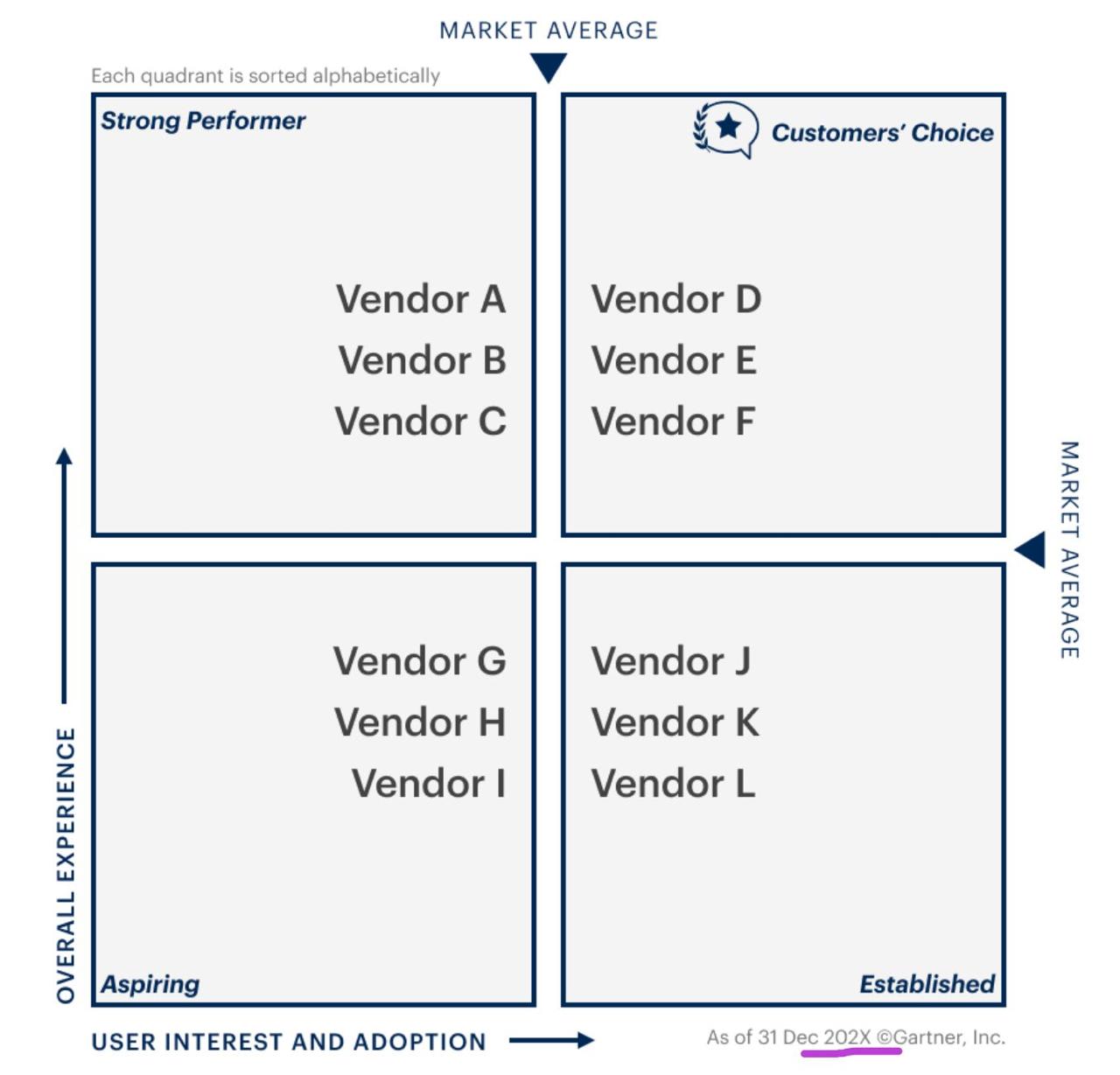
- Customers' Choice (upper-right) — Above market average on both Overall Experience AND User Interest & Adoption.
- Strong Performer (upper-left) — High experience scores, but lower adoption metrics
- Established (lower-right) — High adoption, but lower experience scores
- Aspiring (lower-left) — Below market average on both axes
Being included in a VOC report at all is hard — the review threshold is high given the nature of enterprise buyers, and reports cap at 25 vendors. Any quadrant means you're in the room. Customers' Choice is the badge that matters for marketing — it's the equivalent of G2's Leader or PeerSpot's Tech Leader.
Go deeper: Gartner Peer Insights Customers' Choice and Gartner Peer Insights Strong Performer — what each placement signals to buyers and AI search, and how they differ.
The Two Axes
Y-Axis: Overall Experience A composite score of three elements:
- Overall Rating
- Capabilities rating
- Support/Delivery rating
X-Axis: User Interest & Adoption A composite score of three elements:
- Review/consideration score (how reviews perform relative to the market)
- Willingness to recommend
- Market coverage (across industry, region, and company size)
The June 2025 Methodology Shift
Gartner updated the VOC methodology in June 2025 (v3.5). Reports published through May 2025 used the older approach; everything from June 2025 onward uses the updated version. The key changes:
- Adjusted weightings for industry, company size, and region in the scoring model
- Vendor consideration frequency is now incorporated into the User Interest & Adoption score (X-axis) — meaning how often buyers include you in their evaluation shortlist affects your positioning
- Segment views (breakdowns by industry, company size, or region) are now exclusive to Interactive VOCs for reports after September 1, 2024. A market needs 5+ qualifying vendors and 400+ total reviews to get segment graphics
The segment views change matters because segment placement can differ from your overall placement. A product that's Customers' Choice overall might be "Strong Performer" in the enterprise segment, or vice versa. If your buyers filter by segment, that's the quadrant they see.
What this means practically: If you earned Customers' Choice before June 2025, your next evaluation uses different scoring. The fundamentals haven't changed (reviews, ratings, adoption still matter), but the weightings have shifted — particularly around how broadly your reviews represent different industries and company sizes.
Inclusion Requirements
To appear in a VOC report at all, your product needs:
| Requirement | Details | What This Means |
|---|---|---|
| 20+ eligible reviews | Within the 18-month evaluation window | Reviews older than 18 months don't count |
| 15+ ratings for sub-categories | Both Capabilities and Support/Delivery | Reviewers must rate these specific attributes, not just give an overall score |
| 50%+ market capabilities | Per Gartner's Magic Quadrant or Market Guide definition | Your product must cover at least half the capabilities Gartner defines for the market |
| Reviewer eligibility | Organizations with $50M+ annual revenue | SMB reviews appear on your profile but are excluded from VOC calculations and Customers' Choice |
| First 6 months weighted 50% | Reviews collected in your first 6 months on GPI count at half weight | Prevents review flooding immediately after listing |
Maximum 25 vendors per VOC document. If more than 25 products qualify, only the top 25 are included. Segment views (by industry, company size, or region) may include different vendors.
Recognition is valid for 15 months from the VOC publication date, or until the next VOC report for that market — whichever comes first.
Source: Voice of the Customer Methodology (v3.5, June 2025 — current methodology for all VOC reports published June 2025 onward)
The VOC Publication Schedule (Decoded)
Each GPI market has its own publication date, review eligibility window, and freeze period — there's no universal quarterly cycle. The official schedule is buried in a downloadable Excel file with four tabs and datetime-formatted dates. We decoded it.
The official schedule lives in a downloadable Excel file with four tabs, datetime-formatted dates, and terminology that isn't explained until you find the "About" tab: Gartner Peer Insights VOC Calendar (Excel)
We extracted all 58 markets with their review windows, freeze periods, and publication dates (originally pulled February 4, 2026; the Feb–May 2026 cycles below have now completed or are in flight — the June 2026 cycle is the nearest actionable one, with review windows closing this month). Consolidated into searchable tables below so you don't have to decode the spreadsheet yourself.
How to Read the Schedule
Each market listing has five dates you need to understand:
| Column | What It Means | Why It Matters |
|---|---|---|
| Review Eligibility Start | Beginning of the 18-month review window | Reviews submitted before this date don't count |
| Review Eligibility End | End of the 18-month window | Your hard deadline for collecting reviews |
| VoC Dashboard Live | When Gartner starts showing preliminary data | You can see how you're tracking before publication |
| Freeze Period Start | 2-3 months before eligibility ends — no new products added to the market | If you're not listed before this date, you're out for this round |
| Tentative Publication | Expected VOC report publication month | "Tentative" is real — 92 schedule changes were tracked in 2025 alone |
The freeze period is the hidden deadline most vendors miss. If you're not already listed in your GPI market before the freeze period starts, you cannot be added until after the VOC is published. For a February 2026 publication, freeze periods started as early as August 2025 — six months before the report comes out.
February 2026 Markets (13 markets) — Published
These VOCs have already published. Review windows are closed. If you're in one of these markets, the next round (typically ~18 months later) is your target — check the calendar file for the next review window start date.
| Market | Review Window | Freeze Started |
|---|---|---|
| Communications Platform as a Service | May 2024 – Oct 2025 | Aug 2025 |
| Strategic Cloud Platform Services | Jun 2024 – Nov 2025 | Sep 2025 |
| Finance and Accounting BPO | Jul 2024 – Dec 2025 | Sep 2025 |
| Public Cloud IT Transformation Services | Jun 2024 – Nov 2025 | Sep 2025 |
| SD-WAN | Jul 2024 – Dec 2025 | Oct 2025 |
| DevOps Platforms | Jul 2024 – Dec 2025 | Oct 2025 |
| Unified Communications as a Service | Jul 2024 – Dec 2025 | Oct 2025 |
| Adaptive Project Management and Reporting | Jul 2024 – Dec 2025 | Oct 2025 |
| Contact Center as a Service | Jul 2024 – Dec 2025 | Oct 2025 |
| Employee Recognition and Reward Systems | Jul 2024 – Dec 2025 | Oct 2025 |
| Multichannel Marketing Hubs | Jul 2024 – Dec 2025 | Oct 2025 |
| Digital Adoption Platforms | Jul 2024 – Dec 2025 | Oct 2025 |
| Backup and Data Protection Platforms | Jul 2024 – Dec 2025 | Oct 2025 |
March 2026 Markets (14 markets) — Published; Review Windows Closed Jan 2026
| Market | Review Window | Freeze Started |
|---|---|---|
| Software Asset Management Managed Services | Aug 2024 – Jan 2026 | Oct 2025 |
| API Protection | Aug 2024 – Jan 2026 | Oct 2025 |
| Corporate Learning Technologies | Aug 2024 – Jan 2026 | Nov 2025 |
| API Management | Aug 2024 – Jan 2026 | Nov 2025 |
| CRM Customer Engagement Center | Aug 2024 – Jan 2026 | Nov 2025 |
| Security Information and Event Management | Aug 2024 – Jan 2026 | Nov 2025 |
| Collaborative Work Management | Aug 2024 – Jan 2026 | Nov 2025 |
| Cloud ERP for Product-Centric Enterprises | Aug 2024 – Jan 2026 | Nov 2025 |
| Enterprise Architecture Tools | Aug 2024 – Jan 2026 | Nov 2025 |
| Privileged Access Management | Aug 2024 – Jan 2026 | Nov 2025 |
| Managed Detection and Response | Aug 2024 – Jan 2026 | Nov 2025 |
| Identity Governance and Administration | Aug 2024 – Jan 2026 | Nov 2025 |
| Application Security Testing | Aug 2024 – Jan 2026 | Nov 2025 |
| Distributed Hybrid Infrastructure | Aug 2024 – Jan 2026 | Nov 2025 |
April 2026 Markets (12 markets) — Publishing Now; Review Windows Closed Feb 2026
These 12 markets are in the active publication cycle. Review windows closed February 28, 2026, so this round is locked. Keep an eye on gartner.com/reviews for results as they publish through April.
| Market | Review Window | Freeze Started |
|---|---|---|
| Cloud Financial Management Tools | Sep 2024 – Feb 2026 | Oct 2025 |
| Cloud ERP for Service-Centric Enterprises | Sep 2024 – Feb 2026 | Nov 2025 |
| Access Management | Sep 2024 – Feb 2026 | Dec 2025 |
| AI Code Assistants | Sep 2024 – Feb 2026 | Dec 2025 |
| Cloud Database Management Systems | Sep 2024 – Feb 2026 | Dec 2025 |
| Cyber Asset Attack Surface Management | Sep 2024 – Feb 2026 | Dec 2025 |
| Email Marketing | Sep 2024 – Feb 2026 | Dec 2025 |
| Enterprise Business Process Analysis Tools | Sep 2024 – Feb 2026 | Dec 2025 |
| Contract Life Cycle Management | Sep 2024 – Feb 2026 | Dec 2025 |
| Digital Commerce | Sep 2024 – Feb 2026 | Dec 2025 |
| Outsourced Digital Workplace Services | Sep 2024 – Feb 2026 | Dec 2025 |
| Intelligent Document Processing Solutions | Sep 2024 – Feb 2026 | Dec 2025 |
May 2026 Markets (7 markets) — Publishing Next Month; Review Windows Closed Mar 2026
| Market | Review Window | Freeze Started |
|---|---|---|
| Data Security Posture Management | Oct 2024 – Mar 2026 | Jan 2026 |
| Data Integration Tools | Oct 2024 – Mar 2026 | Jan 2026 |
| Metadata Management Solutions | Oct 2024 – Mar 2026 | Jan 2026 |
| Email Security Platforms | Oct 2024 – Mar 2026 | Jan 2026 |
| Visual Collaboration Applications | Oct 2024 – Mar 2026 | Jan 2026 |
| AI Application Development Platforms | Oct 2024 – Mar 2026 | Jan 2026 |
| Expense Management Software | Oct 2024 – Mar 2026 | Jan 2026 |
June 2026 Markets (12 markets) — Nearest Actionable; Review Windows Closing Apr 2026
These are the nearest actionable deadlines as of April 2026. Reviews must be submitted before the end of April 2026 to count. If you're in one of these markets and not yet listed, the freeze period has already started (February 2026) — you cannot be added to these markets for this round.
| Market | Review Window | Freeze Started |
|---|---|---|
| Software Asset Management Tools | Nov 2024 – Apr 2026 | Feb 2026 |
| Data and Analytics Governance Platforms | Nov 2024 – Apr 2026 | Feb 2026 |
| Business Orchestration and Automation Technologies | Nov 2024 – Apr 2026 | Feb 2026 |
| Source-to-Pay Suites | Nov 2024 – Apr 2026 | Feb 2026 |
| Endpoint Management Tools | Nov 2024 – Apr 2026 | Feb 2026 |
| Revenue Enablement Platforms | Nov 2024 – Apr 2026 | Feb 2026 |
| Customer Data Platforms | Nov 2024 – Apr 2026 | Feb 2026 |
| AI-Augmented Software Testing Tools | Nov 2024 – Apr 2026 | Feb 2026 |
| Financial Planning Software | Nov 2024 – Apr 2026 | Feb 2026 |
| Edge Distribution Platforms | Nov 2024 – Apr 2026 | Feb 2026 |
| Configure, Price and Quote Applications | Nov 2024 – Apr 2026 | Feb 2026 |
| Remote Desktop Software | Nov 2024 – Apr 2026 | Feb 2026 |
One Market Skipping This Round
Digital Experience Services — listed in the calendar with "No VoC publication in the current round." No explanation given. This happens occasionally when markets are being redefined or merged.
Dates Shift — A Lot
The archive tab in the calendar file tracks 92 schedule changes since January 2025. Markets routinely move 1-3 months later than originally planned (we didn't find any that moved earlier). The review eligibility window usually doesn't change when dates shift — just the publication date slides.
Market names also change mid-cycle. Recent examples:
- "Enterprise Backup and Recovery Software Solutions" → "Backup and Data Protection Platforms"
- "Active Metadata Management" → "Metadata Management Solutions"
- "Breach and Attack Simulation (BAS) Tools" + "Penetration Testing Tools" → merged into "Adversarial Exposure Validation"
What "tentative" really means: Plan around these dates, but check the calendar monthly. Gartner updates the Excel file regularly (last updated March 3, 2026), though the downloadable file may lag 24-48 hours behind the vendor portal.
Source: VOC Publication Calendar (Excel), last updated March 3, 2026
Step-by-Step: Working Toward Customers' Choice
Now that you understand the requirements, here are the five steps to work toward Customers' Choice: confirm your market exists, find your deadlines, set your review target, collect reviews, and monitor your positioning.
Step 1: Confirm Your Market
GPI organizes products into "markets" that align with Gartner's Magic Quadrant and Market Guide definitions. This is different from G2 or Capterra categories — GPI markets are analyst-defined.
Visit gartner.com/reviews and search for your product or market. If your product isn't listed, you can request to be added. Listing approval takes approximately 8-10 business days.
If your category doesn't exist: GPI only covers markets that have corresponding Magic Quadrant or Market Guide publications. If Gartner hasn't defined your market, GPI isn't an option right now.
Step 2: Find Your Market's Deadlines
Scroll up to the VOC Publication Schedule and find your market. Note:
- Review eligibility end date — this is your hard deadline for collecting reviews
- Freeze period start — if you're not listed before this date, you're out for this round
- Review eligibility start — reviews submitted before this date don't count
If your market isn't in the February–June 2026 tables above, it either published previously (check the Previous Published tab in the calendar file) or publishes later in 2026/2027 (check the current version of the calendar — Gartner typically publishes the next cycle 2–3 months before the freeze period starts). The tables above were extracted February 2026; verify any specific market against the live calendar before planning.
Step 3: Set Your Review Target
Minimum for inclusion: 20 reviews, with 15+ ratings each for Capabilities and Support/Delivery.
For Customers' Choice: You need to score above the market average on both axes. The more reviews you have (with strong ratings), the better your positioning. But 20 solid reviews is the floor — focus on quality first.
Step 4: Collect Reviews
Who can review:
- Current users who deployed or upgraded in the past 18 months
- People involved in the purchase, implementation, service management, or end use
- Must be from organizations with $50M+ annual revenue
- Must register with LinkedIn or company email
Who cannot review:
- Vendor employees or competitor employees
- Exclusive partners, VARs, SIs, or consultants
- Government/public sector employees
- People from organizations under $50M revenue
- Anyone on the OFAC sanctions list
Review incentives:
- Maximum $25 per review (FTC guidelines)
- Gartner provides new vendors with $1,250 in free incentive funding (50 x $25 gift cards)
- Vendor-funded incentives: up to $10,000 per market per year
- Multi-incentive links let reviewers choose: $25 gift card, $25 charity donation, GPI Plus subscription, or no incentive
For how GPI's incentive ceiling compares to G2, Capterra, and TrustRadius, and what the FTC's Fake Reviews Rule means if you run any outside program, see safe B2B SaaS review collection.
The cost reality: The $1,250 in free incentives is generous — and it's often the starting point of a conversation about broader Gartner for Providers packages. The badge itself is free. But "Review as a Service" packages and GTP (Gartner for Technology Providers) seat-holder agreements are part of the ecosystem around it. The platform is free to use; the full vendor relationship can get expensive. Worth knowing before you start.
Note on INR gift cards: Gartner suspended Indian Rupee gift card redemption in March 2025 due to improper use. If you have India-based enterprise customers, check whether this has been resolved before planning your review campaign.
Review moderation: Takes 3-10 business days. Incentives are distributed after the review is approved.
Source: Incentives FAQs
Step 5: Monitor Your Position
Check your product page on gartner.com/reviews regularly to see:
- Total review count and average rating
- Sub-ratings for Capabilities and Support/Delivery
- How you compare to other products in your market
Note: Gartner paused the Reply to Review feature in July 2025. You currently cannot respond to reviews on the platform. No timeline for restoration has been published.
Marketing Compliance: Read This Before Using Your Badge
GPI requires pre-approval for all marketing materials that reference Customers' Choice, allows only verbatim review quotes with attribution, mandates a specific disclaimer, and prohibits implying analyst endorsement. These are the strictest badge usage rules of any platform we've covered.
The Rules
| Rule | What It Means |
|---|---|
| Pre-approval required | Draft marketing materials using GPI recognition must be submitted for compliance review before publication |
| Verbatim quotes only | You cannot paraphrase reviews. Quotes must be reproduced as published (ellipses to shorten may be permitted if meaning is preserved — check with Gartner's compliance team). Attribution must include reviewer's role and industry. |
| Badge sizing | The Customers' Choice badge must not appear larger or more prominent than your company's own branding — your logo must be prominently displayed |
| No analyst endorsement implied | Cannot suggest that Customers' Choice is equivalent to or endorsed by Gartner analysts |
| Specific disclaimer required | All materials must include Gartner's full disclaimer text (see below) |
| Approved language | Use "distinction" or "recognition" — never "award" |
| Most recent year only | Can only reference the most recent VOC publication |
| Link required | Must link to your GPI vendor page when using badges or logos |
Required Disclaimer Text
Every piece of marketing material that references GPI recognition must include this exact disclaimer:
"Gartner and Peer Insights are trademarks of Gartner, Inc. and/or its affiliates. All rights reserved. Gartner Peer Insights content consists of the opinions of individual end users based on their own experiences, and should not be construed as statements of fact, nor do they represent the views of Gartner or its affiliates."
Approved vs. Prohibited Language
| Approved | Prohibited |
|---|---|
| "Recognized as a Customers' Choice" | "Won the Customers' Choice Award" |
| "Peer-recognized on Gartner Peer Insights" | "Gartner recommends our product" |
| "Reviewed by customers on Gartner Peer Insights" | "Named a leader by Gartner" |
| "Customers' Choice distinction" | "Gartner-endorsed solution" |
Why so strict? Gartner protects the boundary between peer reviews and analyst research. Customers' Choice is based on user reviews, not analyst evaluation. Implying otherwise undermines both programs — and Gartner will enforce compliance.
Templates are available in the Marketing Tools section of the GPI vendor portal. Use them.
Source: Content Compliance Policy
How GPI Verifies Reviews
GPI reviews are anonymous to the public but verified by Gartner through LinkedIn cross-referencing, employment confirmation, and role relevance checks. Reviewers must register with professional credentials and attest they're not vendor or competitor employees. Here's the full process:
- Professional identity — Reviewers must register with LinkedIn or corporate email
- Employment verification — Cross-referenced against LinkedIn profiles
- Recency — Product must have been deployed/upgraded in the past 18 months
- Role relevance — Reviewer must have been involved in purchase, implementation, service, or end use
- Balanced perspective — Reviews are moderated for quality, relevance, and logical consistency between ratings and commentary
- Vendor employee exclusion — Reviewers must attest they are not vendor or competitor employees
Anonymous by design: Reviewers are verified by Gartner but their identity is hidden from the public and vendors. Buyers see role and company size (e.g., "IT Director at a Large Enterprise") but not the reviewer's name or company. This protects enterprise reviewers from vendor retaliation — a real concern when a CISO writes a critical review of a security vendor they still use.
The trade-off: Anonymous reviews mean buyers can't independently verify who wrote them. PeerSpot and TrustRadius both show reviewer names and companies, which adds transparency. Gartner's position is that their verification process is rigorous enough to compensate.
Reviews don't expire — they remain readable on GPI indefinitely, but only reviews from the 18-month window count toward VOC placement.
Quick Reference: The Numbers
Customers' Choice (VOC)
- Above market average on both Overall Experience and User Interest & Adoption
- 20+ eligible reviews in 18-month window
- 15+ ratings for Capabilities and Support/Delivery sub-categories
- Products must cover 50%+ of market capabilities
- Reviewers from organizations with $50M+ revenue
- Max 25 vendors per VOC document
- Recognition valid 15 months or until next VOC publication
Review Incentives
- $25 maximum per review (FTC)
- Gartner-funded: $1,250 free for new vendors (50 x $25)
- Vendor-funded: Up to $10,000 per market per year
- Review moderation: 3-10 business days
Marketing Compliance
- Pre-approval required for all materials
- Verbatim quotes only
- Badge must not be larger or more prominent than vendor logo
- Full disclaimer required
- "Distinction" not "award"
What We Don't Know
GPI's documentation is more thorough than most platforms, but some gaps remain:
- Exact scoring formulas — The five factors for each axis are listed, but how they're weighted or combined isn't published. We know what goes in, but not the math.
- "Market coverage" calculation — One of the X-axis factors. Described as coverage across industry, region, and company size, but how it's measured isn't defined.
- Schedule beyond June 2026 — The VOC calendar only shows ~2 months ahead. Markets publishing July 2026 and later aren't listed yet.
- Why markets skip rounds — Digital Experience Services is listed as "No VoC publication in the current round" with no explanation. We don't know how often this happens or why.
- Reply to Review timeline — Paused since July 2025 with no published restoration date. Vendors cannot respond to negative reviews.
- INR gift card resolution — Suspended March 2025. Unclear if restored.
- What happens at 20 reviews with insufficient sub-ratings — If you have 20+ reviews but fewer than 15 rate Capabilities or Support/Delivery, are you excluded entirely or placed with caveats?
- Review age weighting within the 18-month window — Are recent reviews weighted more heavily than older ones within the eligibility window? Some sources suggest reviews in the first 6 months of the window carry less weight, but we couldn't verify this in official documentation.
- Independent review campaigns vs. portal-managed incentives — The $10,000/market/year cap applies to incentives managed through the GPI portal. Whether independently-run review campaigns (following FTC guidelines) count toward that cap, or are treated differently for VOC qualification, isn't clearly documented.
If Gartner publishes more detailed methodology, we'll update this guide. If you are Gartner — reach out: ceo@blastra.io.
The Magic Quadrant Connection
What makes GPI different from every other review platform: your GPI reviews are used as inputs in Magic Quadrant evaluations. For the vendor-side execution playbook on the MQ itself — Inclusion Criteria, the briefing process, the Customer Interest Indicator, marketing compliance — see our companion guide How to Get Into the Gartner Magic Quadrant.
Gartner analysts use GPI data as one of several customer feedback inputs when evaluating vendors for Magic Quadrant and Market Guide publications — alongside RFI responses, briefing notes, and analyst-led reference calls. This means:
- A strong GPI review profile doesn't just earn you a Customers' Choice badge — it's visible to the analysts evaluating your product
- Negative reviews on GPI can influence how analysts perceive your customer experience
- The quality and depth of your reviews matters beyond the numerical rating
- GPI data alone won't determine your MQ position — but it's the only review platform that's part of the equation at all
No other review platform has this kind of analyst integration. G2, PeerSpot, and TrustRadius reviews exist independently of analyst research. GPI reviews are part of the Gartner research ecosystem.
Note: Following G2's acquisition of Capterra, GetApp, and Software Advice, GPI is now Gartner's only remaining software review and directory property. That makes GPI's role in the Gartner ecosystem more focused — it exists to serve the research, not to compete as a standalone directory.
What this means practically: If your buyers reference Magic Quadrants in their purchasing process (and in enterprise tech, many do), investing in GPI reviews has a compounding effect — badge recognition on GPI, plus analyst visibility in the MQ.
This is also why Gartner is so strict about marketing compliance. They need to maintain clear boundaries between "what customers say" (GPI) and "what analysts conclude" (MQ) — even when the data flows between them.
Source Documentation
We reviewed every official source. Here's what to trust:
Primary Sources (Dated, Reliable)
| Source | Date | Notes |
|---|---|---|
| Voice of the Customer Methodology | v3.5, June 2025 | Most detailed methodology document |
| Getting Listed on Peer Insights | Current | Listing process and eligibility |
| Incentives FAQs | Current | Review incentive program details |
| Content Compliance Policy | Current | Marketing usage rules |
| INR Gift Card Changes | March 2025 | Incentive restriction detail |
| VOC Publication Calendar (Excel) | Ongoing | Per-market schedule (tentative dates) |
Secondary Sources (Useful Context)
| Source | Notes |
|---|---|
| Being Ranked #1 on PeerSpot | Competitor positioning — useful for comparison |
| GPI Vendor Resources Hub | Portal gateway — links to all vendor documentation |
| Listing Guidelines | Additional listing detail |
FAQ
What is the difference between Gartner Peer Insights and Magic Quadrant?
Gartner Peer Insights is a customer review platform; Magic Quadrant is analyst research. GPI collects verified enterprise user reviews, while MQ evaluates vendors on "Vision" and "Execution." The connection: GPI reviews feed into Magic Quadrant evaluations as one of several analyst inputs. For the full MQ vendor-execution playbook (Inclusion Criteria, briefing process, CII gate, reprint compliance), see How to Get Into the Gartner Magic Quadrant.
How many reviews do I need for Gartner Customers' Choice?
You need 20+ eligible reviews within an 18-month window. At least 15 reviews must include ratings for both Capabilities and Support/Delivery. All reviewers must be from organizations with $50M+ annual revenue.
How long does Gartner Customers' Choice recognition last?
Recognition lasts 15 months or until the next VOC report for your market — whichever comes first. After expiration, you must requalify in the next evaluation cycle.
Is Gartner Peer Insights free?
Yes. Listing and collecting reviews costs nothing. Gartner provides $1,250 in free review incentives for new vendors. Using Customers' Choice recognition requires following strict marketing compliance rules.
How does Gartner verify reviews?
Gartner verifies reviewers through LinkedIn cross-referencing, corporate email confirmation, and attestation that they're not vendor or competitor employees. Reviews appear anonymous to the public but are verified by Gartner.
Can I respond to reviews on Gartner Peer Insights?
No. Gartner paused the Reply to Review feature in July 2025 with no restoration date announced. Vendors cannot respond to reviews on-platform.
Key Takeaways
- Enterprise only — for the badge. Reviewers must be from organizations with $50M+ revenue to count toward VOC and Customers' Choice. Reviews from smaller companies still appear on your profile (useful for social proof and SEO), but they won't earn you a badge. If your customer base is primarily SMB or midmarket, G2 or Capterra will give you better ROI.
- 20 reviews is the floor. You need 20+ eligible reviews in an 18-month window just to appear in a VOC report. Plan your review campaign accordingly.
- The MQ connection is the differentiator. GPI reviews influence Magic Quadrant evaluations. No other review platform has this. If your buyers reference Magic Quadrants, GPI reviews have compounding value.
- Gartner funds your first incentives. New vendors receive $1,250 in free gift card funding (50 x $25). Use it — but note the $10,000/market/year cap for vendor-funded incentives after that.
- Strictest compliance rules of any platform. Pre-approval for marketing materials, verbatim quotes only, specific disclaimer text, badge sizing rules. Read the compliance section before planning how you'll use recognition.
- Three enterprise platforms, three different strengths. GPI for analyst influence, PeerSpot for deep case studies in security/IT/cloud, TrustRadius for broader reach with lower barriers. Diversifying across them means you're not dependent on any single platform.
- Find your market's deadlines above. We extracted all 58 markets from Gartner's four-tab Excel calendar file in February 2026. The Feb–May 2026 cycles have now published or are in flight — the June 2026 cycle (review windows closing April 2026) is the nearest actionable one as of this update. For cycles beyond June 2026, verify against the live calendar — Gartner publishes the next cycle 2–3 months before its freeze period.
- Reply to Review is paused. Since July 2025, vendors cannot respond to reviews on GPI. Factor this into your review strategy — you can't address negative feedback on-platform. If you can identify unhappy reviewers through context (role, industry, timing), consider having your Customer Success team reach out privately to resolve issues.
Related Guides
- G2 Badges Guide: How to Earn Badges in 2026 — G2's grid methodology, review requirements, and paid plan considerations
- G2 Summer 2026 Reports: What the Numbers Mean for Vendors — The latest quarterly Grid data and what shifted this cycle
- What G2 Software Awards Teach Us About B2B Marketing — Analysis of the 2026 awards and what they reveal about the market
- Capterra Badges Guide: How to Earn Badges in 2026 — Capterra's category-specific deadlines and 20-review targets
- Software Directories That Actually Reach Latin America — Regional directory coverage for vendors selling to LATAM buyers (relevant context for GPI's regional market expansions)
- Trustpilot Guide: How TrustScore Recognition Works — B2B SaaS guide to Trustpilot's recognition program
- PeerSpot Badges Guide: How to Earn Awards in 2026 — Enterprise tech focus, quarterly awards, 5-factor ranking methodology
- TrustRadius Badges Guide: How to Earn Awards in 2026 — trScore methodology, free badge usage, annual schedule
- SourceForge Badges Guide: How to Earn Badges in 2026 — SourceForge's top 5%/10% thresholds and seasonal awards
- How to Get G2 & Capterra Reviews — Review collection best practices that apply across platforms
- How to Get Ranked on G2 — Understanding G2's Grid positioning
- How SoftwareReviews Awards Work — Data Quadrant + Emotional Footprint, 130-data-point surveys, free badge display
About This Guide
This guide was created by Blastra, a SaaS listings management platform. We help software companies manage their third-party visibility posture across directories like G2, Capterra, and SourceForge.
Gartner Peer Insights has thorough vendor documentation, but it's spread across multiple pages in their vendor resources portal. So we organized it.
Note: Blastra does not currently support Gartner Peer Insights in our directory submission service. This guide is for vendors managing their GPI presence directly. If you want us to manage your GPI listings, reach out at ceo@blastra.io.
This guide reflects publicly available methodology documentation as of February 2026, with schedule framing updated April 2026 as the February–May 2026 publication cycles completed or entered publication. Gartner may update their programs. Verify against official sources — especially the VOC calendar file — for the most current requirements and cycles beyond June 2026.
Don't know where to start with Gartner?
Blastra can submit your Gartner Peer Insights listing and build your review-collection strategy around the market deadlines and compliance rules — then keep an eye on your position and ping you when something needs attention.