


G2 just completed its acquisition of Capterra, GetApp, and Software Advice. Four platforms, one owner. Nothing has merged yet — separate dashboards, separate sales teams, separate pricing.
G2 expresses the intention to unify the assets but we have no idea how or when integration will happen — they could keep both systems running independently for years, or focus on buyer-facing unification (reviews, taxonomy, G2.ai) before touching vendor pricing. But if they will be deciding between their subscription model and Capterra's performance model, we think subscription will win. These two sides charge vendors in fundamentally different ways, and those differences are worth understanding right now.
Two Pricing Models
G2's model: pay for access. Annual subscriptions (for companies under 50 employees starting at $2,999/year first year, $6,000/year on renewal) or monthly billing ($299/month) that unlock features. The things you'd expect to be basic — responding to your own reviews, displaying most badges you've earned — sit behind the paywall. Intent data is included in subscription plans; PPC advertising is available as an add-on without subscription.
Capterra's model: only pay for results. If you want leads, you pay per click ($2/click minimum, $500/month minimum budget, second-price auction) or per qualified lead (human advisors who screen buyers for Budget, Authority, Need, and Timeline before passing them to you). The minimum PPC spend functions like a subscription in practice, but you don't need to pay anything to respond to reviews or display badges. (Note: Capterra, GetApp, and Software Advice share a backend — one review appears on all three platforms, one PPC campaign runs across all three. When Gartner made the merger they focused on the vendor experience, having kept all three platforms for buyers separate.)
What G2 Locks That Capterra Doesn't
Review responses. Your customers take the time to write a detailed G2 review. They mention something that was off, or something you've since fixed. On Capterra, you reply — free, whether you're running PPC campaigns or not. On G2, you can't reply unless you're on a paid plan starting at $2,999/year.
G2's own documentation states: "G2 recommends responding to both positive and negative reviews to show buyers that you take customer feedback seriously." Solid advice, we agree it helps.
We didn't pinpoint exactly when G2 moved review responses to paid tiers, but one profile we manage was able to respond to reviews in 2021 under the free tier. The shift happened somewhere in the years since.
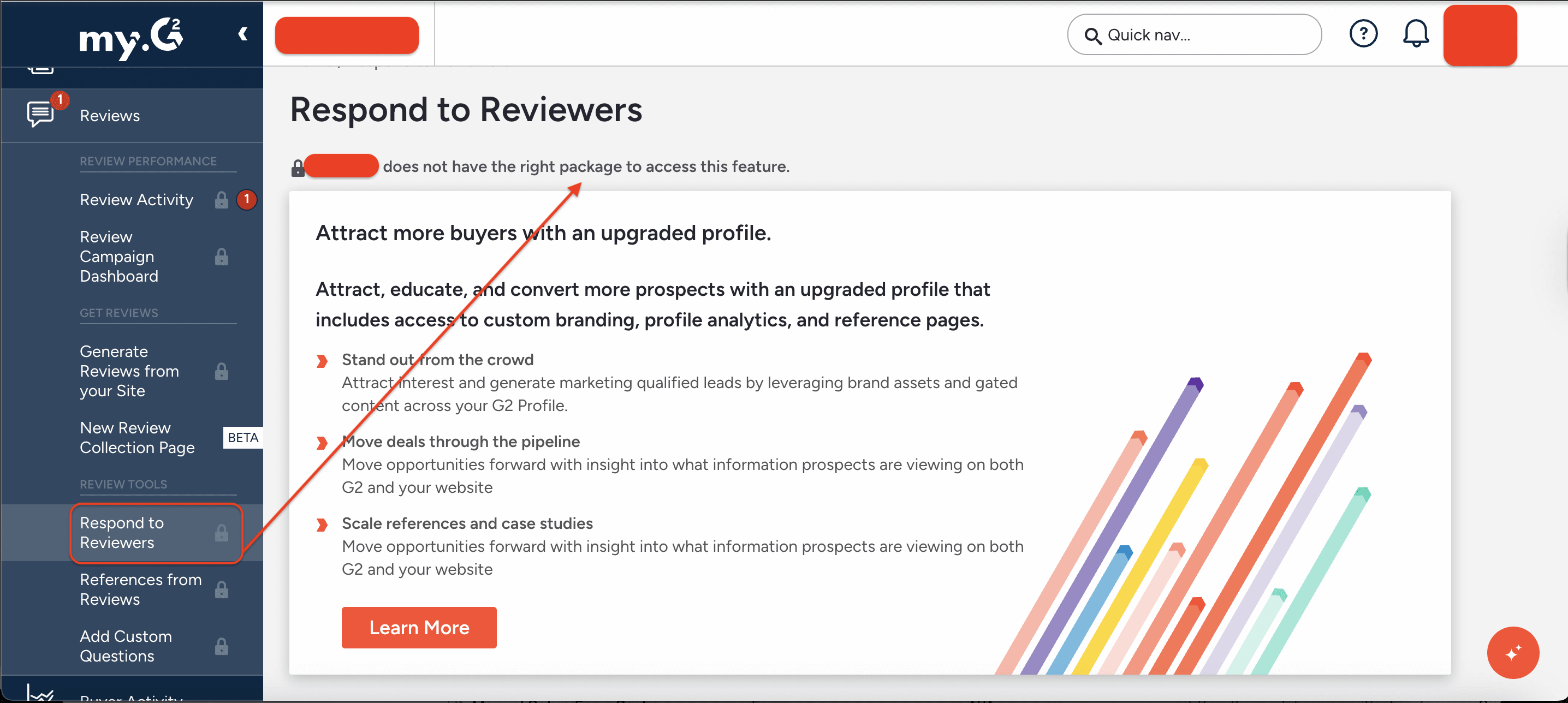
We logged into a G2 free-tier dashboard to see what's actually locked. The answer: almost everything under "Reviews." Review Activity analytics, Review Campaign Dashboard, AI-Assisted Review Collection, Respond to Reviewers, References from Reviews — all locked behind the Starter plan. The free tier lets you have a profile and receive user reviews, but you can't respond to them or access analytics about them.
Badges. On Capterra, you earn badges and display them — free. On G2, you can earn any badge on a free tier, but only the Users Love Us badge (20+ reviews, 4.0+ average) can be displayed without paying. Grid Leader, High Performer, and the annual Best Of badges require a paid plan to license. (See our Capterra badges guide and G2 badges guide for full requirements.)
Review incentives. G2's dashboard shows you competitor incentive activity in your categories. In our test category, competitors had granted $1,476 in review incentives and collected 59 incentivized reviews in the last 90 days. G2 surfaces this specifically to encourage upgrading — "Your competitors have upgraded their G2 profile. Small Businesses with upgraded G2 profiles collect 3x more reviews."
That pressure to upgrade connects to something broader about how each platform communicates with vendors through its interface.
The UI Tells You the Business Model
Here's something that's easy to miss if you're not looking at both platforms side by side.
UI is a nuanced discipline. You make strong statements through placement, hierarchy, and microcopy — small choices that shape how vendors feel about their own profiles.
On G2, visit a product profile that hasn't been reviewed recently and you'll see a yellow banner: "It's been two months since this profile received a new review." Right there on the page, visible to buyers. Next to it: a sponsored competitor ad — a rival product, placed on your profile page by G2. The call to action for visitors isn't just "Write a Review" — it's framed around recency and gaps, signaling to buyers that this profile may be stale. The solution offered to vendors is always the same: upgrade.
Reviews are the core of what G2 sells to vendors. The entire upgrade path — from free tier to $2,999/year Starter to higher tiers — is built around unlocking review-related features. Capterra, which was the first B2B software directory to introduce user reviews back in 2008 (four years before G2 even existed), treats reviews as infrastructure — the foundation that makes PPC valuable, not a product to gate.
On Capterra, a product with zero reviews shows an empty review section with a "Write a Review!" link. Compare the microcopy: "Write a Review!" versus "It's been two months since this profile received a new review... Write a Review." One invites. The other creates context before inviting — and that context is visible to every buyer visiting your page. Capterra does show a "Top-Rated Alternatives" section further down the profile, but it's structured as a comparison grid with ratings and features — a buyer tool you might as well be winning. A sponsored competitor ad at the top of your profile offers no such comparison; the only way to remove it is to upgrade.
The Snapshot
Capterra, GetApp, and Software Advice are identical on every row — same dashboard, same features.
| G2 | Capterra / GetApp / Software Advice | |
|---|---|---|
| Pricing model | Annual subscription + add-ons | Pay-per-click / pay-per-lead |
| Paid plans start at | $299/mo or $2,999/year (first year) | $500/month PPC minimum |
| Free listing | Yes | Yes |
| Respond to reviews | Paid only | Free |
| Earn badges | Yes | Yes |
| Display badges | Mostly paid | Free |
| Competitor ads on your page | Sponsored ads (top of profile) | Alternatives comparison (bottom of profile) |
| Review recency pressure | Yes (public banner) | No |
| PPC advertising | Flexible budget, no minimum | $2/click, $500/mo min, second-price auction |
Capterra's PPC is genuinely well-built — more granular targeting than G2's Clicks product, with per-country and per-category bidding. The question is whether G2 will keep Capterra's PPC mechanics and maybe adapt them for G2 as well, or whether the subscription model absorbs everything.
What's Free Today May Not Be Free Tomorrow
We can guess the general direction — reviews across platforms will likely unify, given that G2 has already announced plans to combine the review databases. Beyond that, it's speculation.
What isn't speculation: these pricing models are different enough that the right choice depends on what you need right now. If you want to build a profile and collect reviews without paying, Capterra gives you more for free. If you want intent data and competitive intelligence, G2 has products Capterra doesn't.
The features worth watching are the ones that are free on one side and paid on the other: review responses, badge display, and the absence of competitor ads on your profile page. Those are the clearest differences between the two models — and the ones most likely to shift.
This is also one more reason to diversify your review presence across platforms like SourceForge, TrustRadius, and PeerSpot. When 55-58% of software review visibility sits under one owner, depending on a single platform's pricing decisions is a risk you can manage.
Sources
| Source | Notes |
|---|---|
| G2 Seller Plans | Official pricing page |
| G2 FY26 Pricing Guide (PDF) | Detailed tier comparison |
| G2 Seller Hub (my.g2.com) — free tier dashboard | Verified locked features |
| G2 Review Activity Documentation | Review response best practices |
| Gartner Digital Markets vendor dashboard | Verified PPC minimum and budget estimates |
| Capterra Vendor FAQ | Free features confirmation |
| G2 Acquisition Announcement | Official announcement |
| The Sale of Capterra — Vista Point Advisors | Capterra founder on 2008 reviews launch |
FAQ: Common Questions About G2 and Capterra Pricing
Can I respond to reviews on G2 without paying?
No. G2 requires a paid subscription ($2,999/year minimum) to respond to reviews. Capterra offers free review responses regardless of ad spend.
Which badges can I display for free on G2?
Only Users Love Us (20+ reviews, 4.0+ average). All other G2 badges — Grid Leader, High Performer, Momentum Leader, Best Of — require a paid plan.
Are Capterra, GetApp, and Software Advice the same for vendors?
Yes. All three share the same dashboard, review database, and pricing. Reviews appear across all three, and PPC campaigns run simultaneously on all platforms.
What's the minimum spend on each platform?
G2: $2,999/year (Starter tier, <50 employees), increasing to $6,000/year on renewal. Capterra: $500/month minimum PPC budget with $2/click floor price.
Will G2 and Capterra pricing merge after the acquisition?
Unknown. The acquisition closed January 2026 but integration hasn't begun. Features most likely to change: free review responses, free badge display, and competitor ad placement.
You Might Also Like
- What Software Awards Actually Mean - Full directory of badges across G2, Capterra, and other platforms
- How to Earn G2 Badges in 2026 - G2 Grid methodology, requirements, and costs explained
- How to Earn Capterra Badges in 2026 - Capterra Shortlist and attribute badges decoded
- G2 Completes Acquisition of Capterra - What the consolidation means for software vendors
- B2B Software Directories & AI SEO Strategy - Why diversifying your directory presence matters
- G2 vs Capterra vs Trustpilot vs TechnologyMatch - A buyer's perspective on which discovery platform works best for IT leaders
Manage your G2 and Capterra presence
Blastra helps B2B software companies manage listings across G2, Capterra, and 30+ other directories — all from one platform.