


First, what Gartner is and what a Magic Quadrant does for vendors
Gartner is an independent IT research and advisory firm. Founded 1979, headquartered in Stamford, Connecticut. Tens of thousands of staff globally, multi-billion-dollar annual revenue. Their core customer is the enterprise IT buyer - CIOs, CTOs, heads of security, procurement teams, IT decision-makers at Fortune 500 and public-sector organizations who pay for research subscriptions to make better technology choices.
How Gartner makes money. Three primary streams:
- Research subscriptions for IT leaders. A CIO buys access to Gartner for IT Leaders or Gartner for Technical Professionals. Includes the research library, analyst inquiries, peer benchmarks, and conference seats.
- Conferences. Gartner Symposium, Security & Risk Management Summit, Marketing Symposium, CIO Leadership Forum, and many others. Sponsorships, ticket sales, vendor presence.
- Vendor-side subscriptions and services. Gartner for Technology Providers gives software vendors access to analyst briefings, market research, and advisory days. Reprint licenses for vendors that appear in research are sold separately.
The structure matters because it shapes what Gartner is optimizing for. Buyers pay to make better choices; vendors pay to understand the buyers; nobody pays Gartner to be in any specific report. Gartner's incentive is buyer trust in the research, because that's what enterprises renew their subscriptions on.
What Gartner publishes. A vendor encounters several Gartner research formats - the Magic Quadrant is the flagship, with companions including Critical Capabilities, Market Guide, Hype Cycle, Cool Vendors, and Voice of the Customer. The full disambiguation - what each publication does, how it differs, and which one applies to your market - lives in its own section below. For now: the MQ is what procurement teams actually pull when they're shortlisting tools at a Fortune 500 company. That's why vendors care about it.
What being included materially does for a vendor. The reasons vendors invest 12-24 months chasing an MQ:
- Shortlist inclusion. "We pulled the Gartner MQ" is the most-cited filter step in B2B enterprise procurement. Being on the quadrant gets you on the list. Leader status moves you up it. A vendor whose competitors are in the MQ and they aren't carries a real structural disadvantage in the same buying conversations.
- Sales-cycle credibility. Risk-averse enterprise buyers use MQ inclusion as a "this vendor is real" signal. The "do we trust this company" friction shrinks. Sales teams report shorter cycles, fewer reference calls demanded, fewer security-review escalations.
- Marketing-ready proof. A reprint license lets the vendor put the MQ graphic and an approved quote on landing pages, sales decks, pricing pages, board reports. The Gartner imprimatur translates directly into trust signals - the sort of third-party validation a vendor's own marketing can't manufacture.
- Analyst inquiry mindshare. Gartner's paying clients can call analysts and ask "who should I look at for X?" Included vendors come up in those calls. Leaders come up first.
- Funding and IPO legitimacy. Investors and acquirers read MQs. MQ Leader status often appears in S-1 filings, due diligence packages, and post-funding announcements as a market-validation signal.
- Board-level credibility. A CMO who can say "we're a Leader in the Gartner MQ" gets an easier audit-committee conversation than one who can't.
The flip side is what makes the work worth it. If three of your direct competitors are in the MQ and you aren't, your buyers see three options without you. That's the structural reality the rest of this guide is about.
TL;DR
The 2024 Magic Quadrant for SIEM (Security Information and Event Management - the security log aggregation and analysis category) required $75M in cloud-native SIEM revenue OR 200 production customers. The 2025 SIEM Magic Quadrant - published October 8, 2025 - requires $85M OR 500 customers, plus a new ">5% new customer acquisition or competitive replacement" gate. Same market, one cycle later, materially harder to enter.
That's just one of an estimated 100+ Magic Quadrants Gartner publishes annually. Each has its own Inclusion Criteria, set by the analyst team, approved by the Content Leadership Board, and rebuilt every cycle. If you're a vendor wondering how to get into one, here's the breakdown of what you can control and where structural limits apply.
Realistic timeline: 12 - 18 months from "we're going to try" to first publication if you qualify the first time. Three cycles before targeting Leader status, per practitioners. Niche Player or Honorable Mention is the median first-cycle outcome, and being named at all is the real prize. The MQ also reaches one specific audience: procurement teams who read MQs. It is a much weaker signal in AI-driven discovery, where buyers ask ChatGPT or Perplexity for category recommendations. Plan for both audiences. For the Gartner Peer Insights (GPI - Gartner's enterprise software review platform) side of the same vendor strategy, see our companion guide.
Should You Prioritize the Magic Quadrant?
Before the methodology, here's the assessment.
MQ is probably worth it if:
- You sell to enterprise buyers in a market that has a current Magic Quadrant
- You can clear the published Inclusion Criteria for revenue, customer count, and geographic spread
- You can commit to 12 - 24 months of analyst engagement (RFI - Request for Information, the formal questionnaire Gartner sends each candidate vendor - briefings, factual review)
- Your buyers read MQs - procurement teams in regulated industries, public sector, Fortune 500 enterprises typically do; mid-market and SMB-focused buyers usually don't
MQ is probably not worth it (yet) if:
- Your customers are primarily SMB, or you don't yet have ~$50M+ ARR or ~200 enterprise customers
- Your market has no MQ - only a Market Guide, Hype Cycle, or Peer Insights coverage
- You can't sustain the time commitment - practitioner estimates put it at 150+ hours per cycle for RFI, briefings, demos, and factual review
- Your product hasn't been generally available long enough - most MQs require GA-as-of (Generally Available - shipped to paying customers and out of beta) cutoff dates (e.g., 1 January 2025 for the 2025 AI-ITSM - AI Applications in IT Service Management - MQ)
Many vendors who eventually enter the MQ start with Gartner Peer Insights (GPI) first. GPI reviews are an input to MQ analysis, and a complete, well-maintained GPI profile is the entry surface for analyst awareness. If you don't yet have an active GPI listing with current data, that's the first move. The full GPI playbook is its own guide - see the cross-link below for the depth on VOC methodology, the Customers' Choice schedule, and review collection strategy.
Start here: Visit gartner.com/en/research/magic-quadrant, search for your market, and check whether an MQ exists. If yes, look at the current Leaders - that's your competitive set. If no, look for a Market Guide instead, or for an Emerging Magic Quadrant if your market is GenAI-adjacent (more on eMQ below).
Magic Quadrant vs. Every Other Gartner Publication You've Heard Of
Vendors confuse these constantly. Sales hears "Gartner Cool Vendor" and thinks it's the same as MQ Leader. Marketing sees Customers' Choice and thinks it's a Magic Quadrant award. Different methodologies, different outputs, different levels of vendor effort.
| Publication | What it is | Vendor treatment | Refresh | Vendor effort |
|---|---|---|---|---|
| Magic Quadrant | Vendor positioning in a mature market, 4 quadrants, 2 axes | Dot per included vendor | 12 - 24 months per market | High - RFI, briefing, demo, factual review |
| Critical Capabilities | Product scoring against weighted use cases (1 - 5 scale) | Numeric scores per use case; clients can adjust weights interactively | Paired with MQ | Same data submission as paired MQ |
| Market Guide | Market analysis for emerging, fragmented, or commoditizing markets | "Representative vendors" listed; no rating, no position | As needed | Lower - briefing only |
| Hype Cycle | Technology maturity curve, five stages | Technologies are listed by maturity stage; the chart names categories rather than vendors | Annual | None - this is about technologies |
| Cool Vendors | Editorial spotlight on ≤5 innovative or emerging vendors per topic | Named with brief writeups | Annual per topic | Briefing-driven; analyst selects |
| Emerging Magic Quadrant (eMQ) | Lighter, faster MQ for fast-moving markets (GenAI sub-markets currently) | Same 2-axis quadrant, lighter RFI | Every 2 - 4 weeks | Lighter - 25-question RFI |
| Voice of the Customer (VOC) | Quadrant report based 100% on Peer Insights reviews | "Customers' Choice" upper-right designation | Per-market schedule | Review collection only |
| Peer Insights | The Gartner-run review platform itself | Profile-level, indefinite | Continuous | Review sourcing |
The Magic Quadrant is the flagship, but it's one of more than ten Gartner research formats. Critical Capabilities is paired with most MQs - same vendor cohort, same RFI submission, but the output is numeric scores against use cases instead of a quadrant. VOC uses Peer Insights review data with no analyst interpretation; the Customers' Choice badge comes from VOC.
For VOC depth - the methodology, the 58-market schedule, freeze periods, and Customers' Choice mechanics - see our Gartner Peer Insights guide.
How the Magic Quadrant Compares to Other Analyst Frameworks
The MQ is one of four major analyst-evaluation frameworks enterprise vendors face. Each has its own RFI and timeline; most enterprise vendors run all four in parallel.
| Framework | Vendor inclusion process | Output | Refresh |
|---|---|---|---|
| Gartner Magic Quadrant | Inclusion Criteria + RFI + briefings + Peer Insights inputs | 2-axis quadrant, 4 zones | 12 - 24 months |
| Forrester Wave | Inclusion criteria + briefings + customer surveys + scoring | Wave plot - Leaders / Strong Performers / Contenders / Challengers | ~24 months |
| IDC MarketScape | Vendor selection + briefings + customer interviews | Concentric ring chart - Leaders / Major Players / Contenders / Participants | ~12 - 24 months |
| GigaOm Radar | Inclusion criteria + analyst evaluation | Radar chart - Leader / Outperformer / Challenger / etc. | Annual |
The frameworks compete on credibility with different buyer audiences. Procurement teams in F500 and public sector lean Gartner-first. Architects and technical evaluators read Forrester. Mid-market and developer-led buyers increasingly cite GigaOm. This guide covers Gartner; the others are companion reading.
There's also Info-Tech Research Group's SoftwareReviews, an analyst-evaluation framework built on verified user reviews. Different methodology, different output, but it shows up in the same enterprise-evaluation conversations. We cover it separately in How SoftwareReviews Awards Work.
The Four Quadrants and Two Axes - What They Mean for Vendors
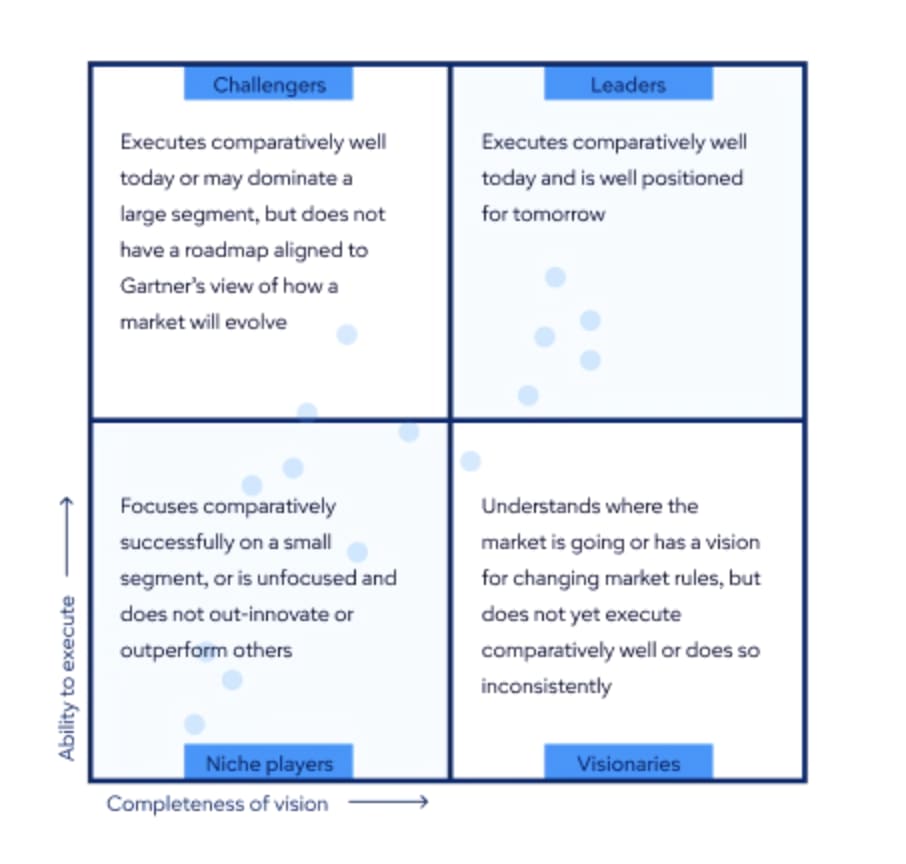
A Magic Quadrant plots vendors on two axes:
- Y-axis: Ability to Execute - current product, sales execution, market responsiveness, customer experience, operations, overall viability
- X-axis: Completeness of Vision - market understanding, product strategy, innovation, geographic strategy, vertical strategy
Four quadrants form from the median of each axis. From the 2025 SIEM MQ, verbatim:
- Leaders - strong functional match for general market requirements; high market share or strong revenue growth; positive customer feedback; superior vision and execution for emerging requirements.
- Challengers - multiple product or service lines, modestly sized customer base; meet a subset of requirements; strong execution but lack a complete capability set or competitive track record.
- Visionaries - strong functional match for general market requirements but less Ability to Execute than Leaders (fewer features, smaller revenue base, smaller installed base, or general viability concerns).
- Niche Players - narrow focus on a specific segment (midsize, region, industry, or limited functional set); small installed base or limited capabilities.
The math. A typical MQ includes 15 - 25 vendors. Across the markets we've reviewed, Niche Players is usually the most populated quadrant; Leaders typically holds 3 - 6 vendors in mature markets.
Across both axes there are 15 sub-criteria total (Gartner's own count). Weights vary per MQ. Gartner does not publish raw scores. Scoring combines quantitative and qualitative inputs and is comparative across the included cohort.
The 2025 SIEM and 2025 AI-ITSM MQs were published a month apart and use different weights:
| Sub-criterion | 2025 SIEM | 2025 AI-ITSM |
|---|---|---|
| Ability to Execute | ||
| Product or Service | High | High |
| Overall Viability | Medium | Low |
| Sales Execution / Pricing | High | High |
| Market Responsiveness | High | High |
| Marketing Execution | Medium | Medium |
| Customer Experience | Medium | Medium |
| Operations | Medium | Low |
| Completeness of Vision | ||
| Market Understanding | High | High |
| Marketing Strategy | Medium | Medium |
| Sales Strategy | Low | Medium |
| Offering (Product) Strategy | High | High |
| Business Model | Not Rated | Medium |
| Vertical / Industry Strategy | Medium | Low |
| Innovation | High | High |
| Geographic Strategy | Medium | Low |
Weights in the same year, in adjacent markets, look different. Geographic Strategy is Medium for SIEM (a global enterprise market) and Low for AI-ITSM (where North America still drives most of the buying). Don't assume one MQ's weights apply to another's.
Inclusion Criteria - What It Takes
Inclusion Criteria are the structural gates Gartner uses to decide which vendors can even be considered for a given MQ. They're public - they appear in the back of every reprint PDF - but they're market-specific and they tighten cycle to cycle. We pulled verbatim criteria from two recent reprints so you can compare.
The pattern across MQs: thresholds combine product capability, scale (revenue OR customer count), geographic spread, and active marketing presence. The specific magnitudes are rebuilt every cycle by the analyst team.
2025 Magic Quadrant for SIEM - verbatim Inclusion Criteria
Published 8 October 2025. To qualify, a vendor needed:
- A cloud-native software or SaaS SIM+SEM product (Security Information Management plus Security Event Management - the two halves of a SIEM platform; managed-services-only is excluded), with all six must-have capabilities: data collection from on-prem and cloud, end-user threat-detection self-development, multi-source correlation, case management, reporting, long-term storage.
- At least 50 vendor-provided collectors plus formal partnerships with at least 10 major technology vendors.
- Behavioral analysis or correlation across non-vendor-ecosystem sources.
- At least 2 of 4 specified additional capabilities (federated search, search beyond SIEM repo, third-party data lake integration, 365-day hot recall) in the SIEM as of 31 December 2024.
- At least 2 of 3 add-on capabilities (workflow augmentation, threat intelligence platform, advanced analytics or UEBA - User and Entity Behavior Analytics).
- Either $85M+ cloud-native/SaaS license-and-maintenance revenue in the 12 months prior to 31 December 2024 or ≥500 distinct production customers on cloud-native or SaaS contracts.
- ≥25% of cloud-native/SaaS SIEM revenue from buyers headquartered outside the vendor's region, or ≥25% of production customers headquartered outside the vendor's region.
- Online marketing campaigns, events, or third-party promotions across at least 2 geographic regions, distributed prior to 31 December 2024.
- Cloud-native/SaaS SIEM platform hosted in more than 3 major geographic regions.
- New customer acquisition or competitive replacement above 5%.
Source: Magic Quadrant for Security Information and Event Management, Gartner, 8 October 2025 (Doc ID G00822919). 2025 SIEM Leaders: Microsoft, Splunk, Google, Securonix, Gurucul, Exabeam. Challengers: Fortinet, Rapid7.
2025 Magic Quadrant for AI Applications in ITSM - verbatim Inclusion Criteria
Published September 2025. To qualify, a provider needed:
- General Availability since 1 January 2025.
- Product covers Gartner's AI-in-ITSM market definition with at least 5 of 6 common features (Virtual support agents, Operations assistants, AI search, Agent advice, Pattern recognition, Content generation), each with sub-feature checklists.
- Each common feature: GA to customers as of 1 January 2025, not labeled beta, fully vendor-supported, in active production use by at least 5 customers, comprehensively documented.
- Proprietary AI: vendor must offer AI models directly. White-label arrangements or third-party model integration alone don't qualify. Proprietary knowledge discovery (fine-tuning, RAG - Retrieval-Augmented Generation, deep research).
- Proven Enterprise Viability: between 1 April 2024 and 1 April 2025, at least 10 new active paying enterprise customers in production, each spending $100K+ annually on AI-for-ITSM features OR with 100+ IT workers actively using practitioner features.
- Actively Marketed since 1 January 2025 (homepage or homepage-linked product page focused on AI features).
- Customer Interest: ranks in top 20 by Gartner's Customer Interest Indicator (CII) - more on this below.
Criteria tighten cycle to cycle
The 2024 SIEM MQ Inclusion Criteria are publicly visible too. Compare to 2025:
| Criterion | 2024 SIEM | 2025 SIEM |
|---|---|---|
| Cloud-native SIEM revenue threshold | $75M | $85M |
| Customer-count alternative | 200 | 500 |
| Out-of-region revenue requirement | 15% | 25% |
| Out-of-region customer alternative | 30 customers | 25% of customers |
| Capabilities cutoff date | 31 March 2023 | 31 December 2024 |
| New customer acquisition / competitive replacement | not specified | >5% (new gate) |
Same market, one cycle later, materially harder.
How the Customer Interest Indicator (CII) gates inclusion
The 2025 AI-ITSM MQ requires a top-20 ranking by Customer Interest Indicator (CII). CII appears as an explicit top-N inclusion gate in at least five named MQs and Critical Capabilities documents:
- AI-ITSM (top-20)
- APM (Application Performance Monitoring) and Observability Platforms (top-20)
- 2025 FP&A - Financial Planning and Analysis (top-16)
- Data and Analytics Governance Platforms (top-20)
- Supplier Risk Management Critical Capabilities (top-25)
CII is Gartner's internal measure of how much paying clients are asking about a vendor. Documented inputs include:
- Gartner client inquiry volume
- Gartner Peer Insights review activity
- Gartner.com search trends
- Open-web search trends
- Social media followers
- Web traffic
- Vendor-customer engagement reported in the RFI
- Vendor-customer sentiment from Peer Insights
Inputs are documented; weights are not published. A vendor with sustained Gartner client engagement - paid subscriptions, frequent inquiries, briefing cadence - generates more CII signal than one without. This is the most concrete structural mechanism behind the framing we're about to walk through.
The Process and Timeline
From Gartner's official Magic Quadrant methodology page and the Magic Quadrant FAQ (most recent published version, document RO_1238439), plus practitioner accounts.
The flow:
- Analyst proposes a new MQ as part of an annual research agenda. The proposal includes market definition, draft Inclusion Criteria, draft Evaluation Criteria, and project team. It goes through several internal levels of review, ending with the Content Leadership Board.
- Vendor notification. For new MQs, initial notification usually occurs 25 - 30 weeks before the planned publication date - about six to seven months out. For repeat MQs, the timeline is shorter.
- Project manager emails the vendor to confirm contact.
- PM sends market definition and Inclusion Criteria, asks the vendor to verify they qualify.
- Analyst sends Evaluation Criteria, weights, research process, and timeline.
- Vendor briefings. A briefing is recommended as a starting point, but per Gartner's FAQ: "providing a Vendor Briefing does not guarantee or increase the likelihood of inclusion."
- Customer references. Per the FAQ: "Authors of a Magic Quadrant and/or Critical Capabilities will not ask vendors to provide customer reference names" in the standard process. Direct customers to Gartner Peer Insights instead. (Older AR practitioner guides still mention "submit three customer references" - the FAQ language supersedes.)
- Vendor preview. Vendors get 5 business days to factually review draft content (the graphic with all dots plus their own write-up). This is for accuracy. Placement isn't open to negotiation. Responses must be in writing.
- Publication.
A few load-bearing details the FAQ states explicitly:
- No opt-in, no opt-out. If a vendor meets the criteria, they must be represented. A vendor can decline to participate in the RFI; a disclaimer is added; they're still evaluated.
- Disagreement escalation: the analyst, then the analyst's manager, then the Office of the Ombuds (Gartner's internal escalation body for vendor disputes about research process or coverage).
- Time commitment per cycle: practitioner estimates put it at 150+ hours of vendor effort. The RFI alone is typically 200+ questions in standard MQs, plus briefings, demos, and factual review.
Realistic vendor journey. Carilu Dietrich, the former Atlassian CMO who has written extensively about analyst relations, describes a 3-year journey from her startup's first analyst engagement to its first MQ inclusion as a Leader, and notes the market definition shifted mid-journey. For most vendors, the path is slower than the marketing literature suggests.
For more methodology context, the companion Gartner research document is How Markets and Vendors Are Evaluated in Gartner Magic Quadrants (doc 5292963), which sits behind the gartner.com paywall but is referenced in many third-party explainers.
What's Free, What's Paid, and the Honest Pay-to-Play Question
Gartner's official position is that inclusion in research costs nothing. The Office of the Ombuds answers it plainly: "What does it cost to be included in Gartner research? The answer is simple: nothing."
That's true. It's also incomplete.
What's free
- Inclusion in the MQ. No fee, no subscription required.
- Vendor briefings. Capacity-limited - the analyst has to accept - but free. A 45-minute slot, one or two analysts, scheduled two to four weeks out.
- Customer reference handling via Peer Insights. Reviews are free for both reviewer and vendor.
- Listing on Gartner Peer Insights. Free profile, free badge usage with strict compliance rules.
What's paid
- Gartner client subscriptions (Gartner for Technology Providers, Gartner for Technical Professionals). Practitioner pricing per Quora threads and AR community discussion: reader-only seats around $7K depending on volume; a single seat with one full track around $30K; custom packages bundling events, inquiries, and marketing services into six figures.
- MQ reprint license. What lets a vendor put the MQ graphic and an approved quote in marketing creative. Gartner does not publish a rate card; practitioner sources put licenses in the low five to mid six figures depending on usage rights and term.
- Strategy days, advisory days, custom briefings, marketing-services packages. Generally bundled with subscriptions.
A reasonable rule of thumb from Gartner's own Sway for Startups track - guidance written for early-stage vendors weighing analyst engagement: subscription investment scales with go-to-market stage. See Step 5 below for the seed-vs-Series-B+ breakdown.
The honest pay-to-play framing
The pay-to-play question has been litigated - twice. ZL Technologies, an enterprise archiving vendor, sued Gartner in 2009; the suit was dismissed. NetScout, a network performance monitoring vendor, sued Gartner in 2014. The complaint, as covered by Diginomica (an independent enterprise-tech publication), alleged that Gartner staff suggested NetScout's research positioning would benefit from broader paid engagement. Gartner contested the allegations throughout. The case concluded in Gartner's favor — summary judgment was granted in 2018 and affirmed by the Connecticut Supreme Court in January 2020 (SC20079), holding that MQ placement is protected as analyst opinion. The legal record is closed; Gartner's position was upheld.
The defensible synthesis: inclusion is free; sustained client engagement - paid subscriptions, briefings, frequent inquiries - generates the engagement signal that increasingly gates inclusion through CII. Vendors who treat the MQ as purely meritocratic miss the engagement-signal layer. Vendors who treat it as openly for sale also miss the mark.
The Peer Insights Connection
Gartner Peer Insights (GPI) is the only review platform whose data feeds into Gartner analyst research. Per the 2021 MQ FAQ:
"Gartner Peer Insights represents one source of customer input among others that the authors may use to support Magic Quadrant and Critical Capabilities creation. While end-user feedback is important, it is only one aspect in an area of criteria that are considered."
"Providers are not negatively impacted for a lack of reviews provided as part of the Magic Quadrant and Critical Capabilities evaluation, nor are they scored higher for providing more reviews."
The mechanics:
- Cutoff. Analysts use GPI reviews submitted before the MQ data submission deadline - the RFI input deadline stated in the Welcome Packet (the onboarding document Gartner sends each vendor when an MQ cycle opens).
- Time decay on the GPI Overall Peer Rating: 0 - 12 months at 100%, 12 - 24 months at 50%, 24 - 36 months at 25%.
- Time window is set per cycle - analysts use "sufficiently current and relevant" reviews. Roughly six months for high-growth markets, twelve months for maturing ones.
After Gartner's 2026 sale of Capterra, GetApp, and Software Advice to G2 (announced 29 January 2026, closed 5 February 2026), GPI is Gartner's only software directory. The GPI ↔ MQ link is now structurally more important than it was in the multi-property era.
For the full GPI playbook - VOC methodology, the 58-market Customers' Choice schedule, freeze periods, review collection strategy, and badge compliance - see How Gartner Peer Insights Actually Works. That guide owns the depth.
Marketing Compliance and Reprint Rules
If you earn MQ recognition, what you can do with it is governed by Gartner's Content Compliance Policy. The summary below is based on Gartner's public-facing policy and practitioner summaries — the authoritative version is whatever Gartner sends you with your reprint license. The rules are stricter than any other software directory's.
- Logo and badge sizing. Gartner logos and badges must be secondary to the vendor's logo and at least 10% smaller in size. Clear space required around them. Cannot be bundled next to other logos.
- Trademark legal lines. Required, with the full version typically standard ("GARTNER is a trademark of Gartner, Inc. and/or its affiliates"). As of July 2025, an abbreviated trademark legal line is permitted on quotes - a small but datable update.
- Approved language: "named," "placed," "positioned," "acknowledged," "recognized," "identified."
- Prohibited language: "#1," "ranked," "scored," "top-ranked." The MQ is not a ranked list. Vendors who write "ranked #1 in Gartner MQ" are violating Gartner's compliance policy.
- Indemnification Agreement (IA). Vendor must sign an IA before reprint use is granted.
- Pre-approval required. All marketing creative referencing the MQ must be cleared by Gartner.
- Penalty for non-compliance. Immediate quote ban and reprint blackout of up to three months.
What this means for marketing teams: if your team is used to badge-and-go workflow (G2 badges, Capterra badges, TrustRadius badges all have lighter compliance), the MQ workflow will feel slow. Pre-approval cycles add days. The blackout penalty is real. MQ Leaders typically run a dedicated AR function for this reason.
Realistic Outcomes - Including AI Visibility
The opening section covered what inclusion does at the strategic level (procurement shortlists, sales-cycle credibility, marketing-ready proof, analyst inquiries, funding legitimacy, board credibility). Two operational caveats sit downstream of that: time-bounded validity, and the AI-search gap. Plus the consolation pathway for vendors who don't quite clear the criteria this cycle.
Validity is time-bounded. Most MQ recognition is valid until the next cycle of that MQ publishes - usually 12-24 months later. After that, the marketing rights expire and the reader-facing positioning resets.
Honorable Mentions
If you don't meet Inclusion Criteria but the analyst thinks buyers should know you exist, you can be named in the Honorable Mentions section of the MQ. Honorable Mention is useful but ranks below inclusion. The path forward is meeting criteria next cycle.
What inclusion does NOT buy you (the AI-visibility realism)
Gartner's canonical MQ PDFs sit behind bot protection and the Gartner subscription paywall, which keeps them out of LLM training and citation streams at meaningful rates. Vendor-hosted reprint PDFs (Splunk, Microsoft, Securonix, etc.) are publicly indexable, and AI engines - Perplexity, ChatGPT browsing, Bing Copilot - surface them when prompted with vendor-name queries.
For category-discovery prompts ("best SIEM tools," "top observability platforms"), AI engines cite the public web - G2, vendor blogs, news, Reddit, LLM-curated listicles. Paywalled MQ documents stay outside that citation pool.
So MQ Leader status and AI search visibility are separate channels. Procurement teams who read MQs see your dot. Buyers who ask ChatGPT for recommendations see whatever the public web surfaces. Plan for both audiences.
A similar dynamic likely applies to the other analyst frameworks, though with variation in degree. Forrester Wave reprints sit behind similar paywalls. IDC MarketScape excerpts sometimes surface when vendors host them publicly. GigaOm Radar reports are more often open-web. The pattern as we observe it: the more accessible the report is on the public web, the more likely AI engines cite it for category prompts. Procurement-trusted frameworks and AI-engine-cited frameworks often diverge.
For more on how AI-driven discovery works in SaaS, see The AI Search Consensus Pattern and Why Trustpilot Reviews Show Up in AI Answers.
The Emerging Magic Quadrant (eMQ) - A Faster Path for Fast-Moving Markets
Most vendor-side MQ content doesn't mention this one, and it changes the playbook for GenAI-adjacent vendors meaningfully.
Gartner launched the Emerging Magic Quadrant in mid-2024 for markets that move too fast for the standard MQ cycle. Same 2-axis quadrant format, with a lighter process:
- 25-question RFI instead of the standard 200+ question RFI
- Refresh every 2 - 4 weeks instead of 12 - 24 months per market
- Self-assessment via Gartner's Provider Information Portal (the vendor self-service tool where you keep your own data current between cycles)
eMQ launched as a pilot in GenAI sub-markets. As of late 2025, it has expanded across at least six named GenAI areas, each with its own Innovation Guide:
- Generative AI Knowledge Management Apps / General Productivity
- Generative AI Engineering
- Generative AI Specialized Cloud Infrastructure
- Generative AI Consulting and Implementation Services
- GenAI Model Providers
- GenAI Applications
The graduation pattern. The inaugural Magic Quadrant for AI Application Development Platforms (doc 7188230) appeared in 2025 — a market Gartner had been tracking through eMQ Innovation Guide formats before promoting it to a standard MQ. That's the vendor-side path: get into the eMQ early, ride the methodology to a standard MQ when the market matures.
Reprint rule. eMQ reprints follow a different commercial model than standard MQ reprints. Per Spotlight AR's interpretation of the Content Compliance Policy, vendors may "promote the eMQ graphic and leverage a quote from the report" - limited graphic-plus-quote promotion is permitted; full reprint sale stays off the table.
If your market is GenAI-adjacent, eMQ is a meaningfully lower-effort path than waiting years for a standard MQ cycle. If your market isn't GenAI-adjacent, eMQ is irrelevant for now. Gartner has not publicly announced a non-GenAI eMQ pilot, though the model could expand.
Markets Are Dynamic - What Changed in 2024 - 2026
The MQ landscape changes every year. Gartner adds new MQs, retires old ones, renames active ones, and occasionally restores retired ones. A few from the recent record:
New inaugural MQs (2024 - 2026):
- Magic Quadrant for Cyberthreat Intelligence Technologies - inaugural 2026; CrowdStrike, Recorded Future named Leaders.
- Magic Quadrant for Supplier Risk Management Solutions - inaugural recent; Exiger Leader two years running by 2026.
- Magic Quadrant for Service Orchestration and Automation Platforms (SOAPs) - 2024; replaced the retired BPM MQ (which became a Market Guide for Business Process Automation Tools).
- Magic Quadrant for Data and Analytics Governance Platforms - created January 2025; second edition published 2026.
- Magic Quadrant for AI Application Development Platforms - inaugural standard MQ in 2025, after the market was tracked through eMQ Innovation Guides.
Restored MQ:
- Master Data Management - retired 2022, restored and republished April 2026 (per Profisee, an MDM software vendor that announced its inclusion: "the first MDM MQ in four years").
The pattern: Gartner adds MQs in markets where AI is creating new vendor categories, and restores MQs where consolidation has reignited buyer interest. For vendors, this means treating the MQ landscape as alive - your market may not have an MQ today and may have one in twelve months, or vice versa. Check the Gartner publication calendar at least quarterly.
What We Don't Know
The honest limits of this guide - areas where Gartner publishes inputs but not formulas, and areas where practitioner data is the best signal we have:
- Reprint pricing. Gartner does not publish a rate card. Practitioner ranges (low five to mid six figures) are estimates with no authoritative source behind them. A vendor about to negotiate a license should expect quotes that vary by usage rights, distribution scope, and term length.
- The actual weight of GPI reviews in MQ scoring. Gartner says GPI is "one of many" inputs. There is no published formula or weight.
- The CII formula. Inputs are documented; weighting is opaque. We can describe the structural role; the optimization formula stays inside Gartner.
- Real win/loss rates for first-cycle vendors. No published statistics. Practitioner anecdotes (Spotlight AR: 1 - 3 years for smaller vendors; Carilu Dietrich: 3 years for first Leader inclusion) are the best signal we have.
- Whether the eMQ format will expand beyond GenAI. Gartner hasn't said publicly; treat any answer as speculation.
- Whether subscription status influences placement in practice. Gartner says no. NetScout alleged otherwise; courts sided with Gartner on opinion-not-fact grounds. The structural critique persists in practitioner discussion.
- The full live list of currently-published MQs. Gartner publishes a Publication Calendar but it shifts. Estimates from third-party reprint indexes suggest 100+ MQs run per year across IT, supply chain, finance, HR, and more - Gartner doesn't publish a single authoritative count.
Step-by-Step: What a Vendor Should Actually Do
If you're starting from "we should be in a Magic Quadrant" and need a concrete sequence:
Confirm a Magic Quadrant exists for your market. Check the MQ catalog (linked in "Should You Prioritize" above). If your space has a Market Guide or Hype Cycle but no MQ, the playbook is different (and lighter). If there's no Gartner research at all, focus on Peer Insights and a Cool Vendors briefing instead.
Pull the most recent Inclusion Criteria for that MQ. Vendor-hosted reprints - Splunk, Microsoft, Securonix, ServiceNow, and others - host them publicly. Confirm you'd qualify on revenue OR customer count, capability coverage, geographic spread, and the GA-as-of date.
Establish a complete, current Gartner Peer Insights profile and start collecting reviews. GPI is the entry surface for analyst awareness. The 18-month review window means today's reviews are tomorrow's MQ inputs - and analysts use "sufficiently current and relevant" reviews, so the listing has to stay accurate over time.
Submit a vendor briefing request. It's free. The submission form lives in the Vendor Briefings area on gartner.com - search "Gartner vendor briefings" to find the current entry point (the canonical URL shifts and Gartner's pages sit behind bot protection, so we don't link directly). The form has a 500-character intro field and asks for your strongest material upfront. Don't waste a slot on a generic pitch - analysts have heard them.
Decide whether you're investing in a Gartner client subscription. Subscriptions enable inquiries, which generate engagement signal - and feed the CII gate that increasingly governs inclusion. For seed and Series A vendors, you don't need one. For Series B+ with enterprise GTM, the math usually pencils.
Plan the timeline. ~25 - 30 weeks from notification to publication for a new MQ, plus 9 - 12 months of pre-notification preparation. Total: ~12 - 18 months from "we're going to try" to "we're in the MQ" - assuming you qualify the first time. If you don't, you may end up an Honorable Mention while you build toward criteria for next cycle.
Set the right outcome expectation. For first-cycle vendors, Niche Player or Honorable Mention is more common than Leader. Practitioners often describe a multi-cycle path before Leader status is realistic. Plan to be in the MQ across multiple cycles.
This is the Gartner half of an enterprise vendor's analyst-relations posture. Forrester Wave, IDC MarketScape, and GigaOm Radar each have their own RFIs and timelines. Most enterprise vendors run all four in parallel - see how TeamViewer manages awards across 8+ platforms for one real-world example.
Source Documentation
| Source | What It Is | When We Used It |
|---|---|---|
| Magic Quadrant for SIEM, 8 October 2025 | Current SIEM MQ reprint (vendor-hosted) | 2025 SIEM Inclusion Criteria + weights |
| Magic Quadrant for AI Applications in ITSM, September 2025 | AI-ITSM MQ reprint (vendor-hosted) | 2025 AI-ITSM Inclusion Criteria + CII gate detail |
| Gartner Magic Quadrant FAQ (RO_1238439) | Official Gartner methodology FAQ - most recent published version | Process, timeline, vendor preview, GPI integration language |
| Magic Quadrant Methodology page | Gartner's canonical methodology landing page | Two-axis framework, four-quadrant taxonomy, evaluation-criteria approach |
| Gartner Magic Quadrant landing | Live MQ catalog and publication calendar | Confirming whether an MQ exists for your market; market lifecycle changes |
| Gartner Peer Insights Vendor Resources | GPI vendor portal | GPI ↔ MQ relationship, time-decay weights |
| Carilu Dietrich, "Mastering the Gartner Magic Quadrant: Part 1" | Practitioner first-person account (Dec 2024) | Realistic vendor journey (3 years to Leader); analyst archetypes |
| Spotlight Analyst Relations | AR consultancy editorial | eMQ format detail, RFI question-count, time commitment |
| NetScout v. Gartner (Diginomica, 2014) | Independent tech publication | Pay-to-play allegation context |
Key Takeaways
- Inclusion Criteria are real, public, and they tighten cycle to cycle. The 2024 SIEM MQ required $75M revenue OR 200 customers. The 2025 SIEM MQ requires $85M OR 500. Pull the most recent reprint before you plan.
- Weights vary per MQ. Don't assume one market's evaluation criteria apply to another's. Two 2025 MQs in adjacent months use different weights for Geographic Strategy, Vertical Strategy, and Business Model.
- CII is now a structural inclusion gate. Top-N rankings by Customer Interest Indicator govern at least five named MQs. CII privileges vendors with sustained Gartner client engagement over those without.
- Inclusion is free; sustained client engagement is what generates the engagement signal that gates inclusion through CII. Briefings are free; subscriptions, reprints, and advisory days are paid. The two pay-to-play lawsuits (ZL 2009, NetScout 2014) both concluded in Gartner's favor — ZL dismissed at the district court level, NetScout decided on opinion-protection grounds (Connecticut Supreme Court, January 2020). Treat the engagement-signal layer as how the system works.
- MQ Leader status reaches procurement, AI search reaches a different audience. Procurement teams who read MQs see your dot. ChatGPT users asking for category recommendations see whatever the public web surfaces. You need both channels.
- eMQ is a real pathway if your market is GenAI-adjacent. 25-question RFI, 2 - 4 week refresh, six named sub-markets and counting, and a documented graduation path to standard MQ.
- Plan for 12 - 18 months and a Niche Player outcome. Three cycles before targeting Leader. Most included vendors land outside the Leaders quadrant. Being named at all is the real prize.
About This Guide
This guide was written by Blastra in May 2026. We work in software directories and analyst-relations content daily - see our companion guides for Gartner Peer Insights, G2 badges, Capterra badges, TrustRadius badges, PeerSpot badges, and SoftwareReviews awards.
If you find errors or your team's experience differs from what's documented here, please tell us - guides like this stay accurate only when readers correct them.
Last verified by Blastra: May 2026. We'll update this guide when Gartner publishes a new MQ FAQ, when the eMQ format expands beyond GenAI sub-markets, when methodology changes are announced, or when new MQ Inclusion Criteria sets surface that materially shift our examples.
Blastra is not affiliated with, endorsed by, or sponsored by Gartner or any product named in this guide. Descriptions of Magic Quadrant methodology and inclusion criteria are our reading of Gartner's publicly available documentation, not Gartner's own statements, and Gartner's published methodology governs. GARTNER and MAGIC QUADRANT are trademarks of Gartner, Inc. and/or its affiliates; the Magic Quadrant diagram shown is Gartner's.