

G2 publishes its Grid reports four times a year, in Spring, Summer, Fall and Winter cycles. Each cycle reranks every report-ready software category from the reviews collected since the last one. This page keeps every quarter we have covered in one place, newest first, so you can read a quarter against the ones before it.
The latest published cycle is the Fall 2026 Reports, released August 25, 2026: more than 28,000 reports across about 1,400 report-ready software categories. (G2 has more than 2,000 categories in total; "report-ready" means the subset with enough review volume to produce a Grid in a given quarter.) The Winter 2027 reports are scheduled for December 1, 2026, and this page will add them.
| Reports | Released | Reports published | Report-ready categories | Share of products earning Leader |
|---|---|---|---|---|
| Fall 2026 | Aug 25, 2026 | 28,000+ | about 1,400 | 2% |
| Summer 2026 | May 26, 2026 | 27,340 | 1,363 | 2% |
| Spring 2026 | Mar 17, 2026 | 27,019 | 1,351 | 3% |
Figures as reported in each of G2's announcements.
What is a G2 report?
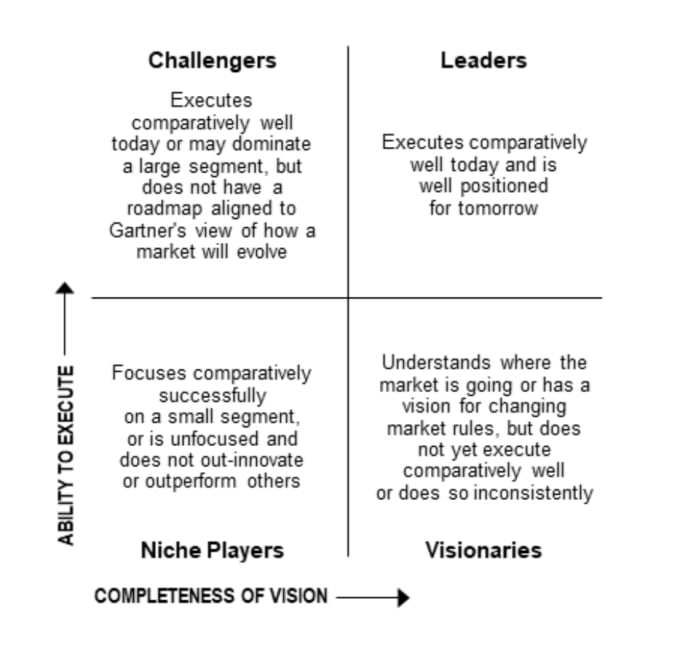
If you've heard of Gartner's Magic Quadrant, G2 reports are the crowdsourced cousin. Gartner's analysts spend months evaluating vendors and plotting them on a four-quadrant chart, an in-depth, analyst-led assessment. G2 builds its version algorithmically from user reviews, publishes it for free, refreshes it every quarter, and covers a much larger sweep of categories. Different instruments, aimed at the same buyer question: who leads this space?
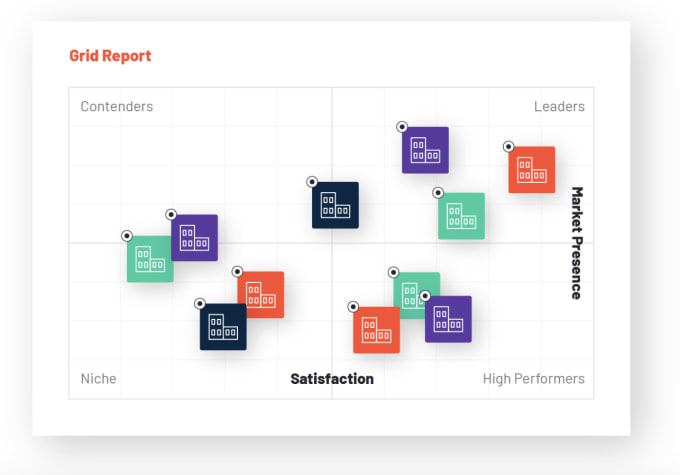
Every quarter, G2 takes a snapshot of review data and generates ranking reports for each software category. The main report is the Grid, a chart plotting products on Satisfaction (review scores) versus Market Presence (review count, company size and revenue, and web presence). Products land in one of four quadrants: Leaders, High Performers, Contenders, or Niche. The top two earn a badge, the images companies post on LinkedIn every quarter. Grid badges require a paid G2 profile to display on your website, though the placement itself is earned through reviews. The badge is the main practical output: third-party validation for sales decks, websites, and marketing.
G2 doesn't publish one report per category. For each category, G2 generates the main Grid, plus Momentum reports (tracking which products are gaining traction fastest), Index reports for specific qualities (Usability, Implementation, Relationship, Results), and slices all of these by company size and region. One category can produce a dozen or more reports. Categories also nest, and each level publishes its own Grid: a product in AI Agents for Business Operations is eligible for that Grid, for the AI Agents Grid above it, and for the Agentic AI Grid above that. So the headline report count multiplies twice over, once across report variants and again up the category tree. Across the accounts we manage, a single-product company in two to five categories typically appears in a few dozen reports, and "we appear in 30 reports" is a less impressive number than it sounds.
Fall 2026: Agentic AI tripled its intake
The headline number in the Fall 2026 cycle is Agentic AI, which added close to 75 products against an average of about 25 a quarter over the year before. We went back a full year, to the Fall 2025 reports, and lined up every quarter in between to see whether anything like it had happened before. It hadn't.
A year of AI categories, in one table
Every quarterly announcement since Fall 2025 has said some version of "AI categories are growing fastest." That's true, and on its own it's not much use to a vendor choosing where to compete. Here is what the announcements say when you put them side by side.
| Reports | Released | Fastest-growing category | Agentic AI (parent) | AI Agents (inside it) | Other AI categories on the list |
|---|---|---|---|---|---|
| Fall 2025 | Sep 10, 2025 | E-Commerce | +22 | +18 | AI Sales Assistant +13, AI Customer Support Agents +11 |
| Winter 2026 | Dec 3, 2025 | E-Commerce | +24 | +16 | AI Chatbots +11, AI Content Creation Platforms +11, AI Agent Builders +11 |
| Spring 2026 | Mar 17, 2026 | Agentic AI | +30 | +26 | AI Agents for Business Operations +15, AI Customer Support Agents +12, Answer Engine Optimization (AEO) +12 |
| Summer 2026 | May 26, 2026 | Agentic AI | +26 | +21 | AEO +14, AI Sales Assistant +11 |
| Fall 2026 | Aug 25, 2026 | Agentic AI | +74 | +70 | AI Agents for Business Operations +25, AI Sales Assistant +17, AI Video Generators +17 |
Product counts are new products added to the category that quarter, as reported by G2 in each announcement. "New" means new to the category: either a product that did not exist before, or an existing one that was not in this category and became eligible for it.
One caveat before reading anything across a row: G2's list mixes parent categories with their own subcategories and does not say which is which. AI Agents sits inside Agentic AI, and AI Agents for Business Operations sits inside AI Agents, so those three Fall 2026 entries are one family at three depths. Synthetic Media and AI Video Generators are a second such pair. The five AI slots G2 counts in this quarter's top ten are two families, which is worth knowing when the announcement says AI categories make up half the list. Comparing a column down the years holds. Adding figures across a row double-counts.
Agentic AI has appeared on the fastest-growing list in every one of the last five quarters, and so have E-Commerce and Governance, Risk & Compliance. What separates it is the top slot, which it has now held for three consecutive quarters. G2's own framing of this quarter's list is that AI categories make up half of it, "including several agent-focused categories."
For the four quarters before this one the count stayed between 22 and 30. Fall 2026 broke the pattern, at roughly triple the pace it had been keeping.
So the crowding arrived this quarter, compressed rather than spread across the year the table covers. G2's count does not separate genuinely new products from existing ones becoming eligible, and that distinction matters for who you end up ranked against: a vendor repositioning into Agentic AI arrives with the review base and the market presence it already built somewhere else.
For a vendor, that makes AI Agents a hard place to earn a placement, and harder this quarter than last. It already holds more than 3,300 products, and the field now spans everything from single-feature startups to the largest platforms in software (we compare how the best-known AI agents are reviewed across directories), which means Market Presence is doing a lot of the separating. That axis rewards the companies that were already large. Agentic AI, the category above it, publishes a Grid too, and is wider still.
Two ways out of the crowd
The first is to go narrower inside the family you are already in. AI Agents for Business Operations sits under AI Agents and holds roughly half as many products, so one step down the tree materially narrows the field you are sorted against. It is the cheapest move available, because it needs no new product story, only that G2 has you categorised one level down.
The second is to look at an AI category in a different part of G2 entirely. While the agent categories absorb the volume, G2 has been minting AI categories of a completely different shape. The eight new categories G2 introduced in July 2026 include Agentic Financial Crime (AI-driven financial crime workflows with human-in-the-loop review), AI Integration Tools Platforms (platforms that let AI agents discover, authenticate with, and act inside business software), and Red Teaming Tools (adversarial testing that stress-tests AI models for vulnerabilities before launch). Emily Malis Greathouse, G2's Director of Market Research, framed the shift in buyer questions this way: "The question used to be 'should we be doing something with AI?' Now it's 'which vendors have actually rebuilt around it, and which ones have just added a feature and moved on?'"
Categories like these are where placement becomes most reachable once they mature. A category needs 6+ products with 10+ reviews each, and 150+ total reviews before it becomes Grid-eligible at all, so a newly introduced one cannot issue a placement yet. It sits close to that line, though, and a category that has just crossed it is fielding six to a dozen products with enough reviews to rank, not hundreds. Which of them are competitive already is not something you can read off a category page. A vendor with a real product and a working review process can land in the top quadrant of a category like that. In AI Agents, with its 3,300-plus products, the same vendor is a dot in a crowd.
The list of products that climbed all the way into first place in their category is as telling for what is absent from it. G2 names twelve climbs across eleven products, with the category given in each case, and the categories are uniformly specific ones: AI Agents for Business Operations, Talent Intelligence, Email Security, Cloud Edge Security, Document Databases, Cross-Border Payment Software, Microlearning Platforms. Neither Agentic AI nor AI Agents produced one of the quarter's big climbs. Every product G2 highlights vaulted from rank 10 or worse, and none did it in the two categories absorbing the most new entrants.
Notion leads that list, up from the low forties to first in AI Agents for Business Operations in one quarter, and it is worth reading carefully rather than as a playbook: G2 publishes neither that category's product count nor its review distribution, so a jump of that size is as consistent with a very large product becoming newly eligible and arriving with the market presence it already had as it is with sustained review collection.
Answer Engine Optimization (AEO) shows both halves of this: a specific category is where a placement is winnable, and the window for winning it is short. AEO software helps companies track whether AI systems like ChatGPT and Perplexity are recommending their product. The category launched in March 2025 with fewer than 10 products, became report-ready in the Winter 2026 cycle, then climbed to tenth on the growth list in Spring and third in Summer. This quarter it is off the top-10 list entirely, which puts its intake at or below the 17 that took the last places on it. Profound, an AEO platform, was the only Leader on that first AEO Grid, and announced a $96M Series C at a $1B valuation two months later, under two years from founding. We walked through the mechanics in our Profound case study. That outcome required being early in a category that was still small enough to lead, and the categories that were small enough to lead in Winter are not the ones that are small enough now.
Seventeen categories became report-ready this quarter, at the top of a range that has swung between six and sixteen over the last year. Five are AI or AI-adjacent: AI SDK, AI AppSec Assistants, Large Language Models (LLMs), AI Security Posture Management (AI-SPM) Tools, and Non-Human Identity Management (NHIM) Solutions, the last of which covers identity governance for AI agents and service accounts. Six categories became report-ready in Summer 2026 and none of them were AI. This quarter's five is back in line with Winter 2026, which had six.
One entry on that list is pointed at G2 itself. Large Language Models became report-ready this quarter, so G2 now publishes a Grid ranking the same systems that increasingly read review platforms when generating software recommendations. That reaches products with nothing to do with AI: your reviews and your category placement are part of what those models read when a buyer asks what the best tool for X is, which we took apart in how directories feed AI search.
What else the Fall 2026 data tells you
The Leader squeeze. 2% of products and services on G2 earned a Leader badge this quarter. A year ago, in Fall 2025, it was 3%, and it held at 3% through Winter and Spring before dropping to 2% in Summer 2026. The same caveat applies every quarter: that percentage is calculated against G2's entire product pool, which includes a long tail of dormant profiles with few or no reviews. The more useful number, what share of Grid-eligible products (those with 10+ reviews in a category) earn Leader, isn't part of the announcement. The share stepped down once in the last year, from 3% to 2% in Summer 2026, and has stayed there. G2 rounds to whole percentages, so how large that step actually was is not knowable from the announcements.
Several of the new report-ready categories name a buyer and a task. Alongside those five, the other twelve run to Zero Trust Platforms, Network as a Service (NaaS) Platforms, Software Design Platforms, Call Compliance, Cloud GTM Platforms, Entity Management, Other GRC Tools, Population Health Management, Relocation Management, Apparel Business Management and ERP, Nutritionist, and Pet Sitting and Daycare. Relocation Management and Pet Sitting and Daycare name a buyer and a task, which is the shape of a category a specific vendor can own.
G2 owns Capterra, Software Advice, and GetApp. G2 closed that acquisition in February 2026, buying the three platforms from Gartner for roughly $110 million. Since November 2026 the four sites share one reviews system, and G2 says a new review started on Capterra, GetApp, or Software Advice can count toward G2's Grid and reports. Each site keeps its own category-ranking rules, and there is no public answer yet on badges or category structure. Nine months on, the reports still work the way they did before the deal. Any multi-quarter category plan is being made without knowing what that taxonomy will look like.
Making sense of G2's ranking tables
G2's announcement includes several of these tables. Here's what they measure.
"Companies with most reports" - Microsoft leads with more than 5,300, then Zoho at almost 4,800, Salesforce above 4,200, Google just under 4,000, and SAP around 3,500. This ranks product portfolio breadth. These companies have dozens or hundreds of products, each generating reports. For scale, Microsoft's total has climbed from under 5,000 a year ago to more than 5,300 now, and Salesforce added almost 280 report inclusions this quarter alone, more than any other company. If you're a single-product company, this table measures a different game than the one you're playing.
"Products with most #1 rankings" - Google Workspace leads with almost 380, followed by NinjaOne, HubSpot Marketing Hub and Canva all above 300, and Slack above 260. This table is dominated by widely adopted products, because Market Presence gives larger companies a structural advantage.
"Top products by G2 Score" - Adobe Photoshop takes the top spot at almost 99, with Microsoft SharePoint, Visual Studio Code, Salesforce Customer Success and Adobe Illustrator all above 97. The G2 Score blends satisfaction and market presence across all of a product's categories, so it ranks differently from the per-category #1 list. That table reflects a product's best score in a single category. Your badge comes from your placement in the categories you are actually in.
Most improved: Project Insight climbed more than 150 spots inside Project Management, and Hotjar by Contentsquare climbed more than 130 inside Survey. Summer 2026's most improved was Attio, up more than 140 spots inside CRM. The same caution applies to why these happen, but the unit is the right one: a category, a quarter.
What matters for most vendors: your placement in the Grid quadrant for your specific categories. That determines your badge. A smaller company with strong reviews typically lands as a High Performer, high satisfaction with lower market presence, which is a meaningful and realistic target.
Earlier quarters
Summer 2026
G2 released its Summer 2026 Reports on May 26, 2026: 27,340 reports across 1,363 report-ready software categories.
The Leader squeeze keeps tightening. Only 2% of products on G2 earned a Leader badge this quarter, down from 3% in the Spring 2026 reports and 4% in Spring 2025. Same caveat as last quarter: the 2% is calculated against G2's entire product pool, which includes a long tail of dormant profiles with few or no reviews. The more useful number - what percentage of Grid-eligible products (those with 10+ reviews in a category) earn Leader - isn't part of the announcement.
The trend is what matters here. Even if the underlying math is similar quarter to quarter, the headline number keeps moving in one direction. The total pool grows faster than the Leader slots do. If you're aiming for a Leader badge, category choice matters more this quarter than last.
AI categories still dominate growth - and the mix is shifting toward sales and marketing. Among the fastest-growing categories: Agentic AI (+26 products), AI Agents (+21), Answer Engine Optimization (AEO) (+14), and AI Sales Assistant (+11). AEO - software that helps companies track whether AI systems like ChatGPT and Perplexity are recommending their product - continues its run; the category launched in March 2025 with 7 products and grew to more than 150 by January 2026. Profound, an AEO platform and the only Leader on G2's first-ever AEO Grid in Winter 2026, went from launch to $1B valuation in under two years on the strength of that positioning - we walked through the mechanics in our Profound case study.
AI Sales Assistant joining this list is new. Last quarter the AI growth was concentrated in horizontal infrastructure (Agentic AI, AI for Business Operations, AI Customer Support). Now a sales-specific AI category has cracked the fastest-growing list - AI is moving into category-specific roles, and G2's taxonomy is keeping pace.
OpenAI just became the newcomer on G2's list of top-scored companies this season. That roster has historically been long-running enterprise software makers, so an AI-native company landing there stands out. It's also a small meta moment: G2 separately launched a Large Language Models category, which means G2 now ranks the same systems that increasingly pull from review platforms when generating software recommendations. A Semrush study G2 has referenced puts G2 among the top 20 most-cited domains in LLM responses, so the loop applies whether or not your product touches AI. Your reviews and directory placement are part of what those models read when buyers ask "what's the best tool for X." We wrote about how that works. For the inverse problem (an incumbent trying to reposition into AI but blocked by the categories on the shelf), see our teardown of Miro's category positioning.
Six new categories became report-ready. Among them: Zero Trust Platforms, Software Design Platforms, Population Health Management, Investor Reporting, Auto Shop Management, and Yard Management. When a category first becomes report-ready, few products have badges - earning a placement is meaningfully easier than in a mature category with hundreds of competitors. Whether to anchor your strategy on a new category is a separate question; some are stepping stones, some are dead ends.
The Summer 2026 ranking tables
"Companies with most reports" - Microsoft (5,181), Zoho (4,556), Salesforce (3,941), Google (3,734), SAP (3,434). This ranks product portfolio breadth. These companies have dozens or hundreds of products, each generating reports. Adobe added 704 reports this quarter - the largest single-quarter jump in the top 10 - which reflects more Adobe products qualifying in more categories. If you're a single-product company, this table measures a different game than the one you're playing.
"Products with most #1 rankings" - Google Workspace (383), Canva (327), HubSpot Marketing Hub (297), Slack (293), NinjaOne (293). Dominated by widely adopted products with large Market Presence scores. G2's Market Presence axis weighs employee count and revenue, which gives larger companies a structural advantage for #1 rankings.
"Top products by G2 Score" - Microsoft SharePoint (98.63), Adobe Photoshop (98.57), Visual Studio Code (98.51), Salesforce Customer Success (98.28), Articulate 360 (97.79). Looks different from the #1 rankings because it's calculated differently. Articulate 360, an e-learning authoring tool, sitting at #5 on this list is a good reminder: a smaller product can outscore household names when its review base is concentrated and strong.
Most improved: Attio, a CRM, climbed 143 spots inside its category. CRM is one of G2's most contested categories, so the move stands out. The pattern - concentrated review collection inside a single category - is the one most vendors use when competing for placement.
Spring 2026
G2 released its Spring 2026 Reports on March 17, 2026: 27,019 reports across 1,351 software categories.
The Leader badge is getting scarcer. G2 says only 3% of products earned Leader status this quarter, down from 4% in their Spring 2025 announcement. The denominator is important here: G2 calculates the share against all "the software products and services on G2," a pool that includes every listed product whether or not it has enough reviews to qualify for a Grid. (The Spring 2025 announcement put that pool at 190,029 products and services.) G2 doesn't publish what percentage of Grid-eligible products (those with 10+ reviews in a category) earn Leader, which would be the more useful number.
What this does tell you: the total number of products on G2 is growing faster than the number earning Leader badges. If you're targeting a Leader badge, the categories you choose matter - a less crowded category gives you better odds.
Five of the twelve fastest-growing categories are AI. Agentic AI added 30 products this quarter. AI Agents added 26. AI Agents for Business Operations added 15. AI Customer Support Agents added 12. And Answer Engine Optimization (AEO) added 12.
AEO is worth a closer look. This category launched in March 2025 with 7 products and grew to over 150 by January 2026 - over 2,000% in under a year. AEO tools help companies track whether AI systems like ChatGPT and Perplexity are recommending their product. These tools exist because AI is becoming a channel for software discovery, and companies need to know whether they're being recommended. Profound - the only Leader on G2's first-ever AEO Grid in Winter 2026 - went from launch to $1B unicorn in under two years on the strength of this positioning; we walk through the playbook in our Profound case study.
G2 also created a Large Language Models category this quarter, which means G2 now ranks the same AI systems that cite G2 data when generating software recommendations. A Semrush study G2 has referenced puts G2 among the top 20 most-cited domains in LLM responses.
This matters even if your product has nothing to do with AI. AI systems pull from review platforms when buyers ask "what's the best tool for X." Your G2 reviews and directory presence are part of what they read. We wrote about how that works and what you can do about it. For the inverse problem - an incumbent trying to reposition into AI but blocked by the G2 categories on the shelf - see our teardown of Miro's category mismatch.
Sixteen new categories became report-ready. Among them: Application Security Posture Management, Data Security Posture Management, Secure Enterprise Browser, Semantic Layer Tools, and Large Language Models. When a category first becomes report-ready, few products have badges - earning a placement is meaningfully easier than in a mature category with hundreds of competitors.
G2 now owns Capterra, Software Advice, and GetApp. These reports were published after G2 closed its acquisition in early February 2026 of Capterra, Software Advice, and GetApp from Gartner for approximately $110 million. G2 has promised a unified taxonomy across all four platforms, but there's no public timeline for when that happens or what changes it brings to reports, badges, or category structure. The acquisition isn't mentioned in the Spring reports, and at the time everything worked the way it did before the deal. The Fall 2026 section above has what has changed since.
The Spring 2026 ranking tables
"Companies with most reports" - Microsoft (5,178), Zoho (4,429), Salesforce (3,993). This ranks product portfolio breadth. These companies have dozens or hundreds of products, each generating reports. Zoho's 32% jump means more Zoho products qualified in more categories - a category-spread strategy. If you're a single-product company, this table measures a different game.
"Products with most #1 rankings" - Google Workspace (407), Canva (328), Slack (303). Dominated by widely adopted products with large Market Presence scores. G2's Market Presence axis weighs employee count and revenue, which gives larger companies a structural advantage for #1 rankings.
"Top products by G2 Score" - Visual Studio Code (98.52), Microsoft SharePoint (98.29). Looks different from the #1 rankings because it's calculated differently. Your category-specific Grid placement matters more than your global G2 Score.
What to do next
The starting point is knowing where you are listed, which categories you sit in, how many reviews you have, and whether there are badges you have earned without knowing it.
Blastra checks this for you. A security team we recently onboarded discovered a SourceForge Leader badge they didn't know about, and listings being managed by people who'd since left the company.
If you want to earn a G2 badge: you need at least 10 reviews in a category to appear on the Grid, and a clean way to collect them, since incentivized or gated review asks can get flagged. G2 runs four collection cycles a year. Winter 2027 collection closed on November 3, 2026, and those reports publish December 1, 2026; G2's research agenda lists the deadline for the cycle after it. Spend the first week of any cycle on category selection: pull the list of categories your product could plausibly sit in, check how many products in each already have 10+ reviews, and aim at the narrowest one that still describes you accurately. Creating a category is an option if nothing fits. Aim for High Performer first; Leader is a longer game.
If you're already earning badges: consider diversifying across directories. With Capterra, Software Advice, and GetApp now inside G2, more of the discovery surface sits in one ecosystem. Presence on TrustRadius, PeerSpot, Gartner Peer Insights, and SourceForge is a hedge, and we keep a running comparison of the platforms that work as G2 alternatives. AI systems cite multiple sources when recommending software, so a wider reviewed footprint widens the surface they read from.
If managing all of this sounds tedious: it is. That's what we do.
Know where you stand across every directory
Blastra scans your presence on G2, Capterra, SourceForge, and dozens of other platforms - and shows you what's there, what's missing, and what to do next.
Or you can try navigating the Grid yourself. Dodge bad reviews, land in the right quadrant, earn the badge, all in 90 seconds.
BADGE SWEEPER
Navigate the grid. Dodge the bad reviews.
Click any cell in Ok to start. Right-click to flag. Long-press on mobile.
This page references G2's Spring 2026, Summer 2026 and Fall 2026 Reports announcements (published March 17, May 26 and August 25, 2026), the Fall 2025 and Winter 2026 announcements, and G2's publicly available scoring methodology documentation. Each quarter's numbers reflect the data as G2 published it at the time and may change as reports are updated. Rankings and positions described here reflect how products are represented in G2's published reports, not Blastra's assessment of product quality. Blastra is not affiliated with, endorsed by, or sponsored by G2, Gartner, or any product named on this page; trademarks, logos and brand elements belong to their respective owners, and the Magic Quadrant diagram is Gartner's. GARTNER is a trademark of Gartner, Inc. and/or its affiliates.
Related
- How to Earn G2 Badges in 2026 - Badge requirements, paid vs. free profiles, review thresholds and each cycle's deadlines
- How G2's AI Categories Work - AI categories on G2 and what they mean for your listing strategy
- How to Get Ranked on G2 - G2's scoring algorithm, Grid placement mechanics, and review thresholds
- How to Create a New Software Category - What it takes when no existing category fits
- G2 and Capterra After the Acquisition: A Vendor Guide - What changed for vendors, what did not, and where to focus reviews now
- How G2 Is Building G2.ai Into an Expertise Marketplace - G2's open-beta bet on AI workflows, beyond the Grid and badges
- 25 Software Badges Decoded - Requirements for badges across G2, Capterra, SourceForge, TrustRadius, PeerSpot, and Gartner