

The Trustpilot rebrand reached the trade press last week. The branding magazine Transform reported on 27 October, and the UK design trade title Design Week on 30 October, that the London agency Further had built the review platform a new identity system out of the geometry of its existing star.
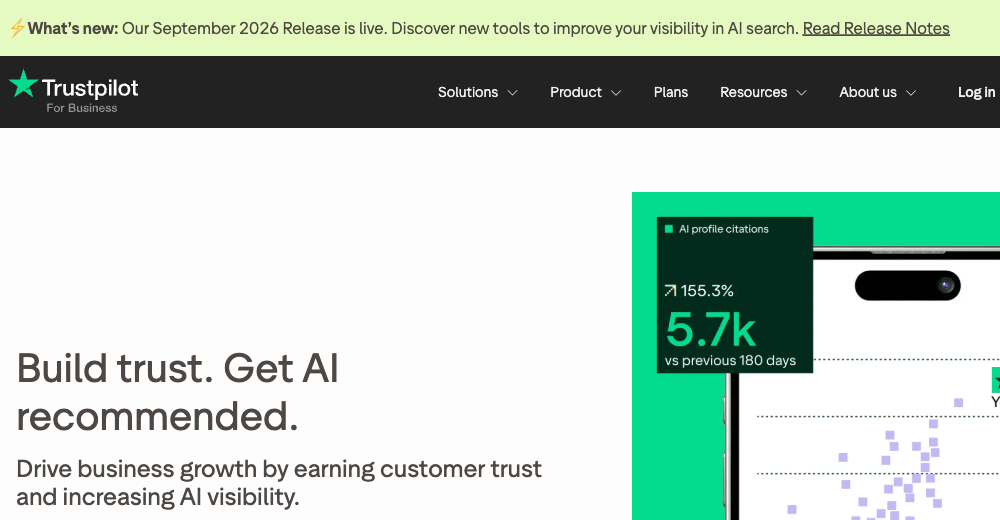
The business change came first. Since at least August, the headline on the page Trustpilot uses to sell to businesses has read "Build trust. Get AI recommended." (it is already there in the Internet Archive's capture of 6 August 2026). Trustpilot now sells companies data on how often AI tools such as ChatGPT cite them. For a software company, that raises a practical question: when buyers ask AI about you, when does the answer come from Trustpilot? We put 90 questions to three AI engines to find out.
What the new Trustpilot identity looks like
Further's case study breaks the familiar star into a modular system of blocks and frames that hold reviews, photography and headlines, all set in Trustpilot's own typeface, Trustpilot Sans. The photography moves to candid, everyday shots. Design Week reports the brand's new line as "Take everyone else's word for it", and reads the project as a move "from Trustpilot as a passive evaluation badge to an active, brand-led technology platform". That reading is Design Week's own; the identity has so far been presented by the agency and the trade press rather than in a Trustpilot announcement.

The identity serves a strategy Trustpilot has named for years: "Trustpilot Everywhere", described in its FY2025 preliminary results (March 2026) and in its results back to at least FY2023. CEO Adrian Blair put the current ambition in one line on LinkedIn on 15 September 2026: "We're building the essential trust infrastructure for the age of AI."
What Trustpilot now sells businesses: AI search data
Two releases this year built the product side:
- April 2026: AI Search Analytics, an AEO (answer engine optimization) feature that Trustpilot says shows "how often you're being surfaced by platforms like ChatGPT, Claude, and Perplexity". The launch announcement called it "the first phase of a broader roadmap".
- 24 September 2026: an "AI discovery suite", described as the second phase. It includes AI Search Market Insights, which lets a business "compare how often AI platforms cite your Trustpilot profile versus competitors"; Product Review Pages; and Trustpilot AI (Beta), an assistant and MCP (Model Context Protocol, the standard that lets AI tools plug into outside data) service that "works within Slack, CRM platforms, and LLMs", offered to Enterprise customers in a limited beta.
The business homepage sums up the bet in two lines: "What AI says about your brand depends on what customers say about you," and "Don't let AI engines write your brand narrative without you." The bet is that more buyers meet an AI answer before a pricing page, and that a review platform should be part of that answer and measure it.
Why AI engines cite Trustpilot so often in the first place is a story we covered in March. Selling that measurement puts Trustpilot in the same market as the AI search tracking tools we compared earlier this year.
Trustpilot vs G2 in AI answers: where it fits for software
A measurement helps only if it counts the questions your buyers ask, so we asked them. On 1 November 2026 we put two questions about each of 15 software vendors to ChatGPT, Perplexity and Gemini, with web search on. One asked about the product (features, ease of use). The other asked about the company (billing, cancellation, support). Ten of the vendors, which we grouped as consumer-adjacent, sell heavily to individuals and small teams: Pipedrive, HubSpot, Wix, Webflow, monday.com, Mailchimp, Zoom, Canva, Dropbox and Grammarly. Five sell to enterprises: Datadog, Snowflake, Okta, Workday and ServiceNow. Then we counted which platforms each answer cited. G2 and Capterra, two of the biggest software review sites, have both been owned by G2 since its acquisition of Capterra closed in February.
| Vendors and question | Trustpilot | G2 | Capterra |
|---|---|---|---|
| Consumer-adjacent, product | 7 of 30 | 25 of 30 | 24 of 30 |
| Consumer-adjacent, company | 30 of 30 | 3 of 30 | 2 of 30 |
| Enterprise, product | 2 of 15 | 12 of 15 | 14 of 15 |
| Enterprise, company | 12 of 15 | 9 of 15 | 13 of 15 |
Answers citing each domain, subdomains included. Blastra scan, 1 November 2026: ChatGPT, Perplexity and Gemini with web search, one run.
On company questions about the consumer-adjacent vendors, Trustpilot was cited in every answer, 10 of 10 on each engine. The Better Business Bureau, the US nonprofit that collects consumer complaints, and Reddit came next, and G2 appeared in 3. Ask about the same vendors' products and the picture turns around. Broad category questions, such as the best CRM for a small business, behaved like product questions: G2 in 9 of 15 answers, Trustpilot in 2. For enterprise vendors, Capterra and G2 share the company questions with Trustpilot, and the analyst firm Gartner and the review sites TrustRadius and PeerSpot appear more often than for the consumer-adjacent vendors. AI answers draw on several sources at once.
The company result is no surprise once you look at how Trustpilot is built. A Trustpilot profile is a company profile, keyed to a domain, and its reviews are about the experience of dealing with that company: billing, delivery, support, cancelling. G2 and Capterra are organized around products and categories, with reviews that ask about features. Trustpilot's new Product Review Pages add a product layer, but they are pitched at physical and consumer products ("fit, quality, and performance", in Trustpilot's words), not software. Whether a software product layer follows, we do not know yet.
Three limits apply. This is one run on one date, and AI answers vary from run to run. The vendors are well-known brands we chose; a smaller vendor with a thin Trustpilot profile may see different results. The company prompt names billing, cancellation and support, which is the ground Trustpilot reviews tend to cover, so the wording favors Trustpilot.
Blastra takes care of your Trustpilot reputation
We claim and manage your Trustpilot profile and respond to your reviews, starting with the billing and support complaints AI quotes. We keep your G2, Capterra and other directory listings current too, so what AI says about your company and your product stays accurate.
What this means for a software company
If your buyers ask an AI whether you are a safe company to buy from, how billing works or whether they can cancel, our scan suggests much of that answer comes from Trustpilot, whether or not anyone on your team has looked at the profile. Trustpilot profiles can exist as an unclaimed profile before anyone takes ownership, which is how an unmanaged listing becomes a liability. It is common. Of the 714 software products scanned through Blastra between June and October 2026, 379 had a Trustpilot profile, and of the 262 profiles where we could tell, 78 had not been claimed by the company. To check yours, open trustpilot.com/review/ followed by your domain.
Two jobs keep the company side of your reputation current. Claim the profile (our claiming guide covers the steps), then reply to reviews, starting with the billing and cancellation complaints, since those are what a buyer, and an AI answer, finds there. Replying is free on Trustpilot. Our guide to handling software reviews covers how to answer them, or Blastra can manage the profile and the replies for you.
If your buyers weigh features through a shortlist and procurement, G2 and Capterra still carried the product side in the answers we collected, after the rebrand. Our Trustpilot directory page sets out how the platform works for software companies, and these are the alternatives if your buyers review elsewhere.
Before paying to track how often AI cites your Trustpilot profile, ask Trustpilot which questions it counts, and whether any of them are about your product rather than your company. On our scan, Trustpilot's citations cluster on company questions. That is where Trustpilot's own warning, "Don't let AI engines write your brand narrative without you", applies most.
FAQ
Did Trustpilot change its logo?
The coverage of the October 2026 identity describes a design system built from the existing star's geometry, with new copy set in Trustpilot Sans, and mentions no logo change.
What is Trustpilot AI Search Market Insights?
A feature from Trustpilot's 24 September 2026 release that lets a business compare how often AI platforms cite its Trustpilot profile against competitors' profiles. It builds on AI Search Analytics, launched in April 2026, which tracks how often a business is surfaced in tools such as ChatGPT and Perplexity.
Does AI cite Trustpilot or G2 for software?
Both, for different questions. In our 1 November 2026 scan, product questions about consumer-adjacent software cited G2 in 25 of 30 answers and Trustpilot in 7. Questions about billing, cancellation and support for the same vendors cited Trustpilot in all 30 and G2 in 3. For five enterprise vendors, company questions cited Trustpilot in 12 of 15 answers, alongside Capterra and G2. It is one run, so read it as a snapshot.
Can someone manage our Trustpilot profile for us?
Yes. Blastra claims and manages Trustpilot profiles for software companies and responds to reviews on their behalf, alongside their G2, Capterra and other directory listings. If you prefer to do it in-house, claiming and replying are free on Trustpilot's own plan.
Should software companies pay for Trustpilot's AI search tools?
Decide by question type. If your buyers ask AI about you as a company, our scan found Trustpilot cited in most of those answers, and measuring that can be worth paying for. If they mostly ask about features, G2 and Capterra carried more of the answer. Trustpilot's general plans and prices are in our Trustpilot guide; confirm with Trustpilot which plan includes the AI tools.
How we ran the scan
We queried ChatGPT (gpt-5.4), Perplexity (sonar-pro) and Gemini (gemini-3.5-flash requested; the API reported gemini-3.6-flash) through the LLM Responses API from DataForSEO, an SEO data provider, with web search on, in a single run on 1 November 2026. The product prompt was "Is {vendor} a good choice for a small team? What do user reviews say about its features and ease of use?" The company prompt was "Is {vendor} a trustworthy company to buy from? What do customers say about its billing, cancellation and customer support?" Fifteen vendors, two prompts and three engines give the 90 answers in the table; five broad category prompts added 15 more, reported separately above. An answer counts as citing a platform if any citation URL sits on its domain, subdomains included. Gemini returns redirect links, so for Gemini we read the domain from the citation title. We counted citations only; ratings and review text were outside the count. Blastra manages directory listings and review profiles for software companies, so we have an interest in where AI answers come from. Blastra is not affiliated with, endorsed by or sponsored by Trustpilot, G2, Capterra or any other platform or vendor named in this post; the Trustpilot screenshot and Further's identity image are shown for commentary. All figures are point-in-time and may change. If you spot an error, contact us and we will correct it.