


Update (October 4, 2026): ai.g2.com has kept changing since this June walkthrough. The homepage now reads "Trusted AI software intelligence" and adds a third section, Agents, where G2 tests AI agents by giving them real work and publishes the results, next to Blueprints and Experts. The Blueprint library has grown to 576, and its entry point is now a "Find My Blueprint" button that matches your problem to a Blueprint. The site still carries a Beta label, and we have not found a formal announcement of it on G2's news page. The walkthrough below describes the site as it was in June.
AI has shaken lots of business models, software directories included. Traditionally, those tool catalogs (Capterra, G2, SourceForge, TrustRadius, and others) used to dominate search results, allowing buyers to discover and compare tools. This used to bring vendors attributable leads. With the software research process shifting to AI, those sites still play a major role in discovery, but the credit, if attributable at all, now often goes to AI. A user who admits "AI recommended your solution to me" does not know that the AI chat assistant was trained on SourceForge data or trusted Capterra's reviews. So while being a critical trust and discovery layer, many directories are in a difficult place where they have to prove themselves and make sure they survive the shift we are going through.
An Invisible Data Provider or the Decision-Making AI?
So far, G2 has been the best at marketing itself (and the entire directory segment) as an essential component in the AI discoverability puzzle. But it seems that surviving as a mere data provider in a world where AI assistants from other companies make decisions is not exactly their aspiration.
In June 2025, among their various AI initiatives, G2 briefly mentioned G2.ai as part of its push to rebuild software buying for an AI-first era. The announcement promised that buyers would be able to look for software in natural language.
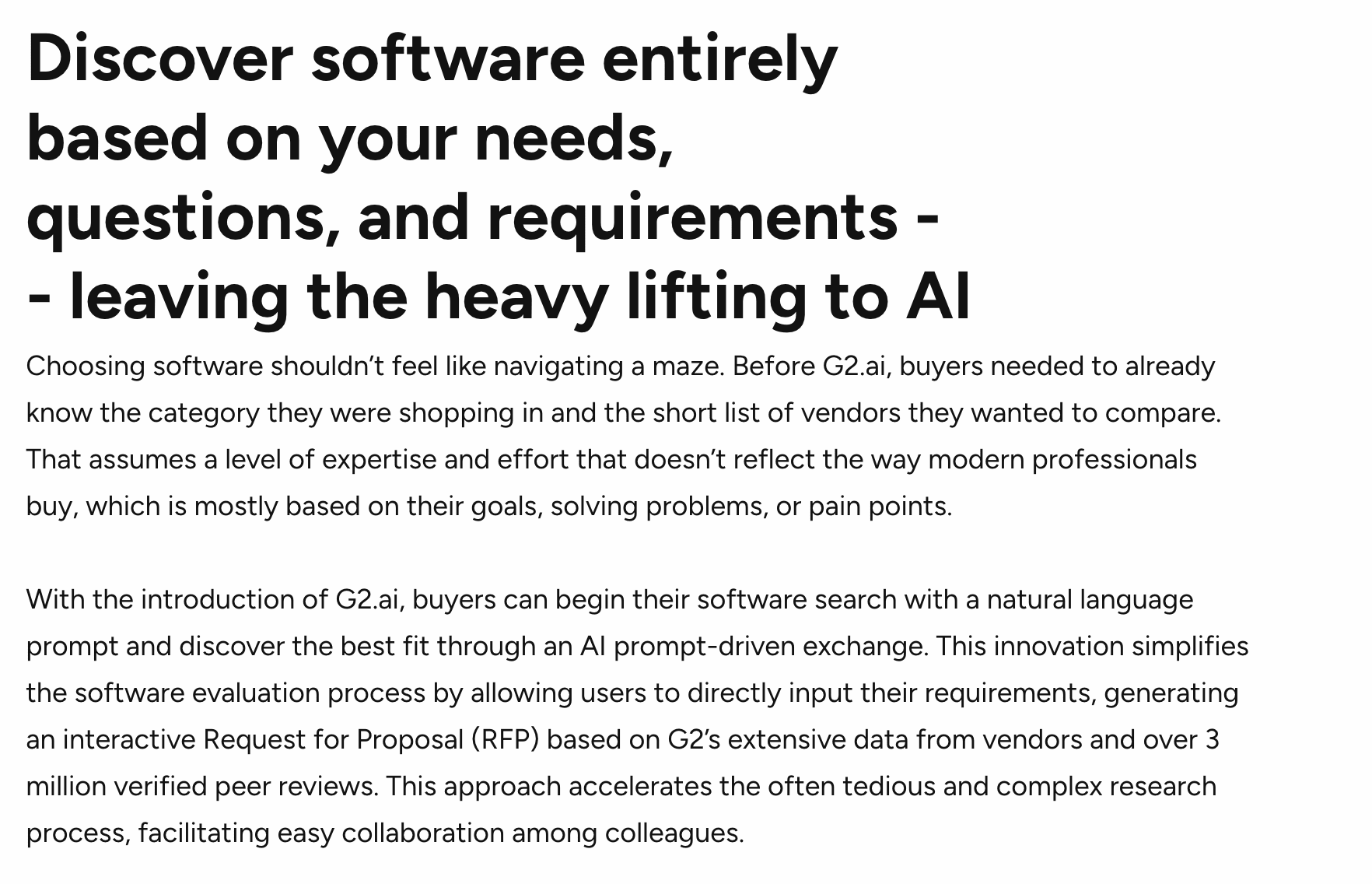
A year later, buyers are indeed looking for software in natural language (according to G2's own research), just not on G2.ai but in chats owned by major LLM labs. I got curious if G2 still had the ambition to fight for the decision-making role with G2.ai. They do. Even more so: the concept has evolved, and when they say they want to revolutionize the software buying process, they mean it.
The New G2.ai: Build and Find Expert AI Workflows
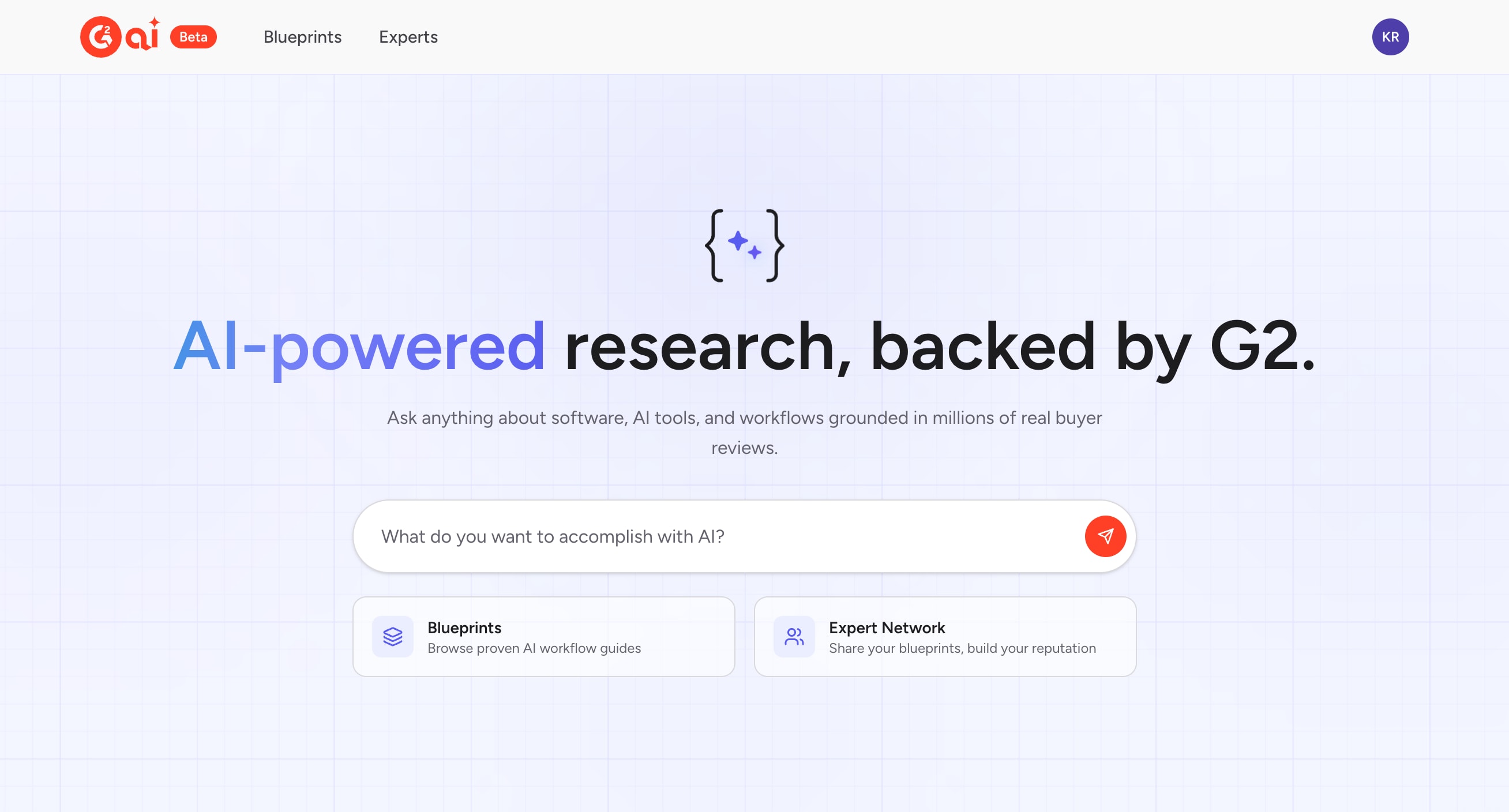
G2's business lives on G2.com, the directory site. G2.ai is a different domain, which redirects to ai.g2.com and features a completely different platform. Essentially, it is still a playground. When you enter the website, the feeling is almost like you shouldn't be there, but it's all out in the open, so clearly it's a bold, deliberate choice, just as the vision behind it.
The new site is called AI Blueprints, and unlike G2.com, where buyers come for software tools, here they come for AI workflows. Those workflows are called Blueprints (or sometimes Playbooks), and they aim to solve real business problems. The Blueprints are the central pieces of the new marketplace: a user can build a blueprint and share it, or use what others built.
Nodes come from G2's database. It seems that for now there's still a lot of dummy data, but since G2 now owns Capterra, GetApp, and Software Advice, I suppose all the listings will be turned into a giant joint catalog.
How and What Works Today
It seems that the G2 team has been actively building the platform: there is a library of 500+ Blueprints, created by employees in May and June. The blueprints range from "Reverse-Engineer the PRD From Any Figma Design" by Neil Kawde, a product designer at G2, to an executive contact-memory skill for utilizing your relationship capital with an AI agent, by Godard Abel, the company's co-founder and CEO. Those blueprints have SKILL.md and other files attached, ready to run in your environment.
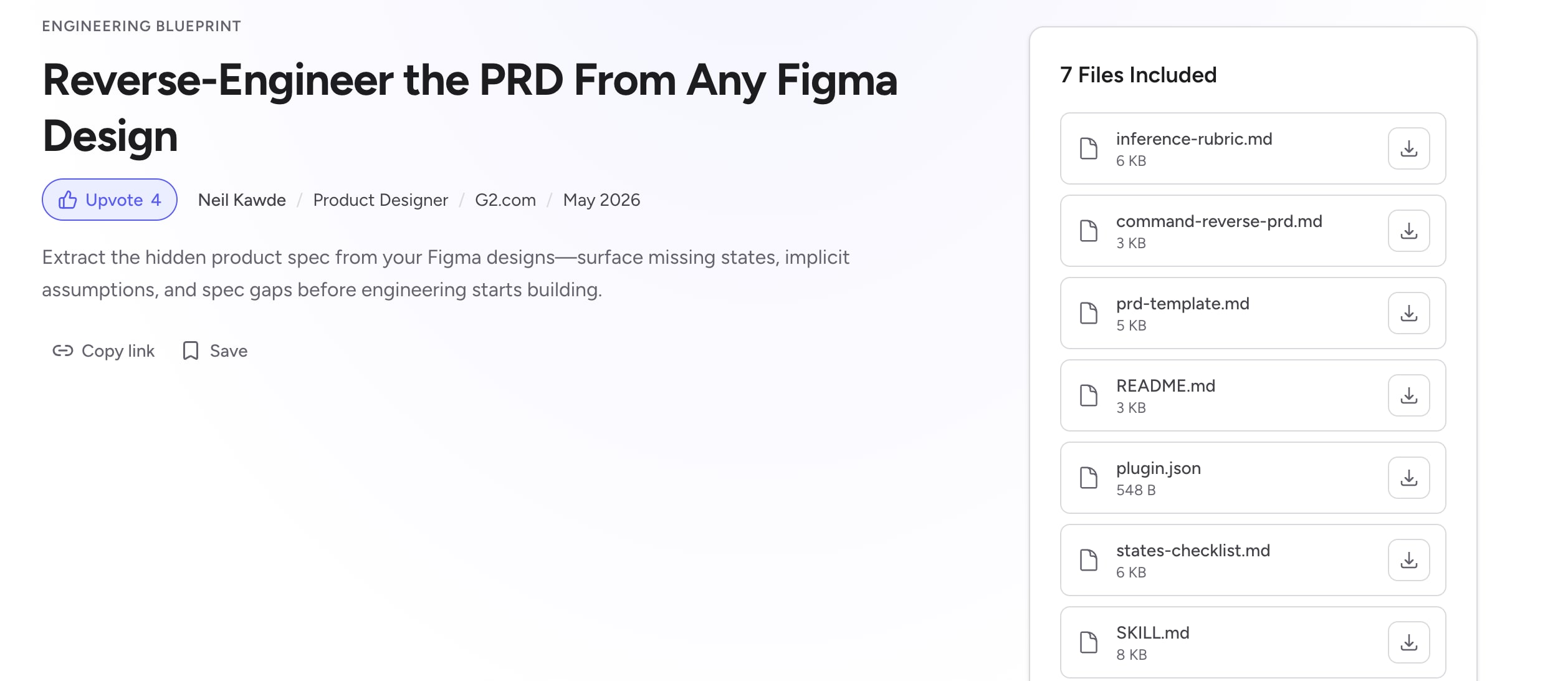
I couldn't quite figure out why, but it seems blueprints come in two types: the ones like above, where tools are simply named, and the ones with software products as nodes.
For the latter, the builder opens with a question:
- "What problem do you want to solve?"
- "cannot see if we are visible in ai"
Two more questions follow, both about you: which areas of work apply (writing, research, automation, data, and six others), and your setup, meaning team size, primary goal, and monthly budget. Then a button: "Build my Blueprint."
What comes back is a numbered workflow where each step is a product pulled from G2's catalog — organized by the AI categories G2 uses to classify software — with an explanation of why it sits at that step, written against the problem and budget you typed in. Every node lists alternative tools with a "Swap" button, and a dashed box at the bottom offers "+ Add another step."
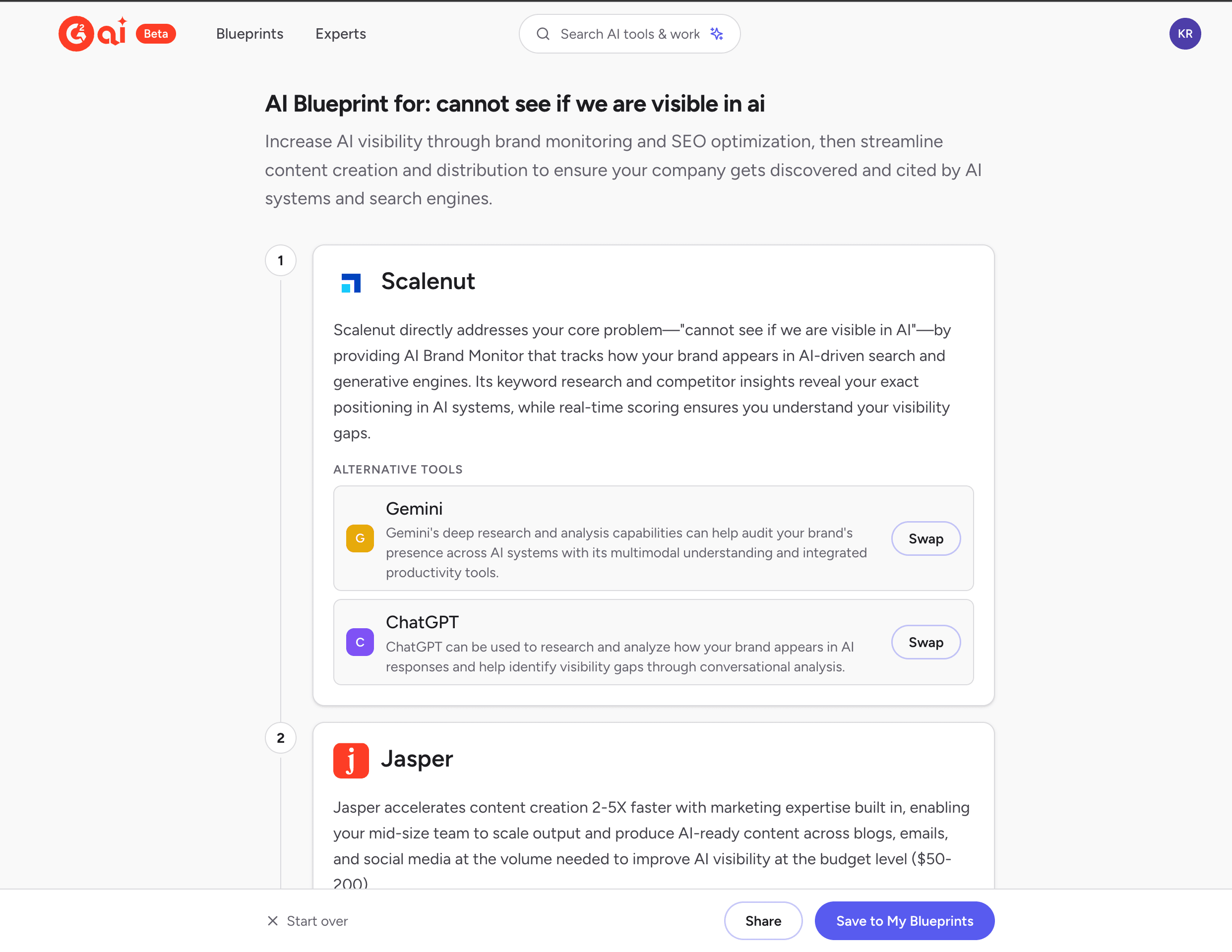
At the bottom of the result, after "Save to My Blueprints" and "Share," the site asks: "Have you actually implemented this workflow?"
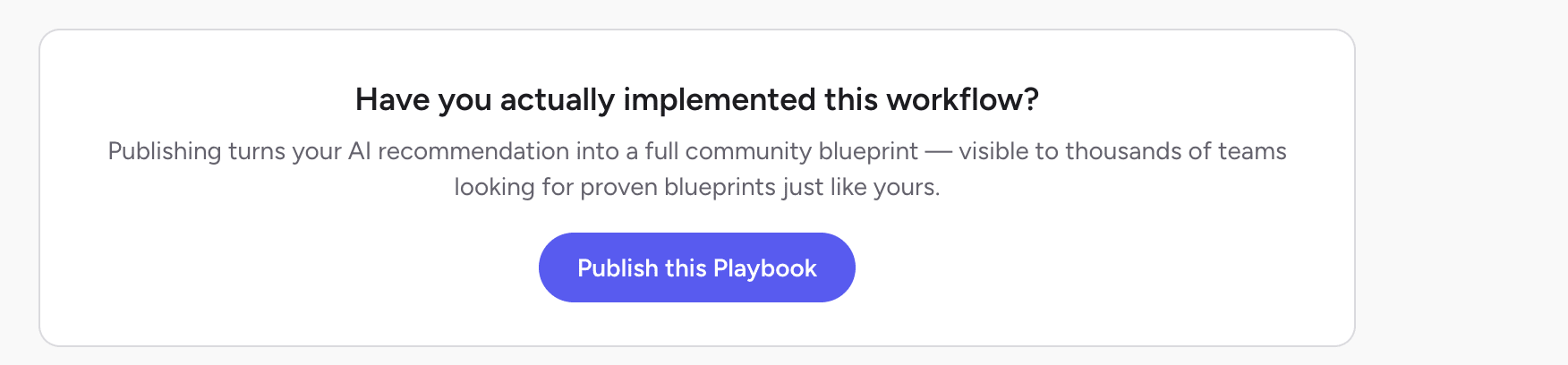
Publish it, the site explains, and your AI recommendation becomes a community blueprint, visible to thousands of teams looking for proven ones. (The button itself says "Publish this Playbook"; the site uses playbook and blueprint interchangeably, another seam of the beta.) The person who arrived with a problem is invited to leave as a contributor.
The Vision
Today's G2.com is about products. Buyers come with focused pains and search for products that can solve them; if they liked the product, their contribution is leaving a review about this product. The future G2.ai is about buyers (or experts). The platform is their canvas: they arrive with problems, draw workflows on the canvas, automatically pulling software nodes, and then use those workflows. They can choose to contribute to the community by sharing what they built. But if the vision is realized, on G2.ai products no longer exist on their own, and G2 is no longer about them: it's about the expertise in solving business problems. A workflow stays relevant even when a software solution it used is replaced with another.
Clearly, the initially declared ability to search for products in natural language is not a differentiator for a company like G2: frontier labs provide a superior experience. But the ability to provide a buyer with a canvas, with underlying data that's not polluted with astroturfed forum threads and self-promotional listicles, might be. The question is how fast they can develop and if the envisioned behavior will materialize into actual habits.
Very interesting to see how this unfolds. In the meantime, you can use Blastra to manage your product narrative on platforms like G2 and other software catalogs.
Disclaimer: this post is based on publicly accessible data on ai.g2.com. Blastra had no special preview access to non-public information; the conclusions are our own, based on what is out in the open. We don't know what will be shipped in the end. We admire the bold decision to build in public and appreciate the opportunity to peek into the new platform while it's still in the making.
Screenshots show ai.g2.com as of June 2026. Blastra is not affiliated with, endorsed by, or sponsored by G2 or any of the products shown. All product names, logos, and brands appearing in screenshots are the property of their respective owners.
Related Reading
- How to Collect B2B SaaS Reviews Without Getting in Trouble — The rules for gathering the verified reviews this whole trust layer runs on
- G2 and Capterra: Vendor Guide After the Acquisition — How to run both platforms now that they share an owner
- G2 AI Reviews (Voice and Chat): We Tested Them — G2's other AI bet, its voice and chat review collection, put through end-to-end testing
- What Is SaaS Listings Management? — The discipline of keeping your catalog data ready for surfaces like this one
- G2 Alternatives With Free Listings for B2B SaaS - The other review sites that list software free, for vendors who don't want to depend on one platform
- G2 Fall 2026 Reports: What the Numbers Mean for Vendors — Four quarters of G2's AI category growth, and what it means for where you compete
- Profound vs. Conductor: The AEO Title Fight — Two vendors fighting over how AI visibility gets measured
Blastra handles your directory presence
Blastra is a SaaS listings management platform. We manage your presence across G2, Capterra, SourceForge, and dozens of other directories — so you're not dependent on any single platform's pricing or policies.