

Profound at a glance
- Founded: 2024
- Latest round: $180M Series D at $1.8B valuation (September 2026), seven months after a $96M Series C at $1B valuation (February 2026)
- Notable customers: Target, Walmart, MongoDB, U.S. Bank
- G2 rating: 4.5 across more than 1,100 reviews (October 4, 2026; a little over 300 when we first published this in April)
- G2 category: Answer Engine Optimization, AI Search Visibility Optimization Tools. Only Leader on the first AEO Grid (Winter 2026); in the Leaders quadrant on August 30, 2026, and ranked second to Semrush by G2 Score on October 4, 2026
- Headquarters: New York, NY
In April 2026, Profound announced a new role, and a free course to train people into it: the Marketing Engineer. The framing positions a more technical marketer, one who ships AI agents and builds autonomous workflows, as a different sort of professional from a traditional marketing ops lead or SEO specialist.
Profound, an AI visibility tool, has been making waves of a kind the industry hasn't seen in a long time. They are defining the entire Answer Engine Optimization category: running the Zero Click summit, and promising brands they can control what AI says about them. In February 2026, they announced a $96 million Series C at a $1 billion valuation — all of that less than two years after founding.

There is some skepticism around the AEO category itself — voices in the SEO community argue that AI is basically another channel to optimize for and track, so the story should be about SEO evolving rather than a new category being born. The trouble with that framing is that it doesn't get you into executive rooms where the big budgets are set, and a $1B valuation becomes much less likely. Profound seems to be distancing itself from SEO — they say AI requires entirely new tooling and roles to orchestrate those tools. When you look at their directory presence, Profound is consistently categorized as AEO or GEO. That categorization shapes how AI systems and buyers perceive them.
The category creation play
Unlike the pioneers of category creation — HubSpot with Inbound Marketing and Gong with Revenue Intelligence — Profound didn't give AEO its name, and wasn't even the first company to start talking about it. But they were there early, with the level of precision that now lets them lead it.
In March 2025, G2 — the leading B2B software review site — formalized the category, originally under the name GEO Tools (later renamed to AEO Tools). Despite the long list of SEO platforms that had been around for years, the category started with only seven products — old SEO tools with AEO functionality and the new pure AEO tools. Profound was one of them.
In December 2025, G2 published its Winter 2026 Reports — G2's quarterly reports are labeled for the quarter they cover going forward. AEO qualified for its first-ever Grid® Report, featuring nine products. Profound was named the only Leader on that Grid. Otterly.AI and Scrunch AI came in as High Performers. Semrush, BrightEdge, and Conductor — companies with decades of combined SEO history and orders of magnitude more total reviews on G2 — sat as Contenders. Quattr, GetCito, and GenRank.io filled the Niche tier. Two months later, came the new funding and the unicorn valuation announcement.
In G2's Spring 2026 Reports (published March 17, 2026), Semrush had mobilized and swept #1 in AEO on G2 — proving that established tools can respond. But Profound is still in the Leadership corner.
What happened after we published
We first published this in April 2026, when the story was a clean one about being early. The months since have added the part about what happens when early stops being enough, so this section carries the update and everything below it stays as the April snapshot it was.
The category stopped being small. Nine products qualified for that first Grid. G2's AEO category listed more than 650 solutions when we checked on October 4, 2026, and sorted by G2 Score the top of it read Semrush, then Profound. When we last looked at the Grid, on August 30, Profound was still in the Leaders quadrant, sitting at the far edge of the Satisfaction axis with Semrush above it on Market Presence. Leading a nine-product Grid and placing second in a category of that size are different achievements, and the second one is the position Profound now defends.
A review campaign became the story in May. On May 21 a screenshot circulated on LinkedIn showing an email from Profound's Founding Marketing Engineer offering a $250 Amazon gift card for a G2 review. We have never verified that email, and we have found no public comment from Profound about it. What the profile shows is the shape of what followed: just over 300 reviews when we scanned on May 18, more than 500 added over the next two days, past 950 by June 1, and above 1,100 as of August 30, 2026. G2 labels reviews by collection method, and the new ones carried a mix of seller-invite and Incentivized tags, meaning the incentives in that mix were disclosed to G2. On June 24, G2 published a $100 cap on any review incentive, a section its Community Guidelines had not carried the day before. Our review-collection guide walks through the rules, the dates and what they do and do not establish.
The Grid went on stage in June. At Zero Click New York on June 11, Profound's own summit, co-founder and CEO James Cadwallader opened with a keynote called "The Agent Revolution" against a backdrop of G2's Summer 2026 AEO Grid Report.
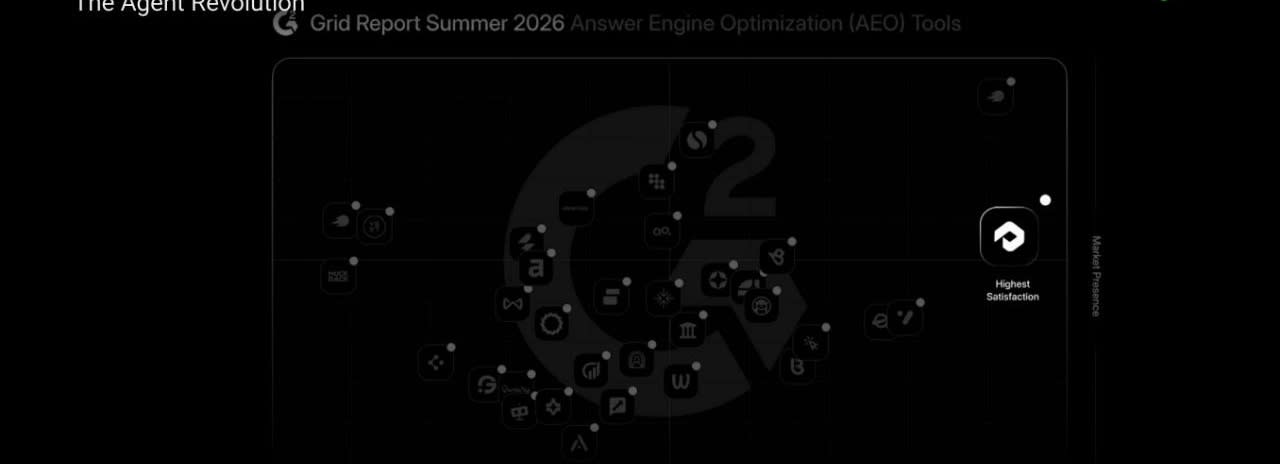
Worth knowing if you are reading the sequence: a review push in the weeks before a stage appearance lifts the Live grid on G2's category page and the review count on the profile, both of which a buyer reaches in one click. That is the surface it moves.
A Series D followed in September. On September 15, 2026, Profound announced a $180 million Series D at a $1.8 billion valuation, co-led by Sequoia Capital and Kleiner Perkins, less than seven months after the Series C. The announcement puts its customer base at more than 1,000 enterprise brands, including 16% of the Fortune 500. By October 4, 2026, Profound also had a Capterra listing, with no reviews yet, which is the first step on the high-confidence prediction further down.
What it does to the playbook below. Nothing in the six lessons changes; the timing point sharpens. Being early to a category buys a Grid position that is cheap to win and expensive to hold, and the holding cost arrives as soon as the category fills. Profound has spent that cost in public.
What the directory data shows
The figures in this section are an April 20, 2026 snapshot and have not been re-run; read them against the update above. We ran a Blastra visibility analysis across 18 directories on that date, comparing Profound against two neighbors on the Grid — Conductor (an established enterprise SEO platform that's leaning into AEO) and Semrush (the new AEO #1 on G2 after Spring 2026). Here's what the three look like side-by-side:
G2
Profound
Answer Engine Optimization, AI Search Visibility Optimization Tools
4.6★322 reviews
Conductor
Answer Engine Optimization, AI Search Visibility Optimization Tools, SEO Tools, AI Writing Assistant, Content Creation (+3 more)
4.5★765 reviews
Semrush
SEO Tools, Answer Engine Optimization, Local SEO, Marketing Analytics, Content Creation (+13 more)
4.5★3,343 reviews
Capterra
Profound
— Not listed
Conductor
SEO Software, Website Monitoring, Website Optimization Tools
4.7★118 reviews
Semrush
SEO Software, Website Optimization Tools, Competitive Intelligence
4.6★2,316 reviews
GetApp
Profound
— Not listed
Conductor
SEO, Content Marketing, Marketing Analytics, Enterprise Content Management, Web Content Management (+4 more)
4.7★118 reviews
Semrush
SEO Software, Website Optimization Tools, Competitive Intelligence
4.6★2,316 reviews
Software Advice
Profound
— Not listed
Conductor
SEO Software
4.7★118 reviews
Semrush
SEO Software
4.6★2,316 reviews
TrustRadius
Profound
SEO
0 reviews
Conductor
SEO, Content Marketing, Competitive Intelligence
4.6★393 reviews
Semrush
SEO, Search Marketing Intelligence, Competitive Intelligence, Market Intelligence, Digital Analytics (+2 more)
4.3★774 reviews
SourceForge
Profound
Generative Engine Optimization (GEO) Tools
3.5★2 reviews
Conductor
Generative Engine Optimization (GEO) Tools
5.0★7 reviews
Semrush
SEO Software
4.7★18 reviews
SoftwareReviews
Profound
— Not listed
Conductor
Search Engine Optimization
4.4★136 reviews
Semrush
Search Engine Optimization, Website Analytics, Customer Intelligence, Competitive Intelligence
4.4★368 reviews
Gartner Peer Insights
Profound
— Not listed
Conductor
Enterprise SEO Platforms
4.6★7 reviews
Semrush
Enterprise SEO Platforms, Social Marketing Management
4.4★134 reviews
Assessment run April 20, 2026 across 18 directories in total. Review counts and ratings are per-product totals across the directory, not per-category. Categories shown are the top five where a listing has more. Capterra, GetApp, and Software Advice are part of G2 following the February 2026 Gartner Digital Markets acquisition. For the full results, ping us at ceo@blastra.io.
G2 is load-bearing. The bulk of Profound's reviews sit on G2, versus fewer than 10 reviews combined across every other directory they're listed on. Profound put everything into the platform that defined their category, and won the Grid badge.
Thin but on-point everywhere else. Key platforms all categorize Profound correctly under AEO, GEO, or AI Visibility. Zero reviews on most, but the listings exist, the categories are right, and AI systems scanning for AEO tools will find them.
The big absence: the Capterra family. Capterra, GetApp, and Software Advice, all now part of G2's acquired Digital Markets portfolio, were not in Profound's footprint in April. That was the most interesting gap. Profound has since added a Capterra listing, with no reviews as of October 4, 2026.
What we'd expect next from them
Three predictions at different confidence levels, made in April 2026. Now that G2's AEO category is getting crowded (250+ solutions when we wrote this, more than 650 as of October 4, 2026), we think Profound might want to increase its reach.
High confidence: Profound will appear on Capterra, GetApp, and Software Advice within 12 months. G2 acquired Gartner Digital Markets in February 2026, and the three properties already syndicate listings and reviews with each other. G2 has not published a timeline for syndicating them with G2.com. For a G2 Leader in an AI-adjacent category, skipping the sister platforms is a visibility gap that should be closed. Update, October 4, 2026: Profound now has a Capterra listing (no reviews yet), the first step on this prediction.
Medium confidence: Capterra PPC becomes a channel, especially for international reach. Capterra's PPC auction lets you bid by country and category, and the localized versions (30+ countries with particularly strong EMEA and Latin America coverage) are one of the fastest ways to buy qualified attention in markets where organic AI citation lags English-dominant platforms. Profound can afford the experiment. With customers like Target, Walmart, MongoDB, and U.S. Bank expanding internationally, it's a hard channel to leave on the table.
Lower confidence: Gartner Peer Insights, eventually. GPI is enterprise-only, requires heavy ongoing work, and is a slow build. But Profound already serves 10% of the Fortune 500 (16% by its September 2026 Series D announcement). The GPI listing exists for companies that want to be part of Gartner's buyer-shortlist process, and with Profound's enterprise trajectory, that may soon become strategic.
Category Creation Playbook: 6 Lessons for B2B SaaS Founders
The Profound story is an example of how AI founders can leverage momentum. Watch the new AI categories G2 creates, be there early, and gather enough reviews. You get a real shot at winning over incumbents who won't have enough category-specific reviews to score high on the Grid. (For the current shape of G2's AI taxonomy and which categories are still Pre-Grid, see our guide to how G2 AI categories work.)
The playbook, observable from the outside:
- Pick a category with momentum. G2 saw AEO early and gave it a shelf. Profound didn't need to persuade the world AEO was a thing — G2 had done that work.
- Go deep on one platform first, with the right reviews. Their G2 reviews represent a sustained investment before the Grid Report cut. The content of those reviews matters as much as the count — Semrush had the data authority and the product reach, but its Winter position suggests the AEO-specific review volume wasn't there yet.
- Get the badge, then amplify it.
- Cover the other directories enough to show up in AI answers, without diluting focus. Correct categories across six other review platforms is sufficient. Reviews can follow.
- Build the profession around the product. Conference, university, certifications, named role.
- Keep the narrative discipline. One message, every surface: purpose-built for AEO.
For the inverse case — an incumbent trying to reposition into an AI category but blocked by the directory taxonomies that drive discovery — see our teardown of Miro's review site strategy. For the rules around how G2 reviews can be collected (and the line between platform-supported incentives and what crosses the FTC's Fake Reviews Rule), see safe B2B SaaS review collection.
Let Blastra help you win
Blastra analyzes your presence across G2, Capterra, TrustRadius, Gartner Peer Insights, SourceForge, and more — then finds what's missing, corrects what's drifting, and pings you only when something needs your attention. We help you strategically submit your product to the directories and categories that grow your visibility and your odds of winning leadership positions, and our competitive intelligence shows you where to channel reviews and when.
FAQ
How did Profound become the AEO category leader?
Profound invested heavily in G2 reviews early, ran a consistent AEO-only narrative across every surface, and backed it with category infrastructure: the Zero Click summit, Profound University, and the new Marketing Engineer role. They were named the only Leader on G2's first-ever AEO Grid in the Winter 2026 reports, when nine products qualified. Holding that position has been a separate exercise: the category now carries more than 650 listings, and Profound's G2 review base went from just over 300 in mid-May 2026 to above 1,100 by the end of August.
What is Answer Engine Optimization (AEO)?
AEO is the practice of optimizing content so it gets cited by AI search engines like ChatGPT, Perplexity, and Claude. G2 formalized AEO as a software category in March 2025 — originally under the name GEO Tools, later renamed to AEO Tools. See our AEO glossary entry for the longer definition.
Is Profound a SaaS category creator or a category leader?
Profound is a category leader, not the original creator. AEO existed as a concept before Profound launched, and they were not the company that named the category. But they were early on the right platform (G2), invested in reviews from the start, and defined the category narrative operationally — through the Zero Click summit, Profound University, and a named role.
How long did it take Profound to reach unicorn status?
Less than two years from founding. In February 2026, Profound announced a $96M Series C at a $1B valuation. The Series C followed two months after Profound was named the only Leader on G2's first-ever AEO Grid Report in the Winter 2026 reports. In September 2026 it followed with a $180M Series D at a $1.8B valuation.
What's the difference between category creation and category leadership?
Category creation is defining and naming a new market segment. Category leadership is winning the top position in that segment, regardless of who named it. Profound led AEO without creating it. HubSpot (Inbound Marketing) and Gong (Revenue Intelligence) are examples of companies that did both.
Who are Profound's main competitors on G2?
On G2's Winter 2026 AEO Grid Report, Otterly.AI and Scrunch AI came in as High Performers. Semrush, BrightEdge, and Conductor sat as Contenders despite decades of combined SEO history. By the Spring 2026 Reports, Semrush had mobilized and swept #1 in AEO, proving incumbents can respond. As of October 4, 2026 the category lists more than 650 solutions, with Semrush first by G2 Score and Profound second. On August 30, 2026, Profound was still in the Leaders quadrant at the far edge of the Satisfaction axis.
Related Reading
- A Tactical Guide to Software Category Creation — What to do when the category your product belongs in doesn't exist on G2 yet
- Miro's Review Site Strategy Teardown — The inverse case: an incumbent trying to reposition into AI when the directory categories block the narrative
- How Gartner Peer Insights Actually Works — Why GPI is a slow enterprise build, and when the investment pays off
- G2 Acquired Capterra — The Deal Is Done — Why the Capterra, GetApp, and Software Advice portfolio now matters for any G2 Leader
- G2 Acquires Capterra, GetApp, and Software Advice: What to Know — What the consolidation changes for vendor pricing, reviews, and where to focus
- How to Get Ranked on G2 — Satisfaction and Market Presence, review thresholds, and how Grid placement is scored
Data and Methodology
This analysis was run on April 20, 2026. We assessed Profound's presence across 18 software directories and review sites. Review counts, ratings, and claim status are point-in-time snapshots.
A note on the Semrush comparison. Profound and Conductor each have a single product listed on G2 and across the other directories in the scan. Semrush has eight products on G2 alone. The ratings and review counts shown for Semrush above reflect Semrush's core product only (the flagship "Semrush" listing), not the combined footprint of the entire product line. A fair head-to-head on Semrush's total AEO/SEO presence would also include Semrush AI Toolkit, Semrush Local, Semrush Enterprise, and the rest of the portfolio.
Profound is not a Blastra customer. This teardown uses publicly available data. Contact us if you are interested in our assessments: ceo@blastra.io
Blastra is not affiliated with, endorsed by, or sponsored by G2 or Profound; trademarks, logos and brand elements belong to their respective owners, and the G2 Grid is G2's. Positions described here reflect how products are represented in G2's published reports and category pages, not Blastra's assessment of product quality. Screenshots of third-party material are reproduced for reporting and commentary. Review counts, ratings and category sizes are point-in-time observations of publicly visible data on the dates stated.