

TL;DR
G2 — one of the largest software review marketplaces, with more than 2,000 categories and 200,000+ listed products — created nearly 30 new AI-specific categories between March 2025 and January 2026. That's roughly one in three of all new categories G2 added during that period. Categories like AI-SPM, AI SOC Agents, and AI Medical Diagnostic Platforms didn't exist a year ago. Now they're live, and 15 of 29 still don't have Grid reports — meaning the window for first-mover advantage is open.
G2 category placement is how your product shows up in buyer comparison pages, quarterly ranking reports (called Grids), and increasingly in AI search results. The newest AI categories have a handful of listed products, and most of those products have zero reviews. Getting listed in a G2 category costs nothing and doesn't require a paid plan — it's based on whether your product meets the category's feature requirements.
This guide covers what G2 AI categories are, how products get placed in them, which ones still have room, and whether it's worth pursuing for your product.
Should You Prioritize Getting Into a G2 AI Category?
Yes, if:
- Your product uses AI as a core capability (agentic workflows, ML-driven features, generative AI)
- You already have a G2 profile with reviews in other categories
- You want to appear in AI-specific buyer comparison pages and Grid reports
Maybe, if:
- You've added AI features to an existing product and aren't sure if they qualify
- You're in a category that doesn't feel right anymore because your product has evolved
One clarification: Getting into a category is the easy part — it takes a support request and 1–2 business days if approved. The harder part is collecting enough reviews attributed to that specific category to appear on a Grid report. Of the 29 AI categories we checked, 15 don't have Grid reports yet — meaning no products hold ranked positions. The section on Grid Active vs. Pre-Grid categories below explains why Grid status matters more than the review count displayed on a category page.
One in Three New G2 Categories Is Now AI
Between March 2025 and January 2026, G2 added dozens of new categories to its taxonomy — nearly 30 of them AI-specific, roughly a third.
Meanwhile, products listed directly under G2's "Artificial Intelligence Software" parent total more than 18,000 out of approximately 200,000 on the platform — nearly 1 in 10. (Many AI categories sit under functional parents like Sales Tools or Recruiting Software rather than under the AI parent directly, so the actual number of AI-categorized products is higher.) Most of those products are concentrated in a handful of massive categories. The newest AI categories are the opposite — nearly empty, with products that have zero reviews.
Here's what the timeline shows. The first wave (March/April 2025) established the foundations: Emerging AI Software as the catch-all incubator, GEO Tools, AI Customer Support Agents, AI IT Agents, AI SDRs, and AI Coding Assistants. These were categories G2 had been watching take shape inside broader categories for months.
By mid-2025, the categories got specific. G2 chose names like "Autonomous Endpoint Management" over something broad like "AI for security," and "AI Software Testing Tools" instead of a general "AI for testing." G2 was slicing by function.
Then came the agentic wave. AI SOC Agents, AI Agents for HR, AI Interview Agents — six categories following the same pattern: "AI [job function] Agents." G2 is organizing AI software by the job it performs. They confirmed this direction by launching "Best Agentic AI Products" as a new award in their 2026 Best Software Awards.
The last categories created (AI-SPM, AI Documentation Generators, AI Interview Agents, AI Medical Diagnostic Platforms) are among the newest. Some have products listed with zero reviews. The real signal of whether a category is competitive is whether a Grid report exists. AI Interview Agents already has an active Grid despite being created in January 2026, while Revenue AI — also created in January 2026 and showing ~48,000 displayed reviews — does not. The displayed count reflects product reviews carried over from other categories (Salesforce, Gong, Clari), not reviews attributed to Revenue AI specifically.
For a list of AI categories created during this period with creation dates, see the appendix.
A note on G2's taxonomy: Not all AI categories live under the "Artificial Intelligence Software" parent. G2 organizes many AI categories under their functional parent — Revenue AI sits under Sales Tools, AI Recruiting under Recruiting Software, AI SOC Agents under System Security, and so on. This means you won't find every AI category by browsing a single parent page. The appendix at the end of this guide consolidates categories from across G2's taxonomy.
The Emerging AI Software Category Deserves Special Attention
One category in this list works differently from the rest: Emerging AI Software.
G2's research team explicitly described it as an incubator. In their March/April 2025 category announcement, G2 principal research analyst Matthew Miller put it this way: the team created this category to track AI innovations, and as clusters form inside it, they investigate whether a new standalone category has emerged.
This means Emerging AI Software is both a landing zone and a launchpad. Products that don't fit neatly into existing AI categories get placed here. When enough similar products accumulate, G2 spins out a new category — and the products in that cluster become the founding members.
At the time of writing, Emerging AI Software has more than 15,000 displayed reviews across roughly 6,000 listed products. The bar for inclusion is broad: a product must be AI-first, with ML or deep learning at its core, and offer functionality that goes beyond existing AI categories.
If your product is novel — if buyers keep telling you "I don't know what category you're in" — this might be exactly where you belong. And being in the incubator when your cluster gets spun out means you're in the new category from day one, with a head start on reviews. If you want to accelerate that process, our guide to creating a new software category walks through G2's submission process and what to expect on other platforms.
Reading the Opportunity: Grid Active vs. Pre-Grid
Why we use Grid reports to assess category maturity
When buyers research software on G2, the Grid report is what they see first. It's a quadrant chart — updated quarterly — that ranks products as Leaders, High Performers, Contenders, or Niche players based on customer satisfaction scores and market presence. If a category has a Grid, buyers are actively comparing products in it. If it doesn't, buyers browsing that category see a product list with ratings but no competitive ranking — no Leaders badge, no quadrant placement, no "best in category" positioning.
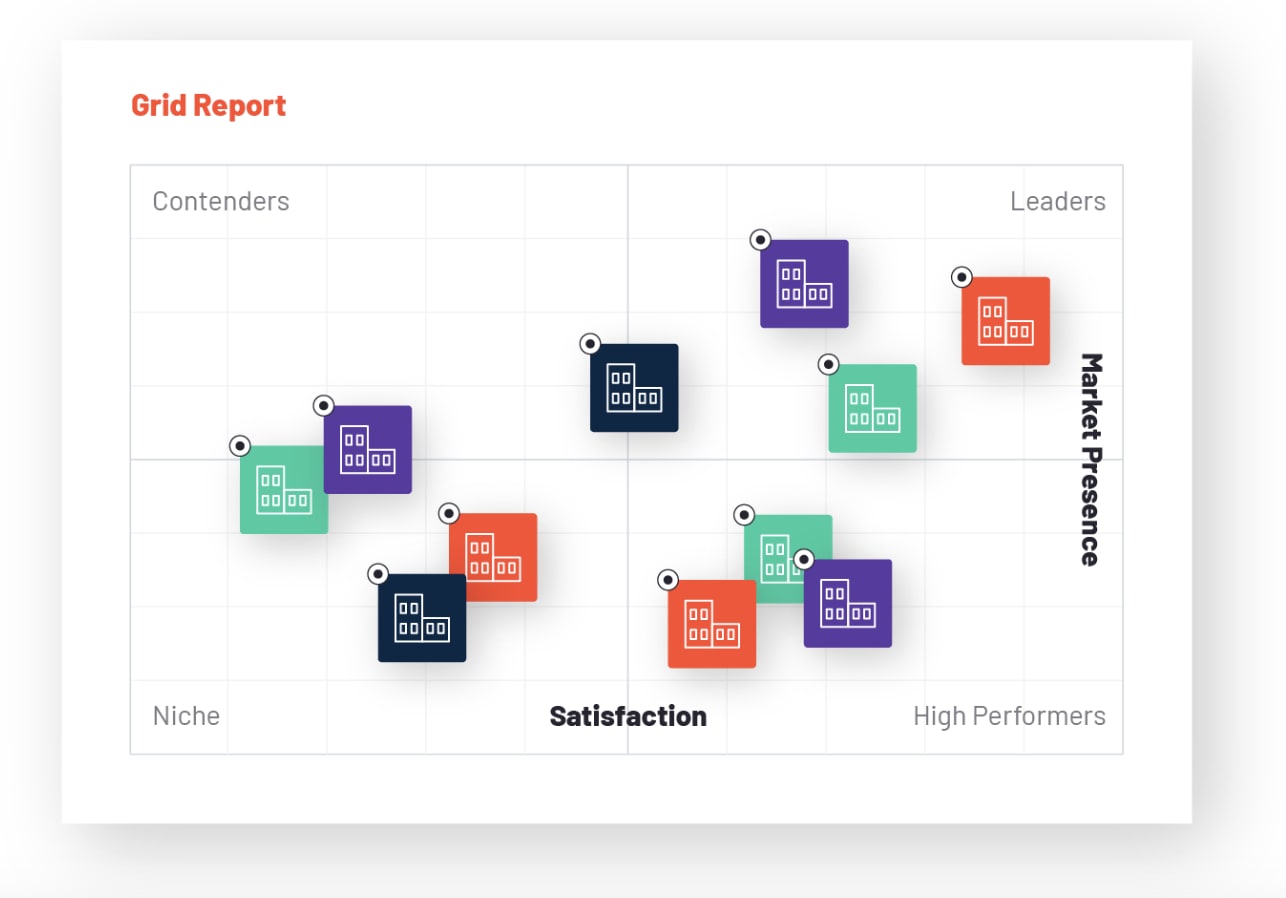
Example of a G2 Grid report. Source: G2 Research Scoring Methodologies
For vendors, Grid placement is the prize. A "Leader" or "High Performer" badge on G2 is a trust signal that shows up in search results, on product pages, and in sales collateral. Without a Grid, there are no badges to earn.
Not every category gets a Grid. According to G2's published methodology, a Grid report is only generated when at least six products have each collected 10 or more reviews attributed to that specific category, and the category has at least 150 total attributed reviews. The key word is "attributed" — this is not the same as the review count displayed on the category page (see "A note on category review counts" below for why these numbers differ).
We checked all 29 AI categories for Grid reports as of March 2026. The results show that the displayed review count on a category page does not predict whether a Grid exists. Revenue AI shows ~48,000 displayed reviews but has no Grid. AI Coding Assistants shows 1,700 displayed reviews and has one. This is because displayed counts reflect total product reviews (carried over from all categories a product is listed in), while the Grid depends on attributed reviews — a separate, invisible layer.
Grid Active (14 of 29 categories): Categories like AI Coding Assistants, AI SDRs, AEO Tools, and AI Customer Support Agents already have active Grid reports. Buyers are using these Grids to compare products. To compete, your product needs enough attributed reviews in the category to appear on the quadrant. See the appendix for the full list.
Pre-Grid (15 of 29 categories): Categories like Revenue AI, AI SOC Agents, AI-SPM, and Emerging AI Software do not yet have Grid reports. This is the clearest first-mover window. There are no Leaders badges to compete against yet. Products that collect attributed reviews now could be among the first on the Grid when it launches — earning the first Leaders and High Performer badges in the category. Don't be misled by displayed review counts: Revenue AI shows ~48,000 and AI Agents for HR shows 7,400+, but these are product-level totals carried over from other categories. The absence of a Grid confirms these categories haven't accumulated enough attributed reviews to cross G2's threshold. A focused review collection effort — see our guide to collecting G2 and Capterra reviews — could get you on the Grid within a quarter or two. The appendix lists all 15 Pre-Grid categories with their creation dates.
For a list of new AI categories with creation dates and Grid status, see the appendix.
You Might Already Be in an AI Category
Before you request a new category placement, it's worth checking what G2 has already done on your behalf. Products get added to categories through three paths:
When you first submit your product to G2, the research team evaluates your features and places you in all categories that fit. This happens during the initial 3–5 business day verification period.
When G2 creates a new category, the research team populates it with existing products that meet the inclusion criteria. G2's categorization methodology page confirms that products are added to categories "when submitted on G2, when a new category is created, and when a category cleaning occurs." This means your product could have been placed in an AI category without you requesting it — or even knowing about it.
During category cleaning, G2 analysts periodically audit the products in a category, updating definitions, inclusion criteria, and product placements.
Here's what we don't know: whether G2 notifies vendors when their product is added to a new category through this automatic process. G2's notification system supports alerts for Grid quadrant movements and new reviews, but there's no documented notification specifically for new category placements. Their category name change FAQ explicitly states they don't send communications for category updates.
How to check: Go to my.G2, navigate to Product Profile → Product Information → Product Categories. You'll see every category your product is currently listed in.
How to Request an AI Category (Step by Step)
If your product isn't in the AI category where it belongs, here's the process:
Step 1: Find the right category. Browse G2's category pages and look at the inclusion criteria. Every category has a "What is [category name]?" section — click "Show More" to see the specific feature requirements. Your product needs to meet these requirements — general relevance alone won't qualify.
Step 2: Request the addition. Go to my.G2 → Product Profile → Product Information → Product Categories → select "Request Updates." This opens a support case with G2.
Step 3: Provide evidence. G2 encourages submitting specific evidence that your product meets the feature requirements: recorded demos, blog content, presentations, or documentation showing how your product delivers the required functionality. The more concrete you are, the faster the evaluation goes.
Step 4: Wait for evaluation. A market research analyst reviews your request against the category's inclusion criteria. If approved, changes reflect on the site within 1–2 business days.
A few things to know about this process: G2 categorizes products by functionality and features. They'll place your product in all categories it qualifies for. There's no limit to how many categories your product can be in, and this applies equally to free and paid profiles. Category placement itself is free.
One more detail that matters: G2's documentation doesn't describe a process for voluntarily removing your product from a category once you're in. As long as your product continues to meet the feature requirements, the listing stays. Getting into an AI category is a durable visibility gain.
From Grid Placement to Grid Impact
Being in a category is step one. Here's what determines whether it helps you:
How Review Attribution Works (And Why You Should Audit It)
Reviews on G2 get attributed to categories through three mechanisms, in order of reliability:
Reviewer selection: When users write reviews, they select which categories their review applies to. If you're in AI SDRs but your reviewers only select "Sales Engagement Software," those reviews won't count toward your AI SDRs Grid placement. You may need to guide reviewers to select the AI category when leaving feedback.
NLP auto-attribution: G2 uses natural language processing to analyze review text and attribute reviews to relevant categories on an as-needed basis. The timing of this process is unpredictable.
Manual audit: G2 occasionally performs manual reviews to ensure attribution accuracy. This happens on G2's timeline, not yours.
The takeaway: don't assume reviews are landing in the right category. Check your review attribution in my.G2 periodically, especially after being added to a new AI category. Existing reviews don't automatically re-attribute — new reviews going forward will give reviewers the option to select the new category.
A note on category review counts
The review count shown on a category page and the reviews that count toward Grid eligibility appear to be two different things.
From what we can see, the category page total reflects the combined reviews of all listed products — regardless of which category the reviewer originally selected. Products like Salesforce Sales Cloud and Gong appear on the Revenue AI page carrying the same review counts they show in CRM or Conversation Intelligence. Revenue AI launched in January 2026 showing ~48,000 reviews, because it includes established products that already had large review volumes built up elsewhere.
Grid reports tell a different story. According to G2's published methodology, a product needs at least 10 reviews attributed to a specific category to be Grid-eligible — and the category itself needs at least six such products and 150 attributed reviews. When we checked all 29 AI categories for Grid reports, we found that displayed review count does not predict whether a Grid exists: Revenue AI shows ~48,000 reviews but has no Grid, while AI Coding Assistants shows 1,700 reviews and has one. The Grid depends on attributed reviews — a layer we can't see from the outside.
The practical takeaway: Don't use the displayed review count to judge whether a category is competitive. Check whether a Grid report exists. The Grid is G2's quarterly quadrant chart that ranks products as Leaders, High Performers, Contenders, and Niche players — it's the basis for the badges that appear on product profiles and in search results. If a Grid exists, buyers are actively using it to compare products, and competitors already hold ranked positions. If no Grid exists, there are no rankings yet, no badges to compete against, and no quadrant placements — that's the first-mover window.
Grid Eligibility and Badge Rules
10 reviews in a category unlocks Grid eligibility. G2 publishes Grid reports quarterly for categories that meet their data requirements. The minimum threshold for a product is 10 reviews in that specific category. (The category itself also needs at least six products with 10+ reviews and 150+ reviews overall.) In a brand-new AI category, being among the first products to hit 10 reviews puts you on the Grid early.
Grid placement is free. Badge usage requires a paid plan. As of the Summer 2025 report release (June 2025), displaying badges (Leader, High Performer, etc.) in your marketing materials requires a G2 Brand Starter plan or higher, starting from $2,999/year for small businesses in Year 1 (increasing in Year 2). Grid placement itself — appearing on the Grid, being ranked — costs nothing. For a deeper dive into how badges work, see our complete guide to earning G2 badges.
Quarterly deadlines matter. G2 publishes its report schedule on their research agenda — check there for exact deadlines. If you're trying to appear in a Grid report for a new AI category, work backward from the next upcoming review deadline.
A Category Win in Under a Year: Profound
Here's what getting AI category strategy right looks like in practice.
Profound is an Answer Engine Optimization platform — it helps brands monitor and manage how AI systems represent them. When G2 created the GEO Tools category in March 2025 (later renamed to AEO Tools), Profound was one of the products placed there. By February 2026, Profound was named a Top 50 AI Product in G2's 2026 Best Software Products, ranking #34 across all B2B software.
That's under a year from category creation to Best Software recognition. At the time of their February 2026 Series C announcement ($96 million round at a $1 billion valuation, bringing total funding to more than $155 million), Profound reported serving more than 700 enterprises. Their CEO, James Cadwallader, used the G2 recognition as a signal that AEO had become a core marketing discipline — the G2 category placement became part of their market-creation narrative.
Profound reached Grid eligibility quickly in the new category and used the G2 recognition to reinforce their market positioning. The category was new, they moved fast, and they turned a G2 listing into a visibility engine.
Why This Matters for AI Search Visibility
G2 categories are structured, labeled data — exactly the kind of signal AI systems rely on when assembling answers about software comparisons. A product that exists in the right G2 AI category with reviews has a fundamentally different discoverability profile from one that doesn't. AI search visibility depends on your product being present across the third-party sources AI systems trust, and G2 is one of the highest-authority sources in B2B software.
G2 knows this. Their post-acquisition hiring shows explicit investment in becoming the primary citation source for LLMs and AI agents — with new engineering and product leadership focused on AI-powered software discovery and a growing team dedicated to how G2 content surfaces in generative search. Getting into the right AI category now positions your product for how G2 plans to serve buyers going forward.
One more thing to watch: In January 2026, G2 acquired Capterra, GetApp, and Software Advice from Gartner — consolidating four of the largest software review platforms under one company. The deal closed in early February 2026. As of this writing, no changes to G2's category taxonomy have been announced as a result of the acquisition. But the combined platform will eventually unify its taxonomy across all four properties. If you're planning your category strategy, this is worth monitoring — what you do on G2 today may carry across a much larger footprint in the future.
What We Don't Know
G2's documentation is thorough on some points and silent on others. A few things we couldn't verify:
How quickly auto-placement happens for new categories. When G2 creates a new category, we know they populate it with existing products — but we don't know the timeline. It could be simultaneous with the category launch, or it could take weeks.
Whether vendors are notified about auto-placement. We found no documentation confirming that G2 sends a notification when your product is added to a new category through their research team's initiative. The safest assumption is that they don't.
The exact rejection rate for category placement requests. G2 doesn't publish data on how often placement requests are denied. Anecdotally, if your product clearly meets the feature requirements, approval is straightforward.
Key Takeaways
- G2 created nearly 30 AI-specific categories in 10 months and is still adding more. If your product has AI capabilities, there's likely a category for it.
- Check my.G2 right now — you might already be in an AI category without knowing it.
- Category placement is free and has no limit. The paid tier gates badge usage, not categorization.
- 15 of 29 AI categories don't have Grid reports yet — including some with high displayed review counts like Revenue AI (~48,000). Per G2's methodology, 10 attributed reviews can make a product Grid-eligible. Check the appendix to see which categories are Pre-Grid.
- Emerging AI Software is G2's incubator. If your product doesn't fit anywhere else, this is both a landing zone and a launchpad for when your category eventually gets created.
Source Documentation
Primary Sources (Dated)
| Source | Date | Notes |
|---|---|---|
| G2 Categorization Methodology | Ongoing | Official methodology, explains category creation and product placement |
| G2 Research FAQ | Ongoing | Confirms multi-category placement, explains review attribution |
| G2 Scoring Methodologies | Updated Dec 2025 | Grid eligibility thresholds, scoring mechanics |
| G2 Product Information Documentation | Ongoing | How to manage categories in my.G2 |
| New Categories: March & April 2025 | May 2025 | First wave of AI categories with analyst quotes |
| New Categories: Nov & Dec 2025 | Jan 2026 | AI-SPM, AI AppSec, AI Documentation Generators |
| New Categories: January 2026 | Feb 2026 | Revenue AI, AI Interview Agents, AI Medical Diagnostics |
| G2 2026 Best Software Awards | Feb 2026 | Confirms Best Agentic AI Products list, <0.6% selection rate |
| G2 2025 Year in Review | Jan 2026 | 200,000+ products, AEO category grew from 7 to 230+ products |
| Profound Series C Announcement | Feb 2026 | $1B valuation, $155M+ total funding, 700+ enterprises, G2 #34 AI product |
| G2 Notifications Documentation | Ongoing | Confirms what notifications exist (and what doesn't) |
| G2 Content Usage Guidelines | Updated Jun 2025 | Badge republication rules, paid plan requirements |
| G2 Plans | Ongoing | Brand Starter pricing, Year 1/Year 2 details |
| G2 Spring 2025 Reports | Mar 2025 | 190,029 total products, 1,270 categories in reports |
Additional Monthly Category Announcements
G2 publishes new category announcements monthly. All announcements from May 2025 through January 2026 were reviewed for this guide. They're available at company.g2.com/news.
Appendix: New AI Categories (March 2025 – January 2026)
This table covers AI-specific categories created between March 2025 and January 2026. G2's full AI category taxonomy — including older categories like AI Writing Assistants, Chatbots, and Machine Learning — is available at g2.com/categories/artificial-intelligence.
Pre-Grid — no Grid report yet; first-mover opportunity
| Category | G2 Parent | Date Created | Reviews | Products |
|---|---|---|---|---|
| AI Medical Diagnostic Platforms | Health Care Software | January 2026 | ~0 | 25 |
| Contact Center AI Observability | Call & Contact Center Software | August 2025 | ~280 | 7 |
| AI SOC Agents | System Security Software | August 2025 | 397 | 30 |
| AI Storyboard Generators | AI Software | ~2025 | 840+ | 83 |
| Prompt Management Tools | AI Software | ~2025 | 1,000+ | 28 |
| AI AppSec Assistants | Generative AI Software | October 2025 | 1,200+ | 18 |
| AI Security Solutions | AI Software | December 2025 | 1,200+ | 34 |
| AI Governance Tools | AI Software | ~2025 | 1,600+ | 174 |
| NHIM Solutions | AI Software | ~2025 | 1,600+ | 14 |
| AI-SPM | AI Software | November 2025 | 1,700+ | 19 |
| AI Documentation Generators | Development Software | November 2025 | 4,300+ | 19 |
| Conversational AI Survey Platforms | AI Software | June 2025 | 5,200+ | 119 |
| AI Agents for HR | AI Agents (Agentic AI) | September 2025 | 7,400+ | 30 |
| Emerging AI Software | AI Software | March 2025 | 15,000+ | ~6,000 (incubator) |
| Revenue AI | Sales Tools | January 2026 | ~48,000 | 22 |
Grid Active — Grid report exists; competition is live
| Category | G2 Parent | Date Created | Reviews | Products |
|---|---|---|---|---|
| AI Coding Assistants | Generative AI Software | May 2025 | 1,700+ | 245 |
| AI Interview Agents | Recruiting Software | January 2026 | ~3,000 | 25 |
| Low-Code ML Platforms | AI Software | October 2025 | 3,200+ | 19 |
| AI Recruiting | Recruiting Software | September 2025 | 3,700+ | 105 |
| Autonomous Endpoint Management (AEM) | Endpoint Protection Software | July 2025 | 6,600+ | 12 |
| AI IT Agents | AI Agents (Agentic AI) | March 2025 | 6,600+ | 56 |
| AI Customer Support Agents | AI Agents (Agentic AI) | March 2025 | ~10,000 | 349 |
| AI Avatar Generators | AI Software | May 2025 | 10,400+ | 120 |
| AI Software Testing Tools | Generative AI Software | July 2025 | 11,600+ | 126 |
| AI SDRs | AI Agents (Agentic AI) | March 2025 | 14,200+ | 137 |
| AI App Builders | Generative AI Software | June 2025 | 14,400+ | 405 |
| AI Orchestration | AI Software | April 2025 | 16,400+ | 305 |
| GEO Tools / AEO Tools | AI Software | March 2025 | 17,300+ | 233 |
| AI Agent Builders | Agentic AI Software | ~2025 | 57,000+ | 216 |
Grid Active / Pre-Grid classification is based on whether a Grid report existed on the category page as of March 2026. Displayed review counts are approximate and reflect total product reviews (not category-attributed reviews — see "A note on category review counts" above). Grid reports are generated quarterly; a Pre-Grid category may become Grid Active in a future cycle. For Grid eligibility requirements, refer to G2's published methodology. G2 adds new categories monthly — verify against official sources for current status.
About this guide: Blastra helps B2B software companies manage their presence across directories like G2, Capterra, and 30+ other platforms. Our Visibility Posture assessment can tell you which G2 AI categories your product qualifies for and whether you're already listed.
Focus on building your product
Blastra is a SaaS listings management platform. We handle your directory submissions and ongoing listing management across G2, Capterra, and dozens of other platforms.