

TL;DR
SourceForge is the oldest software directory still operating at scale - launched in 1999, with over 20 million monthly visitors today. Perceived as a developer-and-IT site, it's largely misunderstood by vendors.
AI sees it differently. SourceForge is now among the most important third-party sources AI uses to recommend B2B software - driven by its authority signals (Moz DA 93, decades of indexed comparison pages), the breadth of its data (100,000+ software products listed, with comparison pages for every pair), and a deliberate platform policy that explicitly permits AI models to train on its data - rare among major review directories.
The result is an asymmetric bet: the AI-crawl benefit comes regardless of paid tier; the human-browse and demand-gen benefits scale with spend.
SourceForge has also been investing in vendor-facing AI features. It's the only major B2B software review and comparison platform that lets vendors track AI search crawls to their listing and comparison pages - already live in v1, with updates coming. Blastra is tracking the rollout.
This guide covers what the shift means for your B2B SaaS marketing strategy.
SourceForge Is a Comparison Directory, Not a Download Site
SourceForge launched in 1999 as an open-source code repository, nine years before GitHub existed. It's owned today by Slashdot Media, which also runs the Slashdot tech news site. Around 2016 the platform extended its scope to become a B2B software directory and review site. Today it is positioning itself as the world's largest and most visited B2B software comparison website - competing directly with G2, Capterra, TrustRadius, and other largest players in the space.
A common misframing of SourceForge today is from its early history of being "the open-source download site." The reality is broader: SourceForge is where buyers come to find the right software for their need, whether that's open-source, fully commercial B2B SaaS, or hybrid. Many modern B2B SaaS companies maintain an open-source community edition alongside their commercial product, and those vendors appear in both SourceForge's open-source section and its B2B section.
The 20M+ monthly visitor figure is corroborated by independent measurement: Similarweb and Semrush both report comparable numbers, and SourceForge's own traffic documentation is itself based on Similarweb data. About a third of traffic is direct (people typing the URL), a third is referral, and less than a third comes from search engines - a distribution that signals strong brand recall and a deep backlink network rather than search-engine dependency. Over 86% of visits are desktop. The UI shows its age, but search-ranking signals are structured data, link graph, and dwell time - none of which the visual chrome affects.
SourceForge is a comparison and review directory that spans every major category B2B buyers shop in - marketing automation, HR, finance, analytics, dev tools, infrastructure, accounting, e-commerce, and dozens more - alongside its open-source catalog. The platform lists more than 4,000 B2B software categories in total, including extensive coverage of new AI categories - much more than other major directories. Category labels matter for AI search: AI assistants use them to map user queries onto product corpora, and the breadth lets SourceForge surface for queries other directories simply don't have category structure for. That breadth, plus the decades of accumulated SEO authority on the domain, is what makes the platform consequential for vendors well outside the developer-tools stereotype.
The Dual Audience: Humans vs AI
SourceForge has two audiences - human visitors and AI crawlers - and they don't overlap as much as you'd expect.
The human audience
The human audience is broader than the legacy developer-and-IT reputation suggests. According to SourceForge, about 31% of its audience is classified as technical (developers, sysadmins, IT decision-makers); the remaining 69% is spread fairly evenly across business, marketing, HR, and other professional disciplines.
Direct-traffic users (roughly a third of all visits) typed SourceForge into their browser because they already know it - a strong signal of repeat-buyer behavior across all professional segments, not just technical ones. Referral traffic comes from a mix of technical forums, knowledge bases, comparison sites, and the company's Slashdot sister property.
Beyond brand recall and referral strength, 9 out of 10 visits are desktop, and the SourceForge traffic doc reports desktop visitors converting at roughly 1.7× the rate of mobile users on B2B software queries (SourceForge doesn't define what counts as a conversion). Both signals point to procurement-grade research during work hours, not casual browsing.
The AI audience - and where it diverges
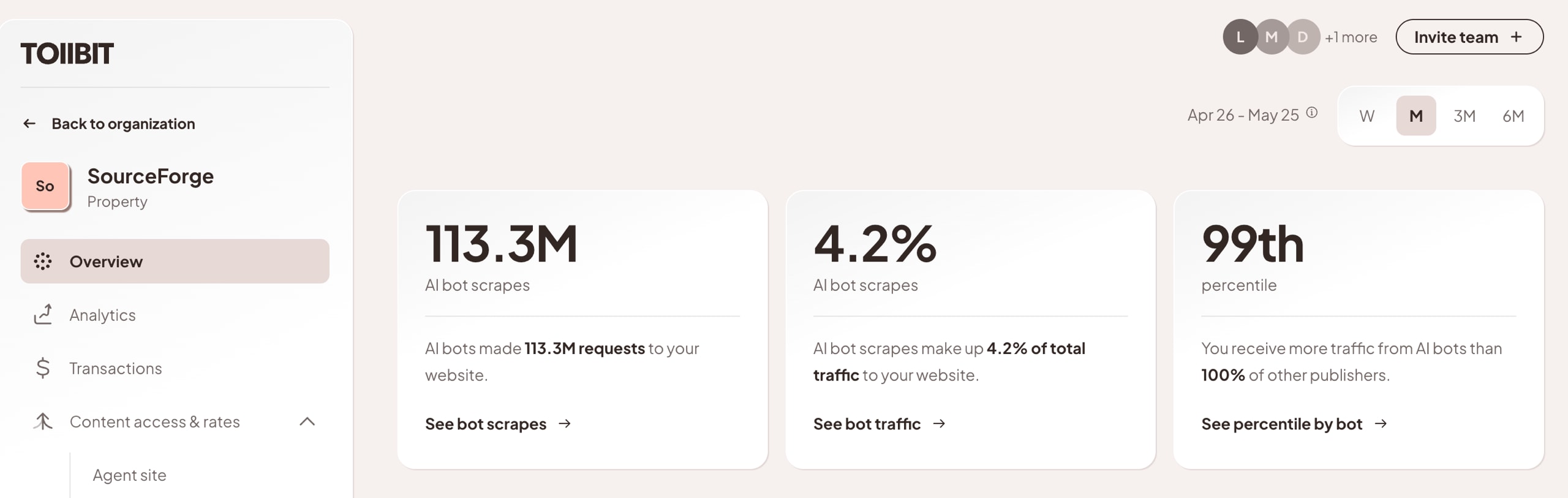
The second audience is AI crawlers and the LLMs they feed. The volume is striking and consistent across every major AI bot. Per TollBit Analytics (Apr 26 - May 25, 2026 window), SourceForge received 113.3M AI bot scrapes in a single month - around 4.2% of the platform's total inbound traffic - placing it in the 99th percentile across the AI-bot-scraped web (more AI bot traffic than any other publisher in TollBit's dataset).
The per-bot breakdown:
| AI bot | Operator | Monthly scrapes | Share of AI traffic | Percentile |
|---|---|---|---|---|
| ClaudeBot | Anthropic | 20.5M | 18.1% | 99th |
| ChatGPT-User | OpenAI | 15.7M | 13.8% | 99th |
| OAI-SearchBot | OpenAI | 12.9M | 11.4% | 99th |
| PerplexityBot | Perplexity | 9.2M | 8.2% | 99th |
The 99th-percentile ranking holds for every individual AI bot - meaning SourceForge is among the most-scraped websites on the web for each major AI operator. SourceForge President Logan Abbott told us the true total is closer to 200M/month when Googlebot is included (TollBit doesn't track Google).
The citation pattern, however, varies by AI surface. Hall AI's 2025 review-platform citation analysis - which sampled 456,570 AI answers across ChatGPT, Perplexity, Microsoft Copilot, and Google AI Overviews between May and June 2025 - shows SourceForge leading review-platform citation share on Microsoft Copilot, with smaller (but still meaningful) shares on ChatGPT, Perplexity, and Google AI Overviews. Same product listings, same review corpus, four different citation profiles.
Two things explain the Copilot peak:
- Open crawler access and explicit training-data permission. SourceForge's robots.txt is broadly open to AI crawlers - and, more importantly, Abbott confirmed in conversation that the platform actively permits AI models to train on its data. The training-data permission is the most important factor in why SourceForge compounds in AI answers across model generations rather than only at retrieval time.
- Index inheritance. Copilot leans on Bing's index, where SourceForge has ranked deeply for over two decades, so Copilot disproportionately surfaces SourceForge content compared to the other AI platforms (which use different retrieval mixes).
The combined effect: SourceForge informs answers broadly across the AI landscape - sometimes as an explicit citation (Hall's data captures this), sometimes as training-data context the model absorbed silently and uses without naming SourceForge. The citation-share peak sits with Copilot; the crawl-volume strength sits with every major AI bot. The asymmetry across AI platforms is in citation distribution, not in whether SourceForge is being read.
A second observation, distinct from the platform gap: when AI does cite SourceForge, it cites for categories that don't match its perceived human audience. EMGI Group's 2026 directory-listings-and-AI-search-citations study found 95% coverage on SourceForge across the 139 SaaS brands measured (132 listed) - effectively every significant B2B SaaS already has a SourceForge presence - and a +18 percentage-point lift in AI citation rate for brands present on the platform versus those absent.
The category breakdown is where it gets interesting:
| Category | Citation rate on SourceForge-listed brands |
|---|---|
| HR tech | 86% (12 of 14 brands) |
| Marketing Automation | 71% (17 of 24) |
| Analytics | 65% (15 of 23) |
| Dev Tools | 65% (15 of 23) |
| Project Management | 54% (13 of 24) |
| CRM | 38% (structural ceiling across all directories per the study) |
The reason: AI extraction systems don't weigh the implied brand reputation - they weigh structured data and authority signals. To the AI, the page is well-structured, accessible, and authoritative on the URL. SourceForge covers the categories AI cares about, it grows the category list to keep up with the latest trends, and features the relevant market players in each - some with claimed and actively managed profiles, others unclaimed but still indexed - in enough quantity to serve as a solid corpus for AI to draw from.
And reviews on SourceForge demonstrably matter for AI citations. Qvery AI's 2026 UGC citation analysis ranks SourceForge as the third most cited user-generated-content platform in the world by AI search engines - a meaningful position alongside Reddit and Wikipedia.
Three Structural Features Beyond the Crawl-Surface Story
Against the full B2B review-platform set - G2, Capterra, TrustRadius, Gartner Peer Insights, SourceForge - SourceForge sits in its own corner. TrustRadius leans enterprise-IT with a moderated long-form review format; Gartner Peer Insights sits within Gartner's broader analyst ecosystem (the same parent that publishes the Magic Quadrant), which in our reading lends it analyst-tier weight with enterprise buyers; G2 and Capterra are now a single ecosystem following the Gartner Digital Markets acquisition. Beyond the open-crawler and training-data story already covered above, three additional structural features set SourceForge apart:
- Newsletter distribution layer. SourceForge's vendor materials describe a B2B software newsletter with 400,000+ subscribers, bundled into some paid tiers. G2 and Capterra don't expose an equivalent native channel to vendors.
- Sponsored podcast and thought-leadership content. Higher-tier packages include long-form vendor content (Q&A articles, 30–60 minute podcast episodes) that gets published on SourceForge subdomains. The content itself becomes indexable and citation-eligible - meaning some paid spend creates lasting AI search assets, not just impressions.
- Independent ownership. With G2's acquisition of Capterra, GetApp, and Software Advice (announced 2025, closed February 2026 - covered here), the largest review-platform ecosystem is now consolidated under one company. SourceForge is one of the few remaining major platforms still independent - useful diversification for vendors who want presence outside the consolidated ecosystem.
Optimizing Your SourceForge Listing for AI Search
Five things matter most for AI search on SourceForge.
1. Write descriptions so AI can extract them cleanly
LLMs extract sentences in self-contained units - a claim plus enough context to stand alone. SourceForge's full-description field is the largest text surface they get for your product. The structure that extracts well:
- Lead sentence states what the product is in plain language.
- Each subsequent paragraph leads with a specific capability or audience, then supports with one concrete detail.
- Avoid coy phrasing ("revolutionary platform," "next-generation solution"). Models trained on product copy down-weight it as low-information.
- Use the named vocabulary your buyers and AI use for your category - if your category has a stable name (CRM, observability, customer data platform), use it explicitly.
The compounding rule for SaaS AI citations explains why extraction-friendly description copy compounds across platforms.
2. Treat category placement as an AI surface
Category placement on SourceForge should be strategic and consistent with how your product is described everywhere else AI looks - your own site, G2, Capterra, Crunchbase, LinkedIn. Inconsistent category placement across third-party sources creates noise that weakens AI's confidence in any single category claim about your product; consistent placement compounds across the corpus and reinforces it.
Practically, that means: pick the category names AI uses for your space (the named, stable ones - CRM, observability, customer data platform - over branded internal vocabulary), match them across your listings, and use SourceForge's allowed category slots to cover the buyer-intent surfaces where your product belongs.
3. Make reviews citation-extractable
AI assistants quote reviewer phrasing in answers - especially Copilot, which surfaces SourceForge reviews directly. Reviews that get quoted have three features:
- Specific feature named (not just "it's great")
- Concrete use case described (industry, team size, what they were trying to do)
- A noun-verb-outcome shape ("the API let us cut onboarding time from 3 days to 4 hours")
When you ask customers for reviews, the prompt you send shapes the response. Generic asks produce generic reviews. Prompted asks produce extractable ones. The same prompt patterns described in how to get G2 and Capterra reviews apply directly on SourceForge.
4. Use the upgraded-listing AI-extraction features
Upgraded SourceForge listings unlock two features that are unusually well-shaped for AI extraction:
- Custom FAQs. Paid listings can publish vendor-authored FAQs on the product page. The question-answer shape maps directly to how AI assistants generate responses, which makes FAQ content among the highest-leverage AI-extraction surfaces on the platform. Write FAQs around the actual questions buyers ask AI ("does [product] integrate with X?", "what does [product] cost?", "how is [product] different from Y?") rather than the questions vendors want to be asked.
- Category-specific descriptions. Upgraded listings can tailor their description per category they're listed in, so the same product shows extraction-optimized prose for multiple buyer contexts. Resist the temptation to paste the same description into every category - that wastes the highest-leverage field SourceForge gives paid vendors.
5. Match your effort to where your category gets cited
If your category gets recommended by Microsoft Copilot - which favors enterprise IT, security, infrastructure, productivity, and increasingly HR tech and marketing automation - SourceForge is over-indexed relative to its human-audience reputation and worth heavy investment. If your category is consumer SaaS or design tools where buyers live inside ChatGPT or Perplexity workflows, SourceForge is under-indexed and the priority probably sits with other platforms.
The minimum useful first move on SourceForge: claim the free listing, complete the optimization checklist, ask 3–5 existing customers for reviews, and re-measure AI-citation outcomes over 60–90 days before considering any paid tier.
How third-party signals propagate into AI answers across platforms is unpacked in AI Search Consensus Pattern and Software Badges Decoded: AI Trust Signals.
Packages and Pricing
SourceForge offers a free tier plus five paid tiers - PLUS, PREMIUM, AMPLIFY, PRECISION ABM, and ENTERPRISE - billed annually. Current pricing is available from SourceForge directly via the public pricing page. Add-on solutions can be layered onto any paid tier: Boost Retargeting, Thought Leadership Sponsored Content, Newsletter Advertising, and a dedicated Podcast Episode.
Two structural notes about the pricing model:
- Position is tied to plan price. SourceForge states this directly in vendor documentation: a product's category-page position is influenced by the price of its plan. This is a different model from G2 (which surfaces position through Grid placement based on reviews and satisfaction) and broadly comparable to Capterra's publicly described PPC (pay-per-click) mechanic where paid spend influences visibility.
- Free-tier listings are deprioritized in sorting but still indexed. A free listing exists, is crawlable, can collect reviews, and can earn the Star Rating badge. It sorts below paid listings on category pages, but the sorting order can be changed, and AI doesn't care much about the order. For pure AI-search purposes - where the URL exists and gets indexed - the free tier captures most of the AI-extraction benefit.
What each tier is for
- Free tier. Claim and manage your listing, collect reviews, get indexed by AI crawlers. Enough to ship a complete listing, collect reviews, and measure AI-citation outcomes over 60–90 days. See the public pricing page for paid-tier details.
- PLUS - first paid tier. Adds profile admin access, category placement, buyer-intent data tooling, and platform-level visibility controls.
- PREMIUM. Builds on PLUS with deeper buyer-intent data, more category slots, and closer SourceForge involvement in structured-data setup.
- AMPLIFY. Adds owned distribution channels - programmatic retargeting, sponsored thought-leadership content, podcast and competitor-intent tracking - that create AI-extraction assets beyond the listing itself.
- PRECISION ABM and ENTERPRISE. Account-based and custom-scoped tiers for vendors running coordinated multi-channel demand-gen against a specific account list, less for early-stage SaaS testing the platform.
A claimed listing only earns its keep if the data stays accurate and current - across descriptions, categories, screenshots, and feature fields. A stale listing degrades both human trust and AI extraction over time, regardless of tier.
Three Patterns Experienced Vendors Spot
Three patterns experienced SourceForge vendors recognize that aren't in the documentation.
Comparison pages outrank product pages on branded competitor queries. SourceForge's auto-generated "[Your Product] vs [Competitor]" pages often rank above the competitor's own site for the head-to-head query. If you're not claimed, the comparison page still exists - and your competitor controls the framing. Claiming is defensive even if you never plan to upgrade past free.
The optimization checklist is more useful than the badge it unlocks. SourceForge gives claimed vendors an in-admin checklist of fields to complete (descriptions, screenshots, integrations, competitor lists, etc.) - finishing it earns a "Trusted Vendor" badge. The badge is fine; the checklist itself is the more valuable asset, since it's a structured prompt for filling every AI-extraction field on the listing.
Free-tier listings can earn Leader and Top Performer badges. SourceForge doesn't gate competitive badges to paid tiers. In a category with thin competition and consistent review collection, a free-tier listing can earn the platform's most visible badges - at zero spend. This can happen in emerging categories where the field is open.
Want Blastra to optimize and manage your SourceForge listing?
Blastra is a SaaS listings management platform. We handle SourceForge submissions, listing optimization across every AI-extraction field, review prompts, and badge eligibility - alongside G2, Capterra, TrustRadius, and dozens of other directories.
Related Reading
- SourceForge in the directory catalog - pricing model, audience, FAQ, badges you can earn
- How to Earn SourceForge Badges - the execution playbook for Leader, Top Performer, and Star Rating
- AI Visibility Tools Ranked by Review Platform Presence - observed SourceForge presence across 15 vendor profiles
- B2B Software Directories AI SEO Strategy - cross-platform mechanics of how directory data shows up in AI answers
- Software Badges Decoded: AI Trust Signals - how AI systems weight badge signals across platforms
Independent editorial by Blastra. This guide is not sponsored or endorsed by SourceForge or Slashdot Media. Quotes from SourceForge President Logan Abbott and the TollBit data shared by SourceForge are reproduced with permission; analysis, recommendations, and any errors are Blastra's.