


In October I asked Claude Code, Anthropic's coding agent that works inside a project and runs commands on its own, to set up two sets of emails for one of our products: a drip for every new subscriber and a short personal note to customers who pay. I said I was deciding between Loops and Resend, two email tools, and that what I wanted most was visibility into sends and stats.
Claude Code checked what the app already sent mail through. Then it searched the documentation of PostHog, the product analytics tool we already used, through PostHog's MCP server (the connector that lets an AI agent read from and act in a product), and answered: "My recommendation is neither Loops nor Resend: use PostHog Workflows for both." It gave four reasons: the triggers would come from data PostHog already collected, email stats would sit next to product data, there would be no new vendor or bill, and one about itself: "I can run it from here. PostHog exposes tools to create, test-run, publish and read stats for workflows, so I can build and iterate on the drip and tell you how it's doing." Over that afternoon it built both workflows through the MCP server, tested them and, when I said go, switched them on. The one part I did by hand was adding the sending domain in PostHog's settings.
The agent chose the tool it was going to operate.
Two situations hide behind "agents as an audience"
Marketers now hear that AI agents are a new audience to win. The phrase covers two different situations, and they need partly different work.
In the first, a person researches with AI. A founder asks ChatGPT or Claude for the best email tools for a SaaS startup. The assistant reads reviews and comparisons and returns a shortlist. The founder picks, and the founder will use the tool. Forrester, the research and advisory firm, put a number on this in its 2027 predictions in October: AI agents will influence 75% of B2B purchase decisions, and buyers "will double their human interactions to validate AI-generated recommendations". Influence and validation describe an assistant. The audience is still the human, reached through a new channel.
In the second, an agent is handed a task and picks a tool for itself. The person wants the emails sent, the report pulled, the support bot running. They may approve the choice with a click. Microsoft calls this Agent Experience: "the experience AI agents have when discovering, choosing, and using your technology." In the marketing pieces we read, "agents as an audience" still mostly means the first situation.
Side by side:
| A person researching with AI | An agent choosing a tool for itself | |
|---|---|---|
| What the person asks for | Help finding a solution | The solution itself: the emails sent, the bot running |
| What the AI looks for | Software for the person to compare, the way the person would search | Tools and frameworks it can use to finish the job |
| What comes out | A shortlist | A finished task, built with the tools it chose |
| Who decides | The person | The agent. Depending on how much freedom it has, it checks with the person or doesn't |
| Who uses the tool | The person, who keeps control even if an agent later works in it too | Mainly the agent. A person may open it now and then |
| What you want | To be found and to compare well against competitors | To be the tool the agent picks |
When the output is a task and the agent both chooses and uses the tool, it is the second audience.
The first audience is the work you may already be doing
Getting recommended when a person researches with AI is what AEO (answer engine optimization) is about. Assistants answer from what they find and what they learned in training: reviews, software directory profiles, comparisons and third-party coverage, and whether those sources agree with each other. Products that several independent sources describe the same way get named more often.
That work also reaches the second audience, because an agent choosing a tool draws on the same memory. Armature, a growth agency for developer-tool companies, ran almost 17,000 sessions of coding agents (AI agents that write and run code for developers) in September, and in the results published by StackOne, an AI integration company, Claude Code searched the web in about 30% of its sessions. The rest of the time it worked from what it already knew and what was in front of it. A product AI has never read about starts behind with agents too.
G2, the software review platform, now tests AI products for the first audience. Its Agent Evaluations connect each vendor's live AI product to a simulated company and give every product the same tasks. That judges a product the way an agent meets a tool: by running it. Yet the leaderboard is written for a human buyer, and the agents on it are the products being tested. Its MCP server works for people too, bringing G2 data into vendors' sales tools and Claude, and into ChatGPT for people comparing software. We found no sign that an agent picking a tool mid-task consults either. (We walked through G2's AI site in June.)
The second audience in two real sessions
In the PostHog session, the agent compared tools by what it could do with them. Loops has a verified connector in Claude's app catalogue, an MCP server, a CLI (a command-line tool an agent can run) and a page called "Email for agents". Claude Code turned Loops down without looking at any of it. It reasoned from the stack in front of it, where PostHog was already connected. To build the workflows, Claude Code followed PostHog's agent skills (instructions a product publishes for AI agents).
Checking search volumes is a task I had done with Grok Bot, the agent product from xAI, several times before, always through my connected account with DataForSEO, an SEO data provider. In November I asked again, and this time it offered me Ahrefs, another SEO data tool, instead. The likely reason: a verified Ahrefs plugin had appeared in Grok Bot's own marketplace, and DataForSEO has none there. I wrote up that session earlier this month.
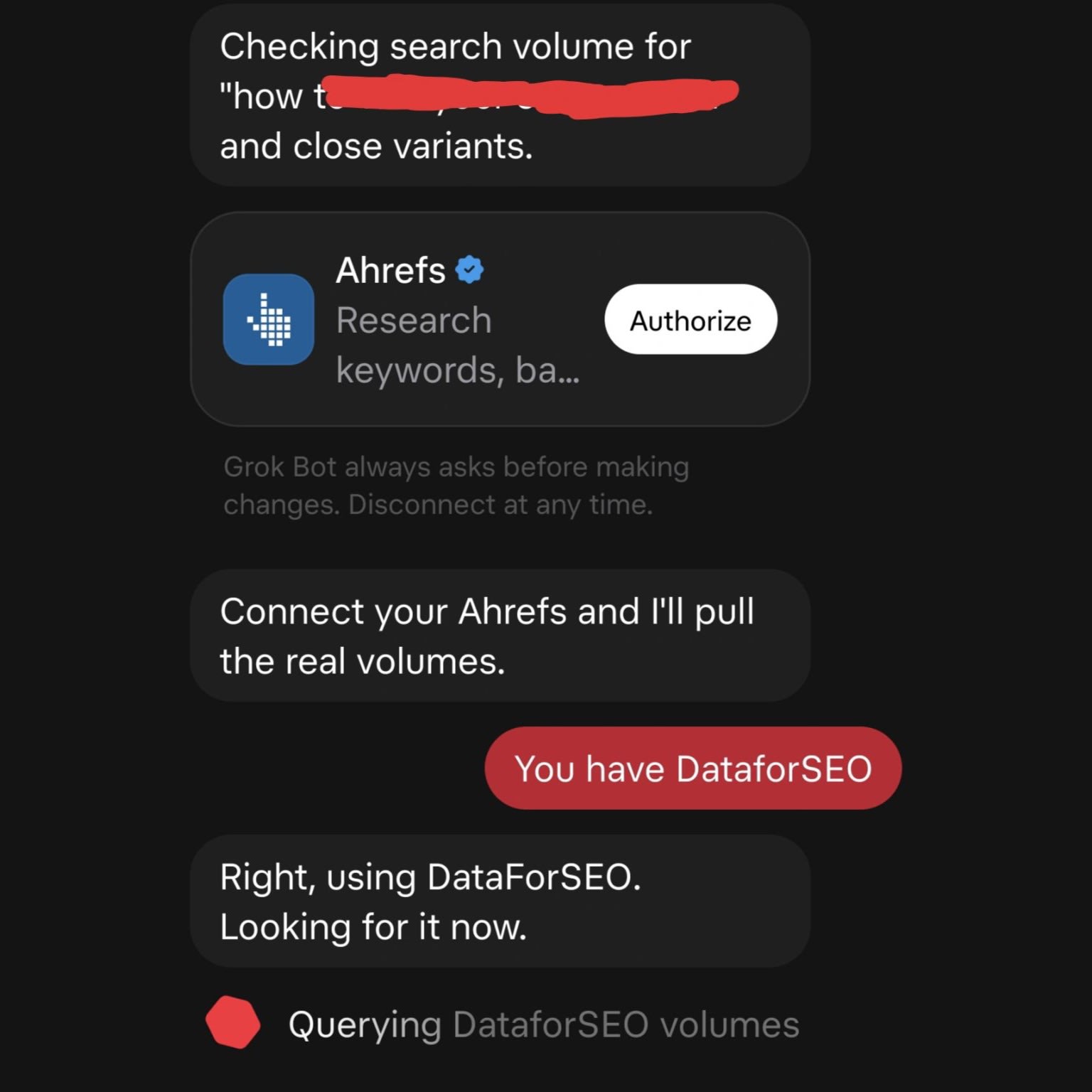
In the first session, the tool already connected won. In the second, a plugin in the agent's own marketplace won over a connected account.
Two sessions are too few to say how these agents rank tools, and PostHog and Ahrefs are both well-known brands the models have read a lot about.
Where to start with the second audience
Run the test first. Microsoft suggests giving an agent a task that does not name your product, such as adding email sending to an app, and watching what it reaches for. Do it in Claude Code, Codex (OpenAI's coding agent), ChatGPT and Grok Bot, a few times each, since answers vary. If you never come up, the moves below are where to begin. If you come up and lose, look at what the winner lets the agent do that you don't.
Be in each agent's own catalogue. Claude suggests connectors inside the conversation, and Anthropic says there are "no paid placements or sponsored answers". When a vendor's CLI runs inside Claude Code, the CLI can ask Claude Code to show a plugin recommendation for the vendor's plugin, as long as that plugin is in Anthropic's official marketplace. As of November 2026 PostHog has a plugin in that marketplace and we found none there for Loops, though my session ran on PostHog's MCP server. Our list of places to submit an MCP server covers each catalogue, what it asks for and how long review takes. The independent MCP directories on that list reach the people who install tools, and crawlers read them like any other site. Apart from Docker's experimental catalogue search, we found no agent that queries them mid-task. A listing that describes the product the way the website and directory profiles do adds to the consensus the first audience already reads.
Write tool names and descriptions an agent can choose from. OpenAI's guidance is that ChatGPT and Codex decide when to call your tool based on the metadata you provide, and it recommends descriptions that start with "Use this when". For an email tool, "Use this when the user wants to send a campaign or an automated email sequence to their contacts" tells the agent more than "Manage campaigns". In ToolTweak, a 2025 research paper on manipulating tool choice, reworded descriptions moved a tool's selection rate from around 20% to as high as 81%, which its authors present as a risk. Both point the same way: say accurately what the tool does, in the words a task would use.
Let the agent finish the job through you. Check which parts of your product's daily work an agent can do through your connector or CLI, and fill the gaps that would send it to another tool. The test above shows where they are: note the step at which the agent leaves your product for another tool or its own code.
Let an agent try you in seconds. Claude Code often writes its own version instead of adopting a tool: Amplifying, an independent benchmark of Claude Code's choices, found in February 2026 that it often built its own solution in 12 of 20 categories. Docs it can fetch as plain text, a free tier and a key it can get without a sales call give it fewer reasons to.
The software directories that people researching with AI read, and that shape what models learn about you, remain the core of what Blastra does. We have also started on the second audience: we keep the list of agent catalogues and MCP directories with a readiness check a marketer can run, have begun submitting MCP servers for customers, and launched our own MCP server in August.
Want help marketing to AI agents?
We are starting to do this work with a few companies: getting your MCP server into each agent's catalogue, writing tool descriptions an agent can choose from, and testing what agents pick. Tell us about your product.
FAQ
Is AEO enough to reach AI agents? AEO reaches people researching with AI and shapes part of what agents already know. An agent choosing a tool for itself can also offer one from its own catalogue, and it needs to be able to do the job through you.
Do review sites affect which tool an agent picks? Assistants often cite review sites when they answer people's questions. We found no test showing that review sites change which tool an agent picks for itself.