


From the Trenches is a Blastra series featuring practitioners solving real problems at work - one shot at a time.
We just wrapped a two-month launch of 2pr.io on AppSumo. Here are the short takeaways, the kind I wish someone had handed me before we started.
First, two bits of context for anyone who doesn't live in this world.
What's AppSumo? It's a deals platform where software companies sell lifetime deals (you pay once instead of subscribing monthly) to a large audience of founders, marketers, and operators hunting for tools. For a vendor it's part launchpad, part trial by fire: thousands of buyers show up at once, and every one of them has a 60-day, no-questions-asked refund window.
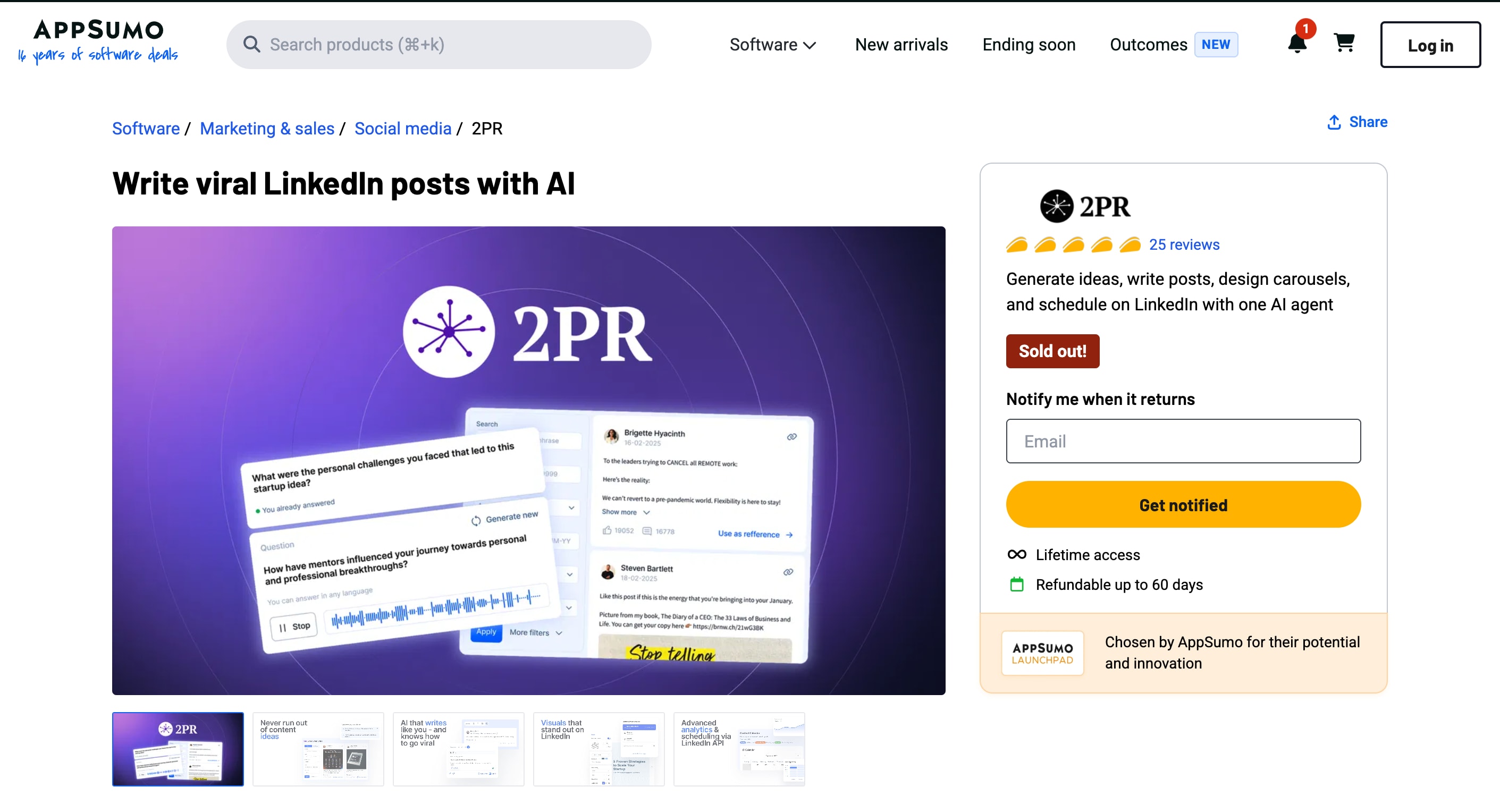
What's 2pr.io? It's an AI agent for growing on LinkedIn: ideas, drafts, visuals, scheduling, replies, and analytics in one app. That's the product we put in front of the AppSumo crowd.
Before You Launch: Getting In, and Getting Ready
You don't just apply and wait. AppSumo has shifted toward sourcing products actively. They scout and approach tools they believe in, rather than working purely from inbound submissions. So there are real people on their side working the process with you. It isn't a black box you submit to and hope.
Budget more time than you think. Total prep runs long, and it's two clocks ticking at once. The first is AppSumo's own readiness to slot your launch; for us that was 3+ months. The second, and the one that matters most, is your product.
The product has to be on par with the best competitors and bug-free from day one. To enforce that, AppSumo runs a thorough multi-stage QA: detailed, multi-page reports that read like a free, active quality review. If your product is buggy or behind the market, they won't let it through. That stage alone took us about a month and a half, across a few rounds. The technical integration, by contrast, is the easy part: well documented, a few days of work.
Then the offer. Get this right or nothing else matters. It isn't something you tune over time; it's a one-shot exercise, and you have to land the number on day one. Do the math and packaging carefully, because of what the price is: a discounted lifetime price, cut further by the platform's 30–50% share. So you model average usage, set a number that survives all of that, and still leave yourself a cushion. 2pr.io fit lifetime well: high willingness to pay, relatively low usage, since people post fairly rarely even though each generation costs us money. Products that are costly to serve forever are where lifetime deals go wrong; video generation is the cautionary tale, with founders who effectively went bankrupt serving users on a one-time fee.
How the Platform Actually Works
Refunds and reviews run 60 days. And it really is no questions asked, none of the soft "refund" you fight for in a web funnel. 😉 That window puts enormous pressure on the product: either it works, or the user refunds. There's nowhere to hide.
The traffic comes from more places than you'd think. AppSumo pulls buyers through several channels at once: their email list, affiliate and partner networks, paid ads on Google and Facebook, plus organic and direct. They invest in performance marketing on your behalf, which is reassuring: the platform is putting its own machine behind your launch and taking a risk alongside you. But the single biggest driver, by a clear margin, is still email. Their own list is what moves the needle.
The economics look brutal on paper. The platform's cut runs 50–70%. On a marketplace of discounted lifetime deals, which already hammers your margin, that sounds like robbery. Partly it is. But given the traffic they bring, and the fact that software has multiplied while the cost of building it has dropped ~10x, the platform sets the terms.
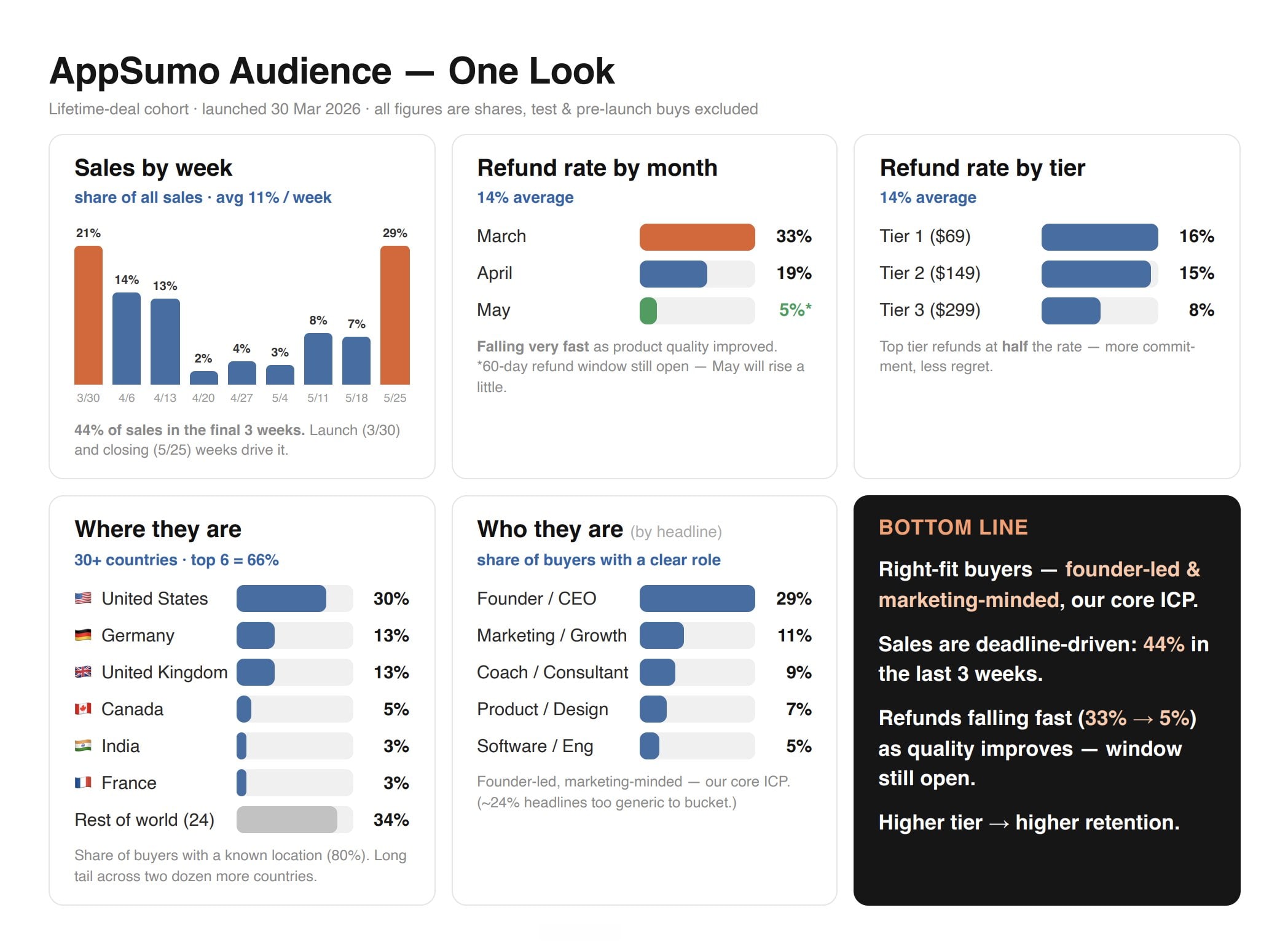
The audience is Western. The main flow came from the US and developed Europe, not the "it's all India" myth you hear. For us it was US 30%, Germany 13%, UK 13%, with the top six countries making up two-thirds of buyers and a long tail across 30+ more.
The feedback is loud, in the best way. These users are engaged. They complain, they want to talk, they send feature requests. They are anything but passive subscribers.
2pr.io's Results
I won't share absolute numbers, but the relative ones tell the whole story.
Refunds as a signal. A high refund rate at the start exposed every weak spot in the product. As we fixed things in real time, refunds fell from 33% in month one to 5% by month three. Average product rating: 4.8. For me, that's the real headline of the launch.
Tier 1 vs. higher tiers. Buyers of the cheapest access (Tier 1) test more and refund more: 16% vs. 8% at the top tier. Higher-tier buyers purchase deliberately, to actually use the tool for work, and they demand a far better product in return. Higher tier, higher retention.
Real B2B. One of our goals was to meet a B2B audience and make 2pr.io work for people running multiple profiles. Goal achieved, and our core buyer turned out to be exactly our ICP: founders and CEOs (29%), then marketing and growth, then coaches and consultants.
Cohort dynamics. The bulk of both sales and refunds hit in the first weeks; in fact, 44% of all sales landed in the final three weeks around the deadline. Later cohorts retained better, because by the end the product had become stable.
Takeaways
1. It's a funded channel, not a payday. Don't expect to get rich here. In practice the platform hands you a loan, paid by your users, to finish building the product; if you break even on fully-loaded cost across the whole run, that's a win. The real prize is what the cash buys: a big first cohort, brutal real-world QA, and a direct line into the segment you came for (for us, B2B).
You can relaunch later, too: once you're in, AppSumo comes back to you. The trap is getting hooked on that easy, one-time revenue, because it doesn't recur. The strongest products tend to graduate: run a deal, then leave to build a recurring business. We might go back, but only after we've shown real recurring growth, so it's a choice rather than a need. The longer game is converting these users into a subscription motion afterward, which works best for tools with ongoing, credit-like usage (email outreach is a good example) and is doable, if not trivial, for the rest.
2. The system forces you to build quality. Two levers you can't game: refunds, and sales that ride directly on reviews that are hard to fake. The numbers above are what that pressure produces: feedback that improved, both in the metrics and in what people wrote.
That second lever is the one I keep thinking about now that the launch is behind us. AppSumo worked as a forcing function because the buyers left a public, verified trail, and that trail decided whether the next buyer showed up. The same logic follows the product everywhere it gets evaluated, long after the deal ends, in the places buyers and AI go to check whether you're real. AppSumo just made the feedback loop short enough to feel in real time.
Bottom line: you have to fight for it. But somewhere in that fight, you end up with a product you're proud to ship.
Have a story from the trenches? Drop us a line at ceo@blastra.io
Related Reading
- Design Partners Trust the Founder. Strangers Trust Other Buyers. — Ami Burstin on the gap between warm intros and the proof a cold buyer needs
- How I Turned Two Days of Recordings Into Six Months of Content — Tom Snyder on solo marketing with AI when there's no team to hand work off to
- How to Launch on AWS Marketplace: What 'Listed' Actually Means — Fahad Jawaid on a very different marketplace launch, where enterprise buyers spend budget they've already committed to AWS
- Directory Strategy as a Competitive Moat — Why a managed third-party presence is hard for competitors to copy
- Top Places to Launch Your Startup — A ranked list of launch platforms, from Product Hunt to BetaList, with traffic stats
- How to Get Reviews on G2 and Capterra: A Vendor Guide — Turning a first cohort into the verified reviews buyers actually trust
- How to Collect B2B SaaS Reviews Without Getting in Trouble — The rules that keep reviews legitimate, and hard to fake
The review trail follows your product everywhere
Blastra is a SaaS listings management platform. We manage your presence across G2, Capterra, SourceForge, and dozens of other directories, so the verified trail buyers and AI check stays accurate long after any launch.