


TL;DR
SoftwareReviews (by Info-Tech Research Group) runs two award programs - Data Quadrant Awards and Emotional Footprint Awards - both based entirely on user reviews. Each review captures up to 130 data points, making this one of the most detailed survey methodologies in the directory space. Listing your product is free, and you can display award badges on your website with a linkback. The catch: SoftwareReviews doesn't publish minimum review thresholds or exact scoring formulas, so you can't reverse-engineer your way to a win. You earn it by collecting high-quality reviews from real users, or you don't. (If you see vendors announcing "Gold Medal" awards - that's the previous name for what's now the "Champion" tier. Same award, rebranded.)
Should You Prioritize SoftwareReviews?
Before diving into methodology, here's the honest assessment.
Yes, if:
- You sell to enterprise IT buyers or government agencies - that's SoftwareReviews' core audience
- Your product is in a category they already track (they cover hundreds of software categories, many split into enterprise and midmarket segments)
- You have customers willing to spend 5-6 minutes on a detailed survey (their reviews go deep - 130 data points, not a quick star rating)
- You want recognition that's entirely review-driven, with no analyst opinion or market presence score mixed in
Probably not your first priority, if:
- You're a consumer-facing or very early-stage startup - the buyer audience skews enterprise/IT
- You have fewer than a handful of customers who could write reviews - the minimum review count isn't published, but you'll need enough to generate statistically meaningful scores
- You need quick wins - Capterra badges have clearer thresholds and faster turnaround
The investment: Claiming a profile is free. Collecting reviews is free (SoftwareReviews even offers gift cards to incentivize reviewers). The main cost is your time - coordinating review requests and optimizing your profile. If you want to use award graphics beyond your website (in sales decks, ads, print materials), you'll need to purchase reprint distribution rights from SoftwareReviews.
Start here: Go to softwarereviews.com/categories, find your category, and look at the current award winners. How many reviews do the top-ranked products have? What are their Composite Scores? That's your benchmark.
Why We Wrote This Guide
SoftwareReviews' methodology documentation is spread across multiple pages - the vendor-awards page, the about page, the what-we-do page, individual category pages, the Info-Tech portal, and older award announcement pages that still use pre-rebrand terminology. The award program recently rebranded from "SoftwareReviews Gold Medals" to "Info-Tech Vendor Awards, Powered by SoftwareReviews," and not all pages have caught up.
We cross-referenced every official source and put it in one place. The source table at the end catalogs what we found, which sources have dates, and which ones you should trust.
What SoftwareReviews Is (And Why It's Different)
SoftwareReviews is a division of Info-Tech Research Group, a global IT research and advisory firm serving more than 30,000 professionals. Founded in 2015 and headquartered in Toronto, SoftwareReviews was built to give Info-Tech's IT advisory clients better data for software selection decisions.
How it compares to other platforms:
| SoftwareReviews | G2 | Capterra | GPI | |
|---|---|---|---|---|
| Scoring basis | 100% user review data | Reviews + Market Presence | Reviews + attribute ratings | Reviews + analyst research |
| Data points per review | Up to 130 | ~50 | ~10 attributes | ~50 |
| Analyst opinion in scoring? | No | No (Market Presence adds non-review factors) | No | Yes (feeds into Magic Quadrant) |
| Badge display cost | Free on website (linkback required) | $2,999+/year subscription | Free forever | Free (strict compliance rules) |
| Buyer audience | Enterprise IT, government | Broad (SMB to enterprise) | SMB to midmarket | Enterprise |
The "100% user review data" claim is worth unpacking: SoftwareReviews doesn't include analyst opinions or market presence scores in their rankings. The composite score aggregates user-provided data - but the formula for weighting those data points is proprietary. So it's user data scored through a proprietary lens, which is a meaningful distinction from platforms that mix in analyst assessment.
The Two SoftwareReviews Award Programs
SoftwareReviews runs two distinct recognition programs per category, staggered roughly six months apart. Each measures something different and carries its own award title.
For example, the Customer Intelligence category shows its next Data Quadrant award in August 2026 and its next Emotional Footprint award in February 2027. Your category's dates will differ - check your category page on softwarereviews.com for specific timing.
Naming note: SoftwareReviews recently rebranded their awards to "Info-Tech Vendor Awards, Powered by SoftwareReviews." Older award pages and press releases still reference "Gold Medal Awards" - that's the same thing as the current "Champion" tier. If you see a vendor announcing a "SoftwareReviews Gold Medal," that's the Data Quadrant Champion badge under its previous name.
1. Data Quadrant Awards (Champions / formerly Gold Medals)
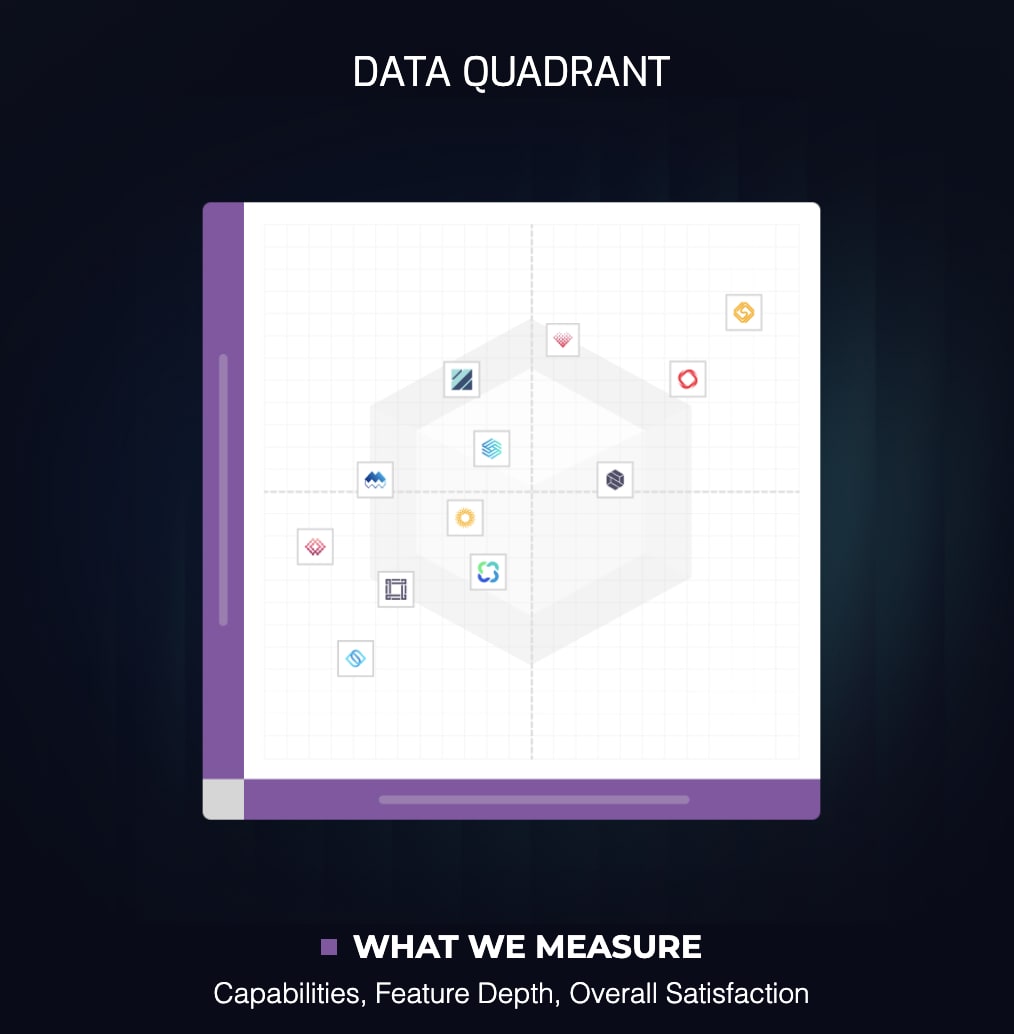
The Data Quadrant is SoftwareReviews' flagship evaluation framework. It plots products in a two-dimensional quadrant - similar in concept to the G2 Grid or Gartner's Magic Quadrant, but scored entirely from user reviews.
The two axes:
| Axis | What It Measures | How It's Scored |
|---|---|---|
| Product Features & Satisfaction (Y-axis) | How satisfied users are with the software itself | Likelihood to recommend + satisfaction across top product features |
| Vendor Experience & Capabilities (X-axis) | How satisfied users are with the vendor relationship | Weighted average of vendor capability scores (implementation, training, support, roadmap) + emotional response ratings (trustworthy, respectful, fair) |
Quadrant placements:
| Placement | Position | What It Means |
|---|---|---|
| Leader | Top-right | Strong on both product features and vendor experience |
| Product Innovator | Top-left | Strong product, developing vendor experience |
| Service Star | Bottom-right | Strong vendor experience, weaker product features |
| Challenger | Bottom-left | Performing well in some areas, trailing in others |
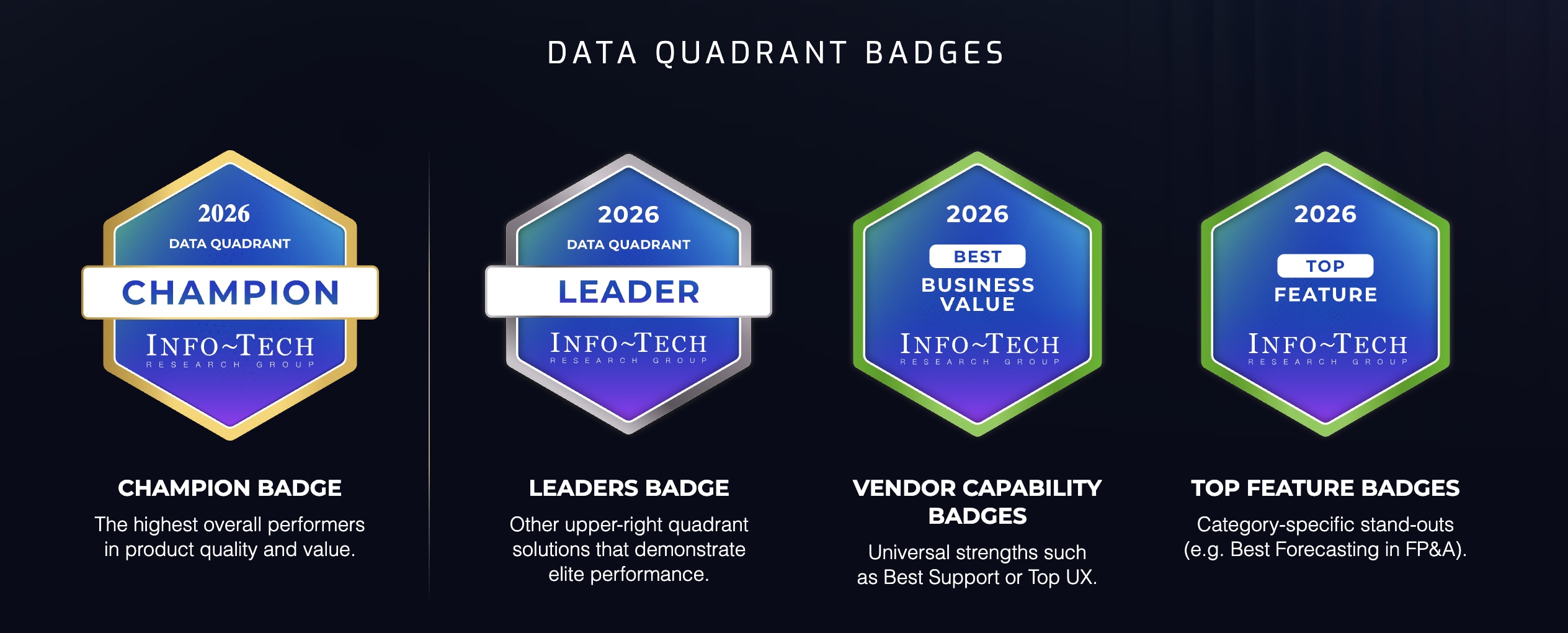
Award badges in the Data Quadrant program:
| Badge | What It Recognizes |
|---|---|
| Champion (gold, formerly "Gold Medal") | Highest overall performers in product quality and value |
| Leader | Other upper-right quadrant solutions with elite performance |
| Vendor Capability (e.g., Best Support, Top UX) | Universal strengths across vendor dimensions |
| Top Feature (e.g., Best Forecasting in FP&A) | Category-specific standout features |
Champions are the headline award. They go to the top-performing products in a category based on a Composite Score (CS) that averages four evaluation areas:
- Net Emotional Footprint - Aggregated emotional response ratings
- Vendor Capabilities - Satisfaction with implementation, support, training, roadmap
- Product Features - Satisfaction across key features
- Likeliness to Recommend - The classic NPS-adjacent metric
The axes are dynamically adjusted based on minimum and maximum values in each category's data set. Your quadrant position is relative to everyone else in your category - there's no fixed score that guarantees a placement.
Go deeper: Data Quadrant Champion and Data Quadrant Leader cover what each tier signals to buyers and AI search — plus Vendor Capability and Top Feature awards for category-specific strengths.
2. Emotional Footprint Awards (Champions)
The Emotional Footprint is SoftwareReviews' measurement of the vendor-customer relationship - the trust and experience dimension that product feature checklists miss.
The Net Emotional Footprint Index tracks responses across 26 dimensions spanning five categories:
| Category | What It Measures | Example Dimensions |
|---|---|---|
| Purchasing | The buying experience | Fair contracting, transparent negotiation |
| Service Experience | Ongoing support quality | Responsiveness, helpfulness, expertise |
| Product Impact | How the product affects daily work | Productivity improvement, reliability |
| Vendor Strategy | Confidence in the vendor's direction | Product roadmap, innovation, market understanding |
| Conflict Resolution | How disputes and problems are handled | Fairness, speed, accountability |
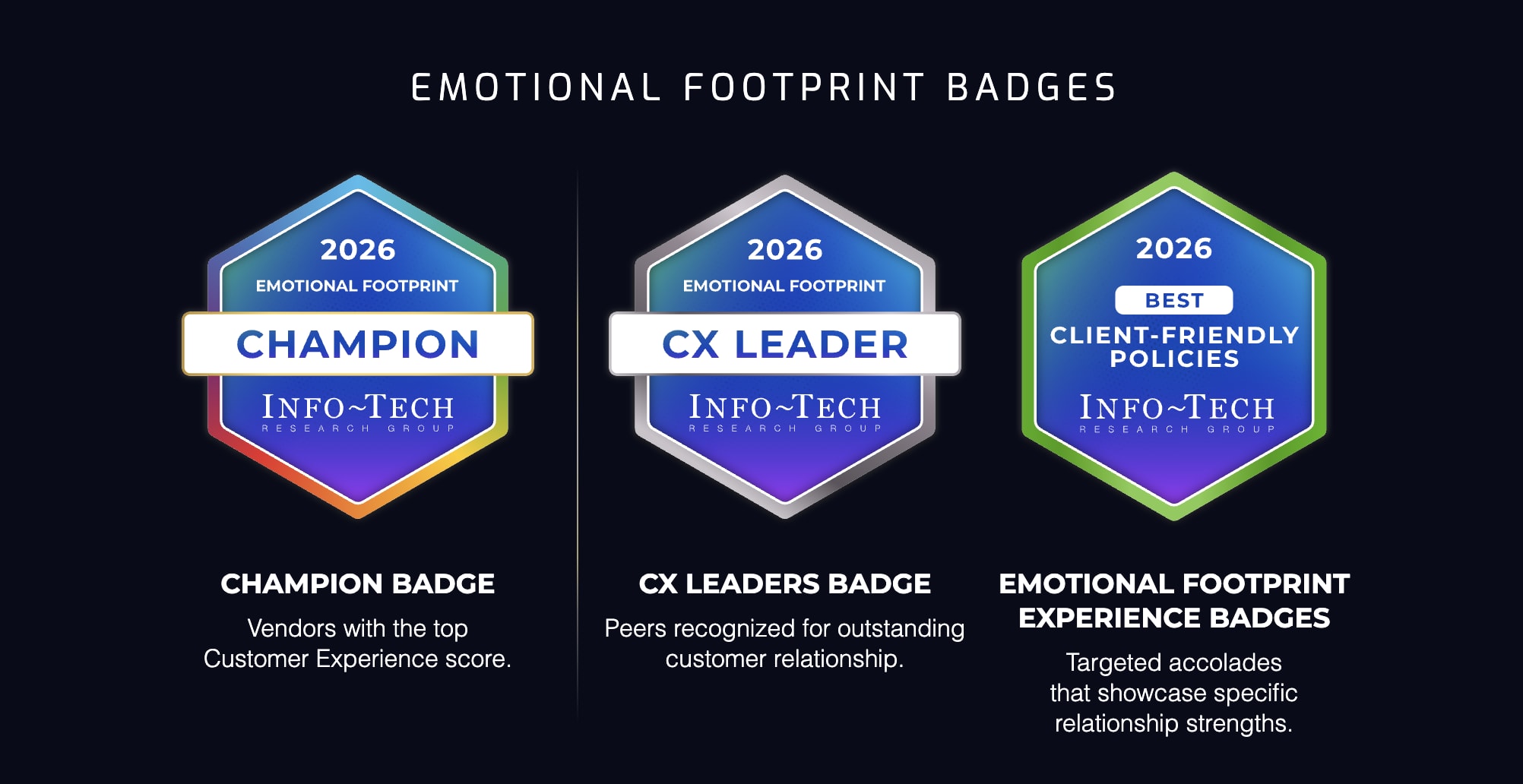
Emotional Footprint Champions are the vendors that score highest across these relationship dimensions in their category.
Go deeper: Emotional Footprint Champion, CX Leader, and Emotional Footprint Experience — how each tier is earned and what it communicates about the vendor-customer relationship.
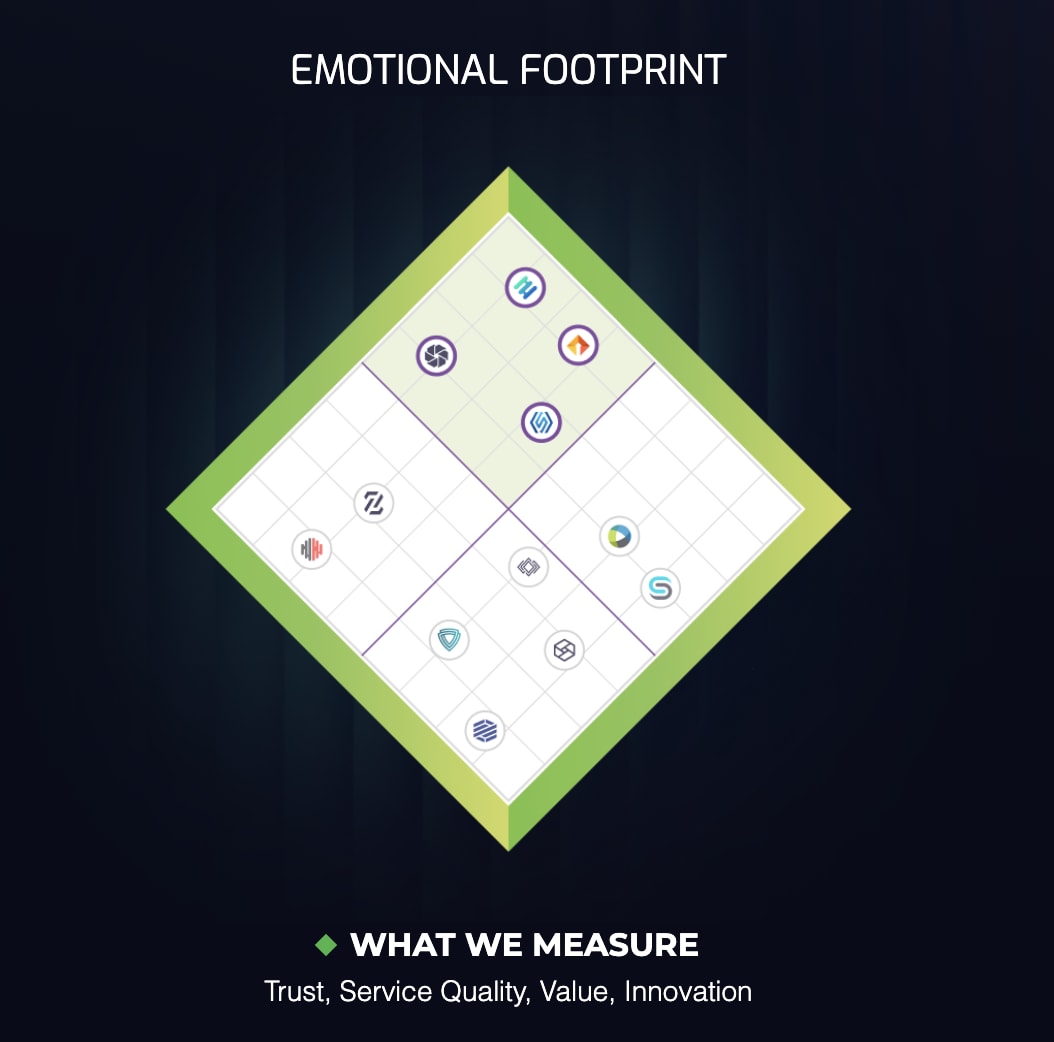
The Emotional Diamond is the visual representation - a diamond-shaped chart that shows how a vendor performs across emotional dimensions compared to perceived value. Think of it as the relationship counterpart to the Data Quadrant's feature-and-capability assessment.
How the Review Process Works
SoftwareReviews collects reviews through a proprietary online survey that captures up to 130 data points per review. Here's what reviewers go through:
Survey details:
- Takes 5-6 minutes to complete
- Covers 11 product features and 11 vendor capabilities
- Includes emotional response ratings across 26 dimensions
- Asks for likelihood to recommend and overall satisfaction
- Reviewers authorize publication of their name, title, organization, and LinkedIn profile photo
Review incentives: SoftwareReviews offers gift cards for reviews that meet their quality standards. This is standard across the industry - G2, Capterra, and others also incentivize reviews. Worth knowing because incentivized reviews tend to skew positive (vendors naturally solicit happy customers).
The output per product:
- Product Scorecard - Detailed ratings across all 11 features and 11 capabilities, with competitive rankings for each factor
- Data Quadrant placement - Where the product falls in the Leader/Product Innovator/Service Star/Challenger quadrant
- Emotional Footprint profile - The diamond visualization showing relationship quality
Free Awards, Paid Advisory: The Business Model
SoftwareReviews' award programs are free to participate in - but the platform also has a paid side worth understanding.
Free for vendors:
- Claiming and maintaining your product profile
- Collecting reviews through the platform
- Earning award placements and badges
- Displaying badges on your website (with linkback)
Paid vendor services:
- Reprint distribution rights for using badges in broader marketing (sales decks, ads, print)
- Marketing content packages (category reports, infographics, buyer experience reports)
- Analyst advisory and research access
- Review collection campaign support
Paid buyer services:
- Software selection advisory engagements
- Full-service consulting for complex procurement decisions
What this means for your awards: Award eligibility is based entirely on user reviews, with no paid placements or analyst opinions influencing results. The paid services are optional marketing and advisory tools. You don't need to buy anything to earn or display recognition on your website.
How to Work Toward SoftwareReviews Awards
SoftwareReviews awards are automatic - there's no application process. If your product collects enough qualifying reviews with high enough scores, you're eligible. Here's what you can control:
Step 1: Claim Your Profile
Go to provider.softwarereviews.com and claim your product profile. Once approved, you'll get an onboarding call. This is free.
Optimize your profile with:
- Product overview and description
- Screenshots and demo videos
- Customer testimonials
- Whitepapers and collateral
A complete profile doesn't affect your review scores directly, but it does affect how buyers perceive your product when they find you on the platform.
Step 2: Start Collecting Reviews
This is where the work lives. SoftwareReviews reviews take 5-6 minutes and go deep, so you need customers who are willing to invest that time.
Practical tips:
- Target customers who've had a strong experience with both your product AND your support team - the survey measures both
- Time your outreach after successful implementations or support interactions
- Be upfront about the survey length - 5-6 minutes is more than a quick G2 review
- SoftwareReviews provides its own review collection tools through the vendor portal
- Reviewers can earn gift cards for qualifying reviews, which helps incentivize participation
Step 3: Focus on What the Survey Measures
Since you can't see the exact scoring formula, focus on the inputs you can influence:
For Data Quadrant placement (features + vendor experience):
- Product quality and feature satisfaction - the product itself needs to deliver
- Implementation experience - smooth onboarding matters
- Training and documentation - do users feel supported?
- Customer support quality - responsiveness and helpfulness
- Product roadmap confidence - do users trust your direction?
For Emotional Footprint (relationship quality):
- Purchasing experience - was the sales process fair and transparent?
- Ongoing service - are you responsive when things go wrong?
- Conflict resolution - how do you handle disputes?
- Strategic trust - do customers believe in your product vision?
Step 4: Monitor Your Category
Check your category page on SoftwareReviews periodically. You can see:
- Your Composite Score and CX Score
- How you rank relative to competitors
- Where you sit in the Data Quadrant (if included in the latest report)
Reports are published approximately twice a year per category.
Step 5: Use Your Awards
If you earn recognition:
Free (with conditions):
- Display award badges on your website - must link back to SoftwareReviews (your product page, category award page, or main award page)
Requires purchased reprint rights:
- Using award graphics in sales decks, advertisements, email campaigns, print materials
- Using Data Quadrant visualizations, Emotional Footprint diamonds, or other branded graphics in unlimited digital and print formats
- Any formatting changes (color, font size) to badge graphics
Attribution always required:
- Reference SoftwareReviews and the specific report
- Include a link to softwarereviews.com
Contact vendors@softwarereviews.com for reprint and web rights pricing.
Quick Reference
Data Quadrant Awards
- Composite Score on a 1-10 scale
- Four components: Features, Capabilities, Emotional Footprint, Likelihood to Recommend
- Quadrant positions: Leader, Product Innovator, Service Star, Challenger
- Top tier: Champion badge (formerly "Gold Medal")
- Additional badges: Leaders, Vendor Capability (e.g., Best Support), Top Feature (category-specific)
- Published once per year per category
Emotional Footprint Awards
- CX Score on a 1-10 scale
- 26 dimensions across 5 relationship categories
- Top tier: Emotional Footprint Champion badge
- Additional badges: CX Leaders, Emotional Footprint Experience badges (specific relationship strengths)
- Published ~6 months after the Data Quadrant for each category
General
- Profile: Free to claim
- Badge display: Free on website (linkback required); broader marketing requires reprint rights
- Review verification: Name, title, organization, LinkedIn profile published
- Review survey length: ~5-6 minutes
- Review incentive: Gift card for qualifying reviews
- Data points per product: Up to 130
- Parent company: Info-Tech Research Group (Toronto, founded ~1997)
- Award branding: "Info-Tech Vendor Awards, Powered by SoftwareReviews" (current); "SoftwareReviews Gold Medal" (legacy)
What We Don't Know
SoftwareReviews' documentation leaves several questions unanswered for vendors trying to plan strategically:
- Minimum review count - The official language says vendors need "a minimum number of current reviews in the year." The specific number isn't published.
- Composite Score thresholds - What score earns a Gold Medal vs. a Leader placement vs. no award? The axes are dynamically adjusted, so thresholds shift by category and reporting period.
- How recency weights reviews - Recency is listed as a factor in product placement, but the decay curve isn't documented.
- Review eligibility window - How old can a review be and still count toward the current evaluation? "Current reviews in the year" is the closest language available, but whether that means calendar year or rolling 12 months isn't clear.
- Exact award publication schedule - Each category gets one Data Quadrant and one Emotional Footprint report per year, staggered ~6 months apart. But there's no single public calendar - you have to check your specific category page for dates.
- How the rebrand affects older badges - "Gold Medal" is becoming "Champion." Vendors who won Gold Medals in previous years may still display those badges. Whether old badge graphics remain valid or need replacing with the new branding isn't documented.
- Reprint rights pricing - Contact vendors@softwarereviews.com. Not published publicly.
- Total category count - Described as "hundreds" in press materials, but the exact count isn't documented.
This level of opacity is common across software directories. SourceForge doesn't publish thresholds either, and even G2's Grid methodology has proprietary elements. It makes strategic planning harder - you're aiming at a target you can see but can't measure precisely.
SoftwareReviews vs. Other Platforms
If you're deciding where to invest your review campaign efforts, here's how SoftwareReviews compares:
| Factor | SoftwareReviews | G2 | Capterra | GPI |
|---|---|---|---|---|
| Best for | Enterprise IT buyers | Broad B2B discovery | SMB/midmarket comparison | Enterprise analyst credibility |
| Review depth | 130 data points | ~50 data points | ~10 attributes | ~50 data points |
| Scoring method | 100% user reviews | Reviews + Market Presence | Reviews + attribute ratings | Reviews + analyst integration |
| Minimum reviews | Not published | 10 for Grid placement | 20 for badges | Not published (per-market) |
| Badge display cost | Free on website | $2,999+/year | Free forever | Free (strict compliance) |
| Award frequency | ~Twice annually | Quarterly | Quarterly | Per-market schedule |
| Unique value | Deepest survey methodology | Largest review volume | Clearest badge thresholds | Feeds into Magic Quadrant |
Our take: SoftwareReviews is worth the effort if your buyers are enterprise IT professionals who trust Info-Tech Research Group as an advisory source. The 130-data-point survey produces detailed evaluations that go well beyond a simple star rating. If you're already collecting reviews on G2 or Capterra, adding SoftwareReviews diversifies your visibility posture - you're reducing dependence on a single platform's pricing changes or algorithm updates. If you have limited review collection capacity, Capterra gives you the clearest path to badges with published thresholds.
Key Takeaways
- Two distinct programs, staggered ~6 months apart. Data Quadrant Awards (Champions + quadrant placement) measure features and vendor capabilities. Emotional Footprint Awards (Champions) measure the vendor-customer relationship. Earning both is the strongest signal.
- 130 data points per review. The deepest survey methodology in the directory space. Reviews take 5-6 minutes, so you need engaged customers willing to invest the time.
- User review data, with proprietary weighting. No analyst opinion or market presence score in the rankings. But the formula for combining those 130 data points isn't public. "Transparent" means reports show the components.
- Free to list and earn. Claiming a profile is free. Collecting reviews is free. Displaying badges on your website is free (with a linkback). Broader marketing use requires paid reprint rights.
- Thresholds aren't published. You can't aim for a specific score because the quadrant axes adjust dynamically based on your category's data. Focus on collecting high-quality reviews rather than targeting a number.
- Enterprise IT audience. If your buyers research software through Info-Tech or trust their advisory services, SoftwareReviews recognition carries weight. Less relevant for consumer tools or very early-stage startups.
- Rebrand in progress. "Gold Medal" is becoming "Champion." "SoftwareReviews Awards" is becoming "Info-Tech Vendor Awards." If you see either name, it's the same program.
- Diversification play. Adding SoftwareReviews to your review portfolio alongside G2, Capterra, or GPI reduces your dependence on any single platform's pricing or algorithm changes.
FAQ
What's the difference between a SoftwareReviews Data Quadrant Award and an Emotional Footprint Award?
Data Quadrant Awards measure product features and vendor capabilities — plotted on a two-axis chart (Y = Product Features & Satisfaction, X = Vendor Experience & Capabilities). Emotional Footprint Awards measure the vendor-customer relationship across 26 dimensions spanning purchasing, service, product impact, vendor strategy, and conflict resolution. Each category gets one Data Quadrant report and one Emotional Footprint report per year, staggered approximately six months apart.
Was the SoftwareReviews Gold Medal renamed?
Yes. "Gold Medal" is now "Champion." The broader program also rebranded from "SoftwareReviews Awards" to "Info-Tech Vendor Awards, Powered by SoftwareReviews." If you see a vendor announcing a SoftwareReviews Gold Medal, that's the current Champion tier under its previous name.
Is there a minimum number of reviews needed for a SoftwareReviews Champion badge?
SoftwareReviews says vendors need "a minimum number of current reviews in the year" but doesn't publish the specific number. The quadrant axes adjust dynamically based on each category's data, so thresholds shift by category and reporting period. Focus on collecting high-quality reviews from engaged customers rather than targeting a fixed number.
Are SoftwareReviews badges free to display?
Free on your website with a linkback to SoftwareReviews (your product page, category award page, or main award page). Broader marketing use — sales decks, ads, email campaigns, print materials, or any formatting changes to the badge — requires purchased reprint distribution rights. Contact vendors@softwarereviews.com for pricing.
How is SoftwareReviews different from G2 and Capterra?
Three main differences. First, SoftwareReviews scoring is 100% user-review based — no Market Presence score, no analyst opinion. Second, reviews capture up to 130 data points each (G2 ~50, Capterra ~10 attributes), which is why reviews take 5-6 minutes. Third, the audience is enterprise IT and government buyers who trust Info-Tech Research Group as an advisory source. G2 and Capterra serve a broader audience; SoftwareReviews is narrower and deeper.
How often does SoftwareReviews publish awards?
Approximately twice per year per category — one Data Quadrant report and one Emotional Footprint report, staggered about six months apart. There's no single published calendar; specific dates are on individual category pages at softwarereviews.com/categories.
Does SoftwareReviews include analyst opinions in the scoring?
No. All scoring comes from user review data — likelihood to recommend, feature satisfaction, vendor capabilities, and emotional response ratings. The formula for combining those 130 data points is proprietary, but no analyst assessment or market presence score is mixed in.
Source Documentation
We reviewed every official source we could access. SoftwareReviews' main site is JavaScript-rendered, so some pages required indirect research through search results and third-party coverage.
Primary Sources (Dated or Official)
| Source | Date | Notes |
|---|---|---|
| SoftwareReviews Vendor Awards | Accessed March 2026 | Award tiers, methodology, badge descriptions, eligibility |
| 2025 Top-Rated Software Press Release | 2025 | Confirms methodology, 130 data points, composite score structure |
| SoftwareReviews Vendor Portal | Current | Profile claiming, features, onboarding process |
| Usage and Attribution Policy | Current | Badge display rules, reprint rights, attribution requirements |
| Customer Intelligence Category Page | Accessed March 2026 | Live example of scores, badges, quadrant, and schedule |
| About SoftwareReviews | Current | Company background, methodology overview |
Secondary Sources (No Date or Third-Party)
| Source | Notes |
|---|---|
| B2B SaaS Reviews Overview | Third-party overview, useful for context |
| Individual vendor win announcements (Convene, Applauz, QorusDocs, Ivanti, Avolution) | Confirm award structure and terminology |
About This Guide
This guide was researched and written by Blastra, a SaaS listings management platform that helps software companies manage their presence across directories. We work in these platforms daily and write about them because we've mapped how they work.
Last verified: March 2026
Freshness note: SoftwareReviews updates their reports and methodology periodically. If you're reading this more than six months after the verification date, check SoftwareReviews' awards page for any changes. Platform methodologies evolve, and what's accurate today may shift.