

When a buyer starts shortlisting software, and when an AI assistant assembles the same shortlist on their behalf, both read from the same set of places: the directories, review sites, and catalogs that describe what each product is and who it serves. Those catalogs shape the comparison before a vendor gets a word in. And the market of directories itself has never been easy to see as a whole. There are dozens of them, they overlap, and which ones matter for any given product is rarely obvious from the inside.
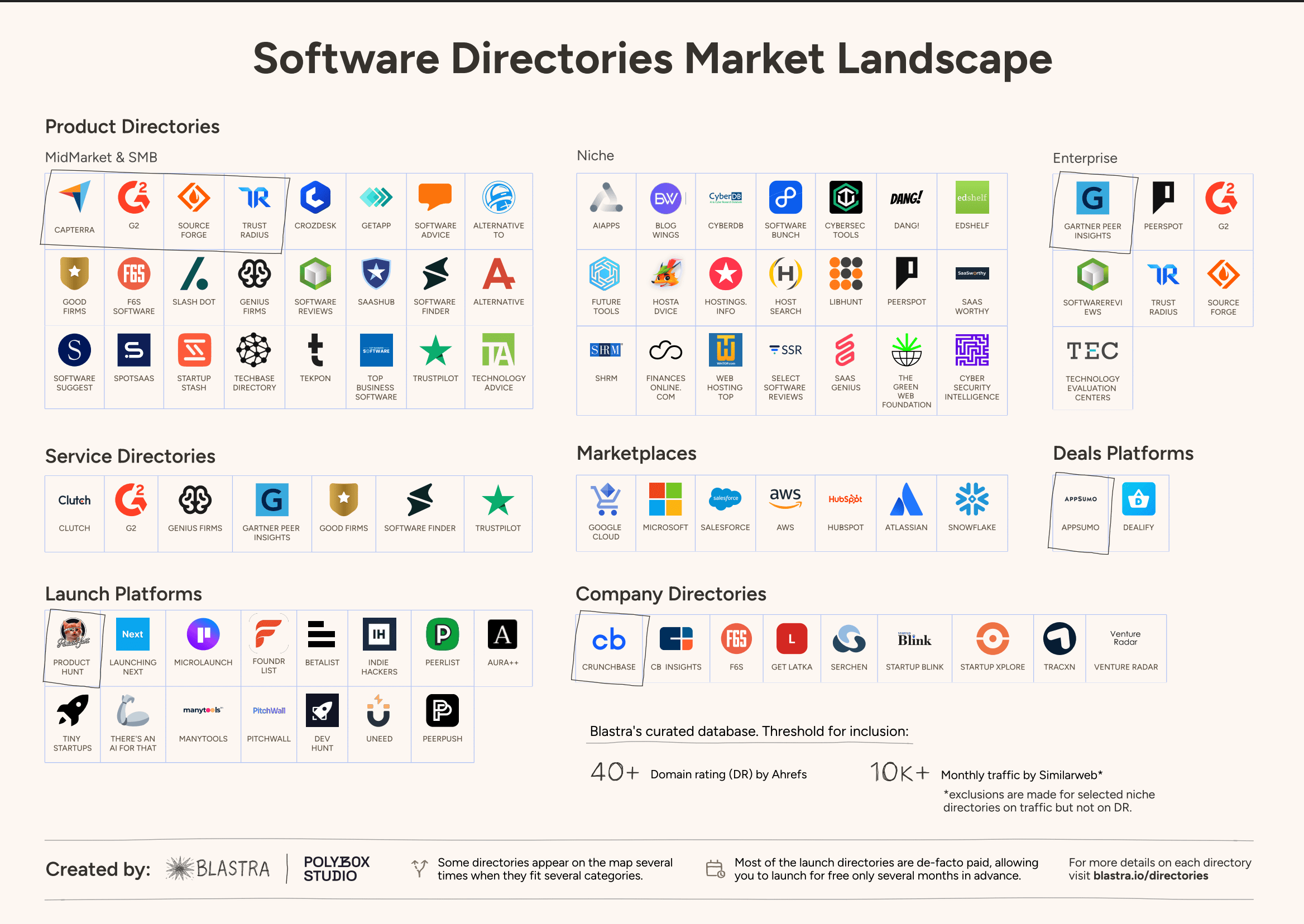
So we drew it. Together with Polybox, a design studio that works with B2B SaaS teams, we built the Software Directories Market Landscape: one view of the catalogs that AI and buyers use to research, discover, compare, and select B2B tech products and services. (The common thread is tech; every catalog serves software and tech companies.) It's free to download, and there's no email wall in front of it.
Directory names and logos shown are the property of their respective owners. Blastra is independent and not affiliated with or endorsed by the directories on the map.
Why we built this
From the outside, every software catalog looks interchangeable, and the space is genuinely hard to read. Community-built lists make it worse: they mix directories in with subreddits and launch platforms, and they keep sending founders to list their product on Clutch, a services directory that was never built for products. A lot of listing effort gets spent in the wrong places.
We see directories differently: they are the trust infrastructure behind AI recommendations. Most have spent years, some of them decades, building the processes that discovery and selection run on: verifying submissions, curating categories, checking that reviews are authentic. That work is exactly what an AI system leans on when it decides which products to trust.
The influence runs deeper than citations. Even when an AI answer doesn't name a directory as its source, these catalogs are the kind of public record models learn from, and they shape what a model remembers about a product long before anyone asks the question. Getting your presence right across them is how you influence what AI takes away about your product.
How the map is organized
The landscape sorts the market into six families:
- Product Directories: where a buyer researches and compares a specific tool. The largest family; within it, catalogs are grouped by the buyer each serves: enterprise, mid-market and SMB, or niche.
- Service Directories: catalogs built for agencies and service providers rather than software products.
- Company Directories: where the company itself is researched, including startup databases and funding trackers.
- Marketplaces: platforms where discovery and purchase happen in one place, inside a cloud or ecosystem the buyer already uses.
- Deals Platforms: where products are found through offers and lifetime deals.
- Launch Platforms: where a new product announces itself to early adopters.
Two things are worth knowing before you read it. A single catalog can sit in more than one family, because some sites cover both products and services, or both a company and its products, so a few names appear more than once. And many launch platforms are effectively paid in practice: they let you launch for free only if you book a slot months ahead.
What earns a place
The map is hand-curated. We pick platforms that have a reputation among humans and AI, some decades old and some relatively new (especially the launch platforms). Regardless of age, status, or category, every catalog clears an authority bar (a Domain Rating threshold from Ahrefs) and a traffic bar measured by Similarweb. Niche directories clear the same authority bar but may qualify on lower traffic, because a focused, relevant listing carries real weight even at smaller scale. No placement can be bought, and every catalog is a software or tech directory: the map leaves out local-business and general listing sites.
See it for yourself
Open the Software Directories Market Landscape
The full interactive map, all six families with every directory linked, and the free PDF, all on one page. Run a directory we've missed? You can nominate it there too.
The landscape is a living document. We refresh it as the market moves and new data comes in, so the version on the page is always the current one. This is the July 2026 edition.
Related reading
- What Are Software Directories?
- How B2B Software Gets Discovered by AI Search
- 50 Free B2B SaaS Directories - Every directory that lists a product at no cost, with domain authority and traffic