

Visibility Posture is how Blastra reports what your directory presence actually looks like.
Sign up and our agent runs an assessment of your presence across software directories. The first scan is free, before you pay for anything. It checks four things — and each one is a deliberate choice about what matters.
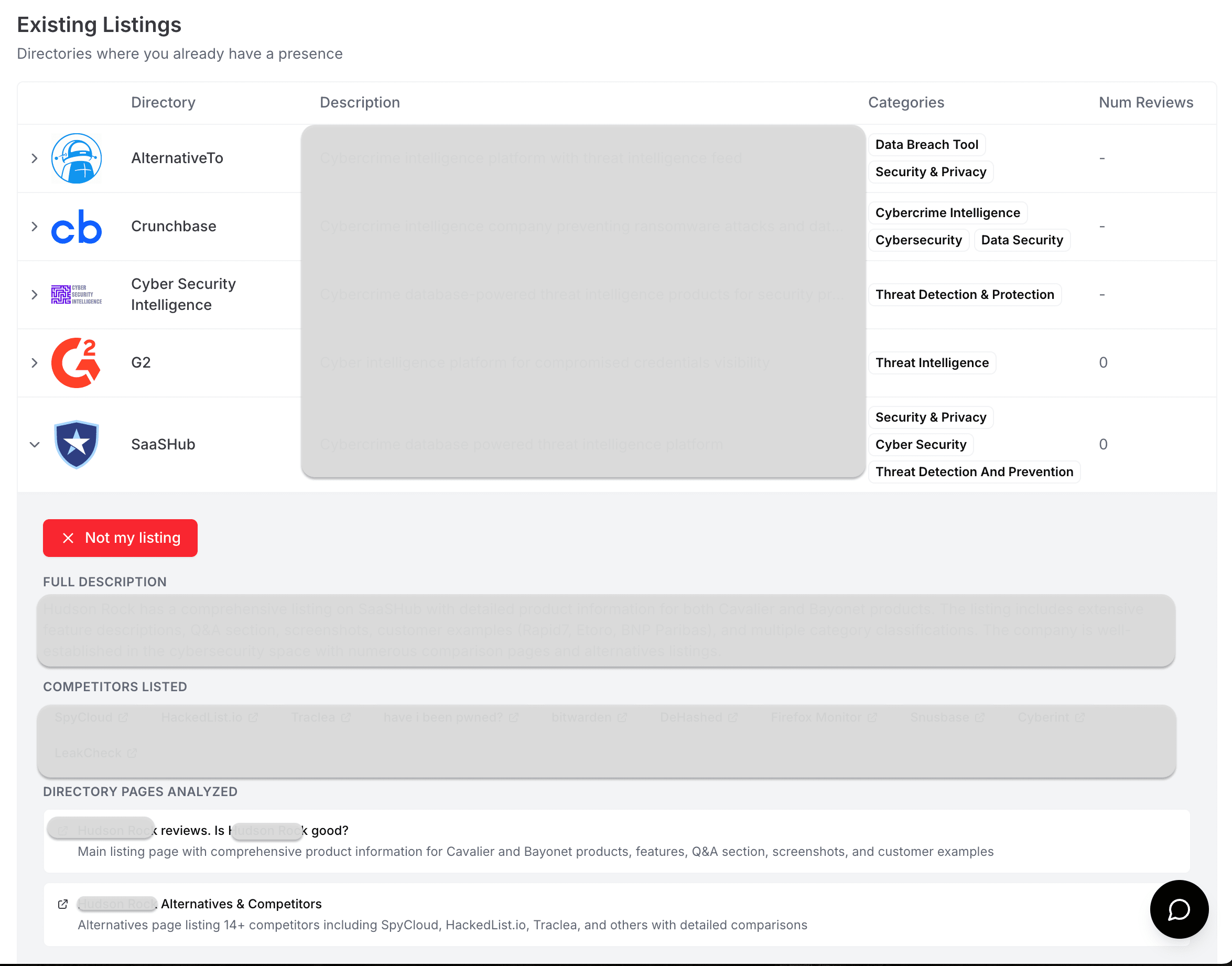
Where you are. Which directories have an active listing for you. Some were created by you, some by a former employee, some auto-generated by the platform itself. The agent finds what actually exists.
What category you're in. How each platform classifies your product. Category determines which comparison pages you appear on and which searches surface you.
What AI understands about your product. What a language model can extract about what you do, who you serve, and what makes you different — from your third-party presence, not your own website. This is the view from outside.
How many reviews you have, per platform. No quality judgment yet — just the count. Volume tells you where you stand relative to others in your category.
From there, you can select new directories to get listed on, or flag existing ones you want us to manage and keep current. The next phase adds review sentiment — what your reviewers consistently say, not just how many you have. After that: scoring, so you can assess your visibility posture at a glance and act on it.
Why SaaS Product Visibility Matters More Than Your Website
On your website, you choose which testimonials to publish and which feedback stays internal. You are biased. On a review platform, you don't control what gets written, what gets published, or how it reads. That's what makes reviews evidence.
Savvy buyers know that. Since the early 2000s, they've been shopping for software on directories that offer convenient ways to compare apples to apples — and to quickly understand what verified users actually say in unedited reviews.
AI by itself isn't that savvy yet. When asked, it gives you surface-level information — and being present on directories helps you show up in those answers. A savvy buyer will then use AI to dig beneath the surface: what do real users say across multiple platforms? That investigation is now faster and cheaper than it's ever been.
This is the work that happens before a buyer ever takes a meeting. Ami Burstin, a fractional CMO, wrote about watching a good company fail in exactly this gap — warm-network deals closed, cold pipelines stalled, and the difference was the proof a stranger needs before they'll evaluate you at all.
But AI is getting better. We believe the next phase of software discovery via AI will be presenting deeper findings without being asked. And those deeper findings live in the same place — software directories with verified reviews. It's where authentic information lives. It's also where the most structured data lives — products categorized, grouped, and reviewed in a format AI can read efficiently without scraping the entire web. According to AirOps research (October 2025), brands are already 6.5x more likely to be cited through third-party sources than through their own domains.
Why we call it "posture"
We borrowed the term from cybersecurity. In cyber, "security posture" is an organization's overall readiness to identify, prevent, and respond to threats — assessed continuously and improved as the landscape changes. Nobody treats security as a one-time project. You assess your posture and maintain it.
The same logic applies here. Your visibility posture is the state of your presence across directories and review platforms. It changes as your product evolves, as platforms update their taxonomy, as new reviews come in or stop coming in, as competitors improve their own presence. It needs ongoing attention — assessment, then maintenance.
That's what we're building toward. The assessment tool shows you where you stand. The platform and SaaS listings management service help you maintain and improve it.
FAQ
What is SaaS product visibility?
SaaS product visibility is how reliably buyers and AI systems can find, identify, and understand your software when they go looking for a solution in your category. It isn't a single number — it's a combination of which software directories list you, how each platform categorises your product, how many verified reviews you have, and what AI models can say about you from third-party sources (not your marketing site). Visibility Posture is our term for that combined state.
How do I improve my SaaS visibility in AI search?
AI models pull from structured, third-party sources far more than from vendor-controlled copy — one study found brands are 6.5x more likely to be cited through third-party sources than through their own domain. To improve AI visibility, list on the directories your buyers and LLMs actually query (G2, Capterra, SourceForge, TrustRadius, category-specific platforms), keep product descriptions and categorisation accurate across all of them, and build consistent verified reviews. AI rewards consensus across independent sources, not volume on any single channel.
What affects SaaS product visibility on directories?
Five things carry most of the weight: (1) whether you have an active, claimed listing at all; (2) correct category placement — the wrong category pulls you into comparison sets you'll lose; (3) review volume and recency relative to competitors in that category; (4) how clearly your description explains what the product does in structured, directory-friendly language (see why directory descriptions work better when written for the format); (5) whether the data stays current as your product evolves — stale listings leak trust with both buyers and AI.
What's the difference between SaaS visibility and Visibility Posture?
"SaaS visibility" is the general concept — can people and AI find your product. "Visibility Posture" is Blastra's framework for assessing and maintaining it: a continuous measurement of where you appear, how you're categorised, what AI understands about you, and how your review footprint compares to competitors. Borrowed from cybersecurity's "security posture," the word signals that visibility is something you assess regularly and maintain, not a one-time setup task.
Related Reading
- Directory Strategy as a Competitive Moat — Why a managed third-party presence is hard for competitors to copy
- How to Get Ranked on G2 — Satisfaction and Market Presence, review thresholds, and how Grid placement is scored
- How to Get Reviews on G2 and Capterra — Verification rules, character minimums, and incentive options that stay within policy
- SaaS Directory Submission Service — How Blastra picks the directories that fit, submits, and keeps every listing current
- Blastra's plans and pricing
See your visibility posture
Sign up and our AI agent assesses where you appear, how you're categorized, what AI understands about you, and your review footprint across directories. The first scan is free.