


Beyond G2 and Capterra: the vertical directories, ecosystem marketplaces and integration listings where telecom, industrial and other technical buyers build their shortlists.
TL;DR
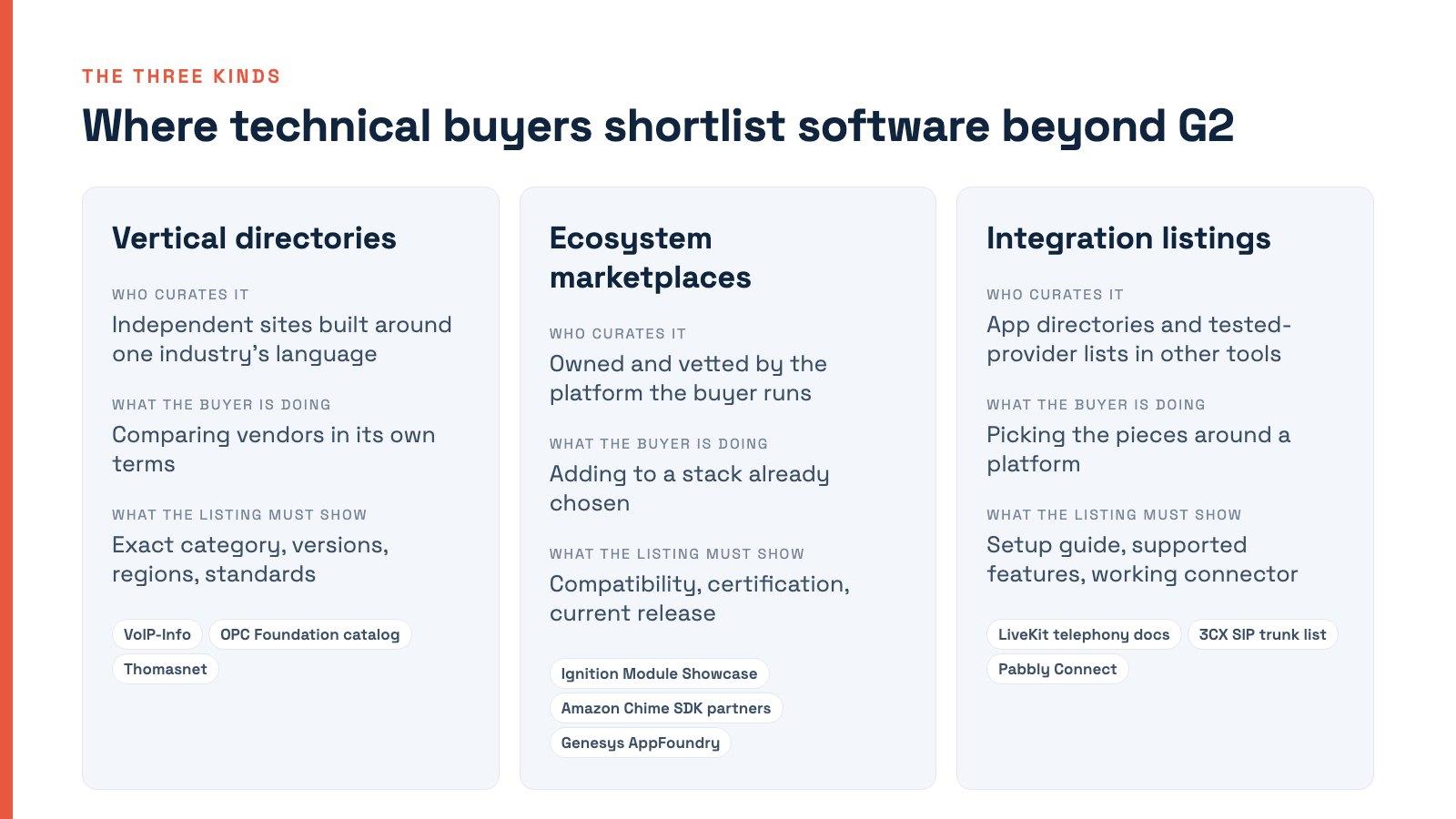
If you sell SIP trunks, SCADA add-ons, MQTT tooling or anything else an engineer buys, the big review grids are only the floor of your directory plan. Your buyers shortlist in three kinds of niche software directories: vertical directories built around one industry's language, ecosystem marketplaces run by the platform they already use, and integration listings inside the tools your product connects to.
Pick them with a five-question test (do your buyers browse it, does it show up for your category prompts, is the taxonomy precise, what does it cost to keep accurate, does it carry trust). Then keep every listing current. Below we walk through two real examples: a global telecom carrier and a Swiss Ignition module developer.
What are niche software directories?
Niche software directories are listing sites that serve one industry, one technology stack or one buyer job, instead of every category at once. A general directory asks "what software do you sell?" A niche one asks a sharper question: which PBX do you work with, which gateway version do you support, which countries can you deliver numbers in.
They sit in one zone of the wider map of software directories, marketplaces and launch platforms, and the line between them and marketplaces is blurry on purpose. If you need the basics first, here is how a directory differs from a marketplace. For this guide, "niche directory" covers anything a technical buyer uses to find and compare vendors inside their own world, whether it calls itself a directory, a showcase, a partner list or a docs page.
Why G2 and Capterra under-serve technical categories
General review sites still matter. In G2's survey of more than 1,000 B2B software buyers, AI chat came out as the top source for building a software shortlist, with review websites second and vendor websites third. That is a strong case for being listed. It is a weak case for stopping there, for three reasons.
- The taxonomy is too wide. "SIP trunking" or "SCADA module" sits inside a broad telephony or automation bucket next to products that solve a different problem. A buyer scanning that category sees noise, and your listing competes with tools it never meets in a real deal.
- Engineers start inside their stack. Someone running Inductive Automation's Ignition looks for add-ons where Ignition lists them. Someone wiring an AI voice agent looks at the voice platform's list of tested carriers. The review grid comes later, if at all.
- AI answers follow the specific page. In Forrester's 2024 Buyers' Journey Survey, 89% of buyers used generative AI in at least one part of their purchase. When the prompt is narrow ("which SIP providers work with LiveKit"), the assistant leans on the page that answers that exact question, and that page is usually a partner list or a docs table.
The three kinds of niche software directories
1. Vertical (industry-specific) software directories
Industry-specific software directories are built around one sector's vocabulary. Think a VoIP wiki with a page per carrier, an industrial sourcing catalog, or a product catalog run by a standards body. They win on precision: the categories match how the buyer already talks, so a correct listing reads like an answer. Traffic is usually small. That is fine, because the visitors who do arrive are close to a decision.
2. Ecosystem and partner marketplaces
These are catalogs owned by a platform: a module showcase, a certified carrier list, a partner directory inside a cloud or contact-center suite. The platform vets who gets in, which is exactly why buyers trust them. The big cloud and SaaS marketplaces (AWS, Microsoft, Salesforce and friends) belong here too, but for technical niches the smaller ecosystems often do more work, because the platform owner sends its own users there.
3. Integration directories
Every tool your product connects to probably keeps a list of what it connects with: an app directory, a connector catalog, a "tested providers" table in its developer docs. These are the most overlooked listings on most vendors' plans, and some of the most valuable. A buyer reading them has already chosen the platform and is now choosing the pieces around it.
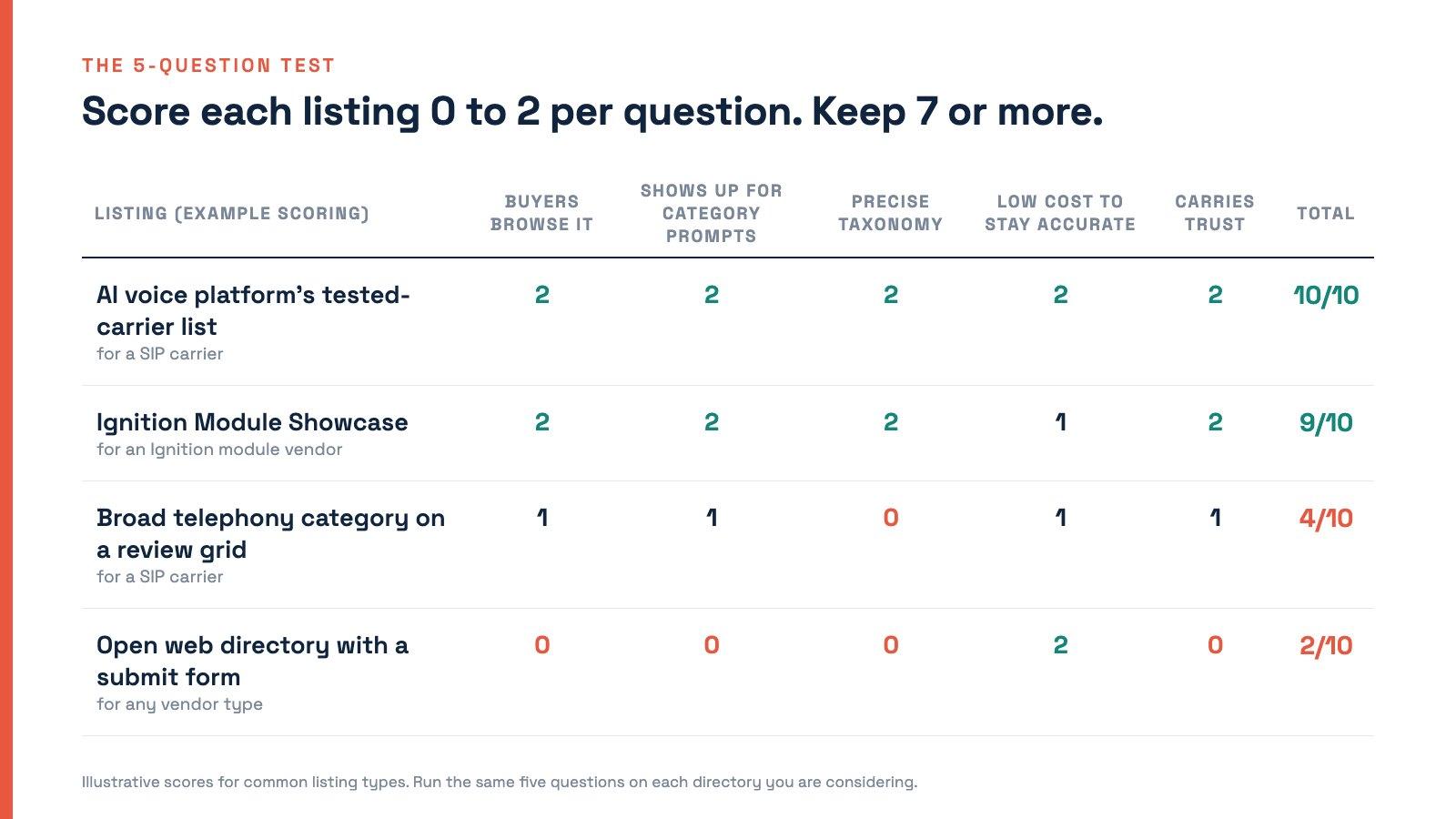
How to pick niche directories: a 5-question test
Most technical vendors have more places to list than time to keep those listings accurate. So the test below is about saying no as much as yes. Before you go niche, cover the general baseline first: the free baseline listings take little effort and give AI engines and buyers a consistent picture of who you are.
- Do your buyers actually browse it? Open the category page. Do you see your real competitors, with recent updates? If the list is full of dead products, buyers stopped coming.
- Does it show up for your category prompts? Search "best [your category]" and "[your platform] + [your category]" on Google, then ask ChatGPT and Perplexity the same questions. Write down which domains appear. A directory that shows up in those answers is worth more than one with ten times the traffic.
- Is the taxonomy precise enough? Can you be listed under the exact thing you do, with the versions, regions or standards your buyers filter on? Vague placement is close to no placement.
- What does it cost to stay accurate? Count fees, review requirements, certification or interop tests, and how often the listing needs updating. Some of the best niche sites need no reviews at all; here are more directories where reviews aren't the game.
- Does it carry trust? Is there curation, a partner check or a certification behind the listing? Or will anyone with a form get in? Curated beats open almost every time.
Score each question 0 (no), 1 (partly) or 2 (yes). Anything at 7 or more out of 10 goes on the list. Use traffic only as a tiebreaker: a general site needs the scale of the directories that pull 1M+ visits a month to be worth the upkeep, while a niche site can earn its place with a few thousand of the right visitors.
Telecom and CPaaS: worked example with DIDWW
Telecom is a good stress test for the model, because no single "telecom software directory" dominates the search results. Discovery is spread across partner ecosystems, developer docs and a few long-running reference sites. A carrier that only looks for "directories" in the usual sense will miss most of where its buyers look.
Take DIDWW, a carrier headquartered in Dublin that sells phone numbers, SMS and global SIP trunking in 241 countries and regions. Its buyers are PBX admins, contact-center teams, developers building AI voice agents and other operators. Here is where a vendor like that gets found, and why each listing type fits a different buyer.
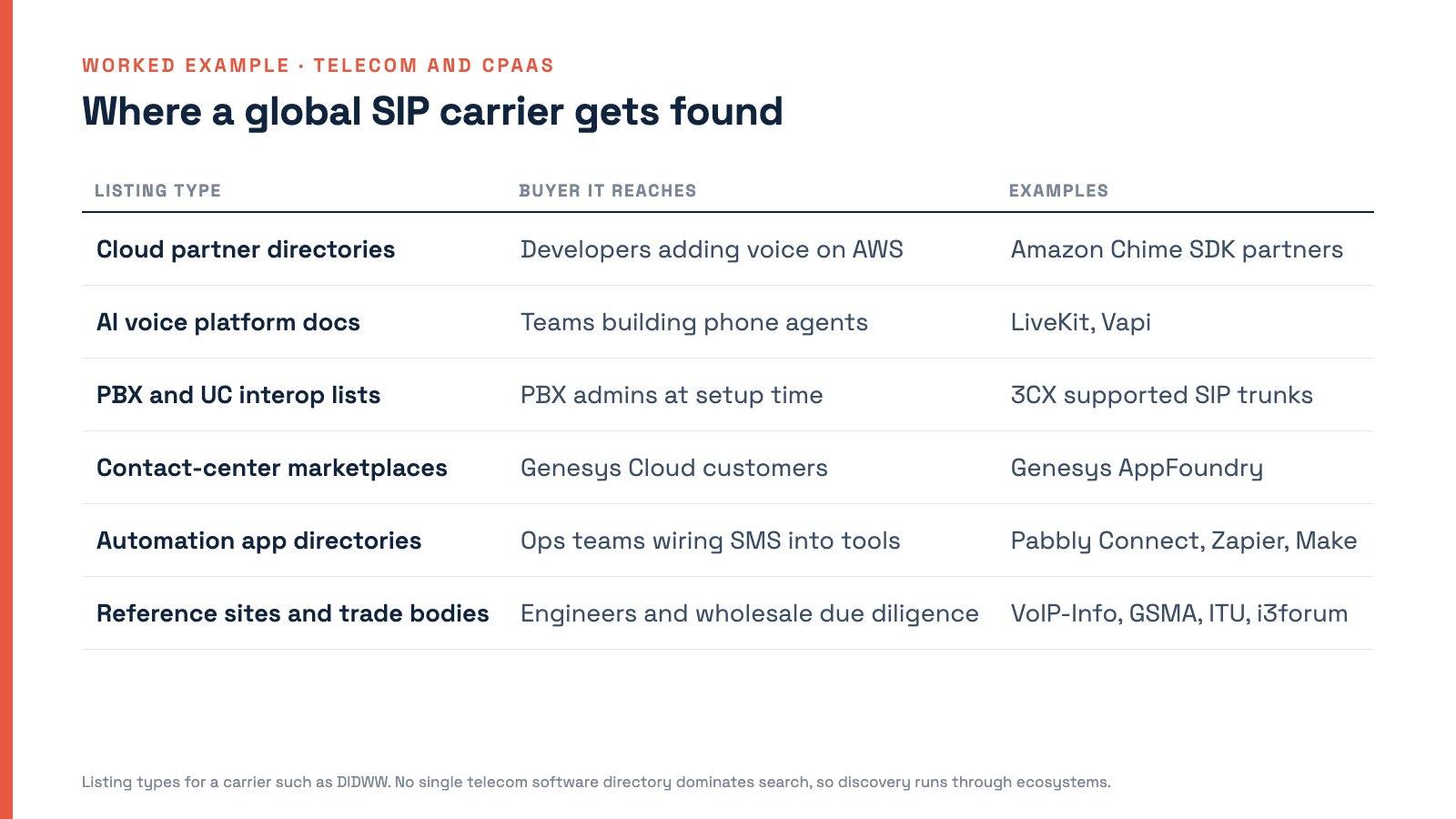
- Cloud partner directories. DIDWW is listed in the Amazon Chime SDK partner directory, where developers adding voice to their apps on AWS pick a carrier. Who it's for: developers on AWS. Reviews: no. Effort: partner approval, then light upkeep.
- AI voice platform docs. This is the fastest-growing listing type in telecom. LiveKit's telephony docs name the SIP providers it has tested, and DIDWW is on that list. Vapi's docs include a DIDWW setup guide in their SIP trunking section. Who it's for: teams building AI agents that answer the phone. Reviews: no. Effort: an interop test and a short guide. AI assistants can quote these docs directly when someone asks which carrier works with a given voice platform.
- PBX and UC interop lists. 3CX publishes supported SIP trunk providers by country, and admins pick carriers from it during setup. Microsoft Teams works differently: the Operator Connect carrier list lives inside the Teams admin center, not on the public web, so getting listed there means joining a partner program.
- Contact-center marketplaces. Genesys AppFoundry is the marketplace Genesys Cloud customers browse for add-ons and partner services, so it is the place a carrier serving contact centers has to be findable.
- Automation app directories. Zapier, Make and Pabbly Connect each run an app directory. DIDWW appears in Pabbly Connect's integrations, which is where ops teams search for "SMS + [their tool]".
- Vertical reference sites. VoIP-Info has run vendor pages for years, and engineers still land there from search.
- Trade bodies. Memberships in groups like the GSMA, ITU and i3forum bring few leads on their own. Wholesale buyers check them during due diligence, and they give AI engines one more independent place to confirm a company is what it says it is.
The lesson for any carrier or CPaaS vendor: the highest-intent listings are the ones attached to a platform your buyer has already picked. If your product touches web hosting or infrastructure buyers too, there is overlap with the directories built for hosting companies.
Industrial automation and OT: worked example with Plantformance
Industrial software is the clearest case of ecosystem-first discovery. Plant engineers trust their platform vendor, their system integrator and their peers, roughly in that order. A listing on a horizontal review site rarely reaches them.
Plantformance is a Swiss company, founded in 2017, that builds Ignition modules for Inductive Automation's Ignition platform, plus HMI hardware and a managed on-premises service. Its modules cover gateway health scans, security auditing, device mirroring from production into development, host operations and charting. For a vendor like this, one niche listing matters more than all the general ones combined.
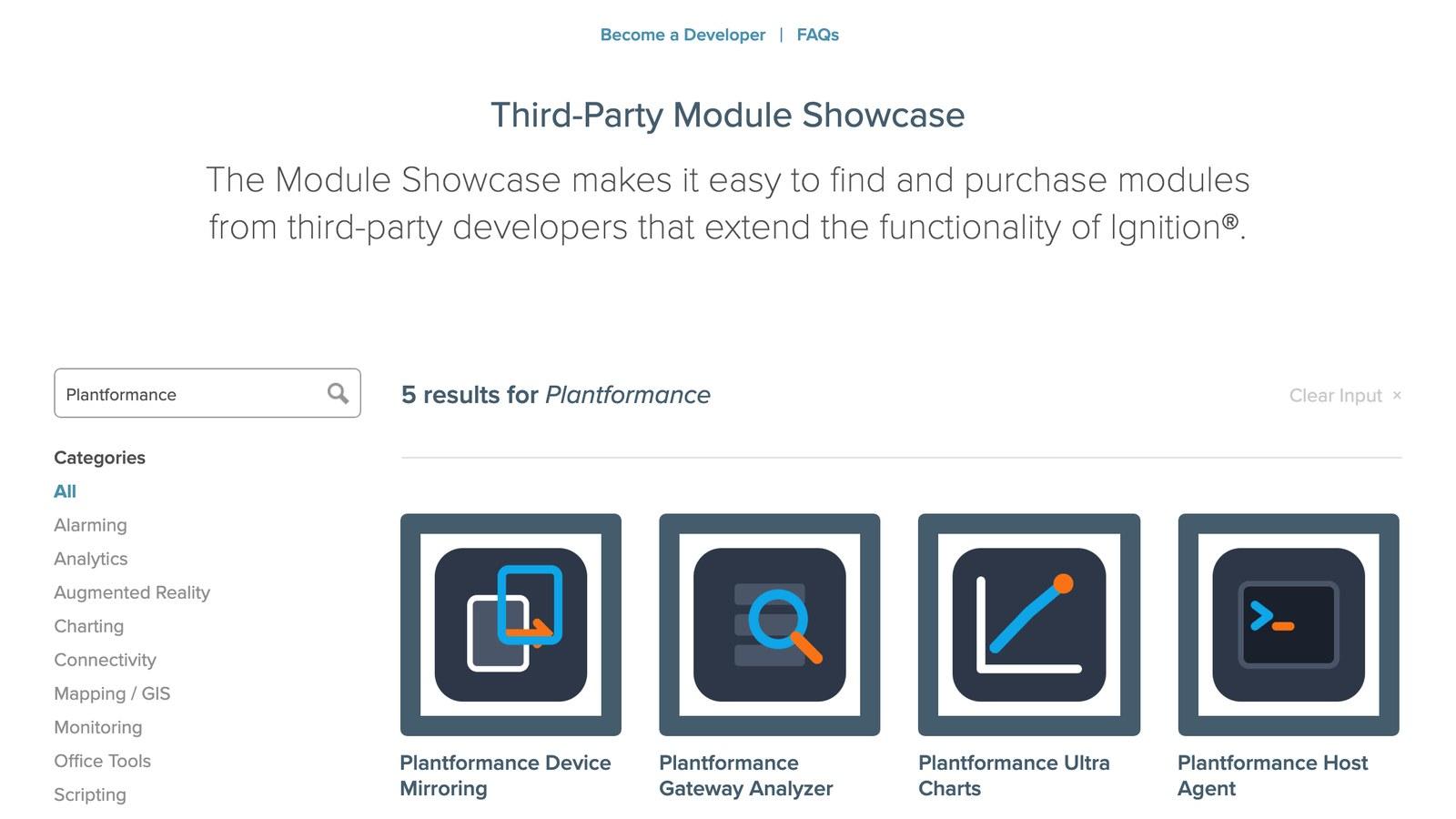
- The platform's own showcase. Inductive Automation runs the Third-Party Module Showcase, the official catalog of Ignition add-ons from outside developers. Each listing shows the developer, the last-updated date and, where one is set, the price, sorted into categories like Security, Monitoring and Charting. Plantformance had five modules there as of November 2026. When someone searches "Ignition modules 3rd party", this is the page they want. Who it's for: Ignition users. Reviews: no. Effort: become an approved developer, then keep versions and dates current.
- The community exchange. The Ignition Exchange is a separate thing: free, community-made resources. Nobody buys there. A useful free tool on the Exchange is still strong top-of-funnel for a paid module from the same team.
- Integrator and partner directories. Inductive Automation also runs an integrator finder, filtered by level, country and industry. Outside the platform, the Control System Integrators Association connects integrators, who often decide which add-ons a plant buys.
- Standards catalogs. The OPC Foundation product catalog is where OT engineers check interoperability before they buy connectivity software.
- Industrial sourcing. Thomasnet offers a free claimed profile and says it has more than 2.2 million registered buyers, the procurement teams who source industrial suppliers.
- Adjacent stacks. IIoT tools have their own partner ecosystems, such as HiveMQ's partner directory for MQTT-based architectures.
The lesson for any vendor building on someone else's platform: get into the platform's own catalog first, keep it accurate, and treat everything else as support.
Other non-default categories: the same playbook
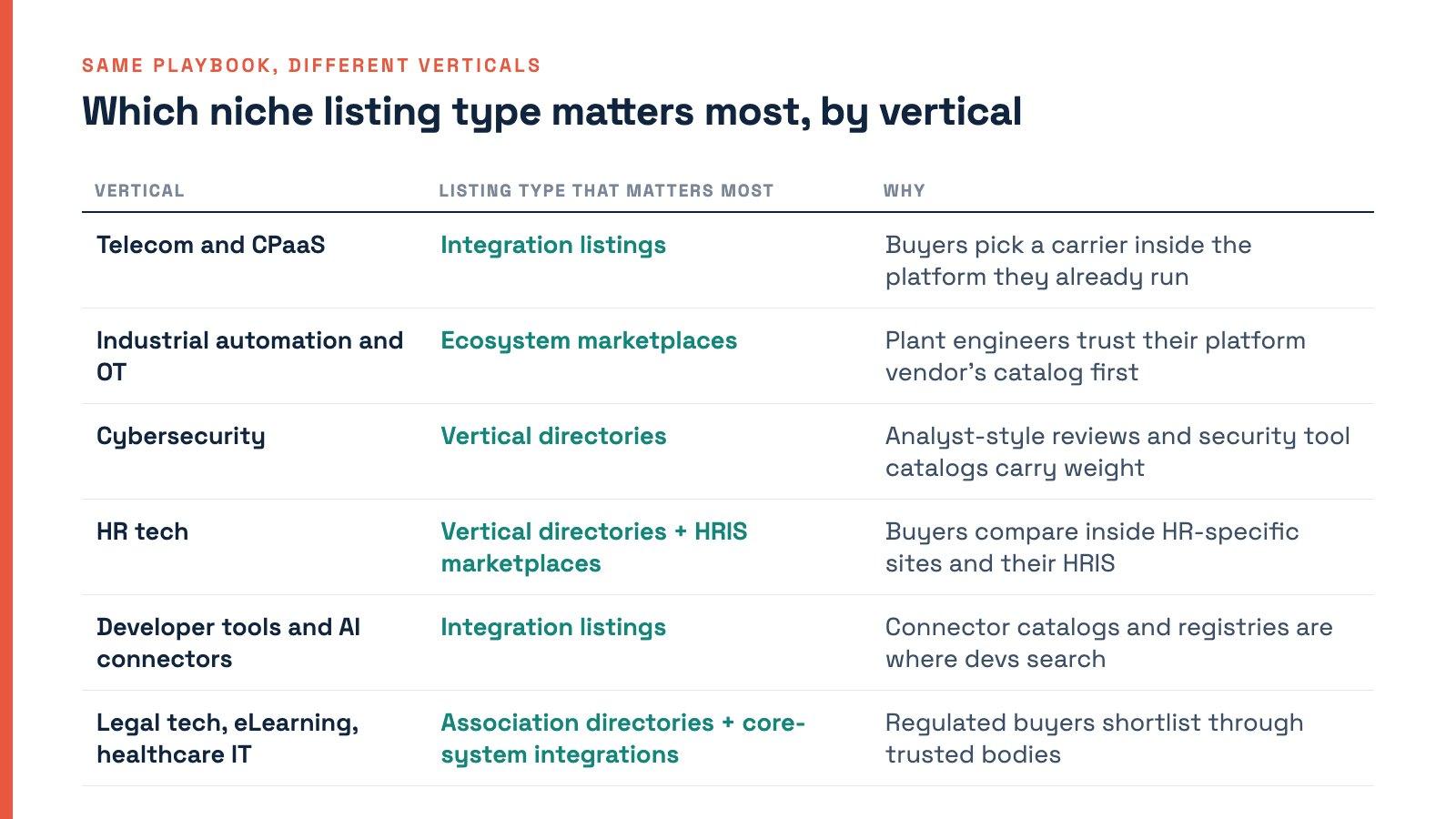
The pattern repeats in most technical and regulated categories. The details change, the three listing types don't.
- Cybersecurity: analyst-style review sites and security tool catalogs. See how cybersecurity vendors pick their directories.
- HR tech: HR-specific directories and HRIS marketplaces. Blastra keeps a full list for HR tech vendors.
- Developer tools and AI connectors: integration catalogs, package registries and the new wave of AI connector directories.
- Legal tech, eLearning and healthcare IT: industry association directories and the integration lists of the core system each industry runs on.
How to list well once you're in
A niche listing is only as good as its accuracy. The buyers who reach it are technical, and they notice a wrong version number or a dead link.
- Use the directory's own words. Match its category names and filters, even if your marketing site says it differently.
- Keep names and facts identical everywhere. Same company name, product names, HQ and coverage claims across every listing. AI engines cross-check these, and mismatches make you look like two different companies.
- Lead with the facts engineers filter on. Supported versions, protocols, regions, compliance and integrations beat adjectives.
- Show the product. Screenshots, a short demo or a setup guide inside the listing do more than a long description.
- Review every listing on a schedule. Pricing, release dates and coverage change. Put a quarterly check on the calendar, or have someone keep every listing accurate after you submit.
Frequently asked questions
What are niche software directories?
Niche software directories are listing sites built for one industry, technology stack or buyer job. They include vertical directories, platform-owned ecosystem marketplaces and integration listings inside other tools. Their audiences are small but close to a decision.
Are niche software directories worth it if they have less traffic than G2?
Yes, when the five-question test says so. A niche directory that shows up for your category prompts and reaches buyers already committed to a platform often sends better leads than a general grid with far more visits. Keep the general baseline, then add the niche sites that score 7 or more out of 10.
Where should I list B2B software that doesn't fit G2's categories?
Start with the platforms your product runs on or connects to: their module showcases, partner directories and tested-provider lists. Then add vertical reference sites and industry association directories. These usually describe technical products more precisely than any general category.
What's the difference between an ecosystem marketplace and a software directory?
An ecosystem marketplace is owned by a platform and lists products built for or certified with that platform, often with a vetting step. A software directory is independent and lists products across many platforms. Buyers treat the first as an endorsement and the second as a comparison.
Do niche directories help with AI search visibility?
They can. When a buyer asks ChatGPT, Perplexity or Google's AI features a narrow question, the answer often draws on the page that matches that exact question, such as a partner list or a docs table. Accurate niche listings give AI engines more consistent places to confirm what you do.
How many niche directories should a technical vendor be on?
Fewer than you think. Most technical vendors do well with the general baseline plus five to ten niche listings that pass the test, kept accurate. Ten current listings beat thirty stale ones.
Listings and figures as checked in November 2026 and may change. Blastra is not affiliated with, endorsed by, or sponsored by any company or platform named in this post; trademarks belong to their owners.